

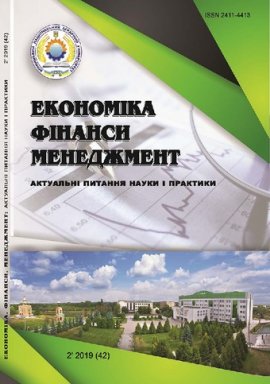
Issue №: 2(42)
The magazine deals with the problems of the agricultural sector of the economy in the context of integration and processes of globalization. Attention is paid to the issues of development of digital economy, rural territories, technologies of enterprise management and organization of accounting, problems of legal support of economic processes, market tendencies of development of various branches of economy. Particular attention is paid to green tourism as a promising segment of the national economy.
ACCOUNTING RECORDS: PAST AND PRESENT
KOVAL Lubov – Candidate of Economic Sciences, Associate Professor of Accounting Department, Vinnytsia National Agrarian University (21008, Vinnytsia, 3 Soniachna Str., e-mail: kovalstar@meta.ua).
The degree of development of science is determined by the level of studying its history. This is also applicable to such an important element of the accounting method as recording. Since ancient times, registration of facts of economic life in accounts has been carried out. Initially, there was a practical activity (accounting), connected directly with keeping records on accounts and their display in corresponding books. Only later on the basis of accounting appeared scientific developments and accounting began to emerge as a set of theoretical knowledge.
The profession of accountant has historical origins and has emerged as a practical activity, so the scientific basis of accounting requires further development and understanding.
The reflection of business operations is carried out in a large number of accounts. Depending on the objects of the accounting, the information is displayed only on the basis of homogeneous business operations, so in practice it is necessary to know the content, function and purpose of each account and understand what information to account for. This contributes to: the application of common approaches to the reflection of economic transactions in the practical activities of public sector entities; obtaining the necessary indicators for monitoring and analysis; making the right managerial decisions.
The purpose of the article is to study the historical periodization of the use of accounts in the past and present.
Accounting records are inextricably linked with the accounting itself. In this regard, the history of the emergence and development of the use of accounts is closely interconnected with the historical aspects of accounting as a science.
The literature distinguishes four main periods of accounting development.
Historical evidence indicates the existence in various countries of the ancient world of accounting the economic operations and their diverse nature and origin. So, there are evidence of that time of the emergence and application of a double entry, reflecting the arrival and departure of products and other tangible assets.
In the Ancient World, accounting was based solely on facts, that is, it occupied a static position. The basis of static accounting is the direct registration of property and regular inventory. Direct registration required the indication of a particular object.
Subsequently, there was an indirect registration, which included the use of data from the "primary documents" to fix the object. Thus, accountants began to use supporting documents that formed the basis of the present primary.
Understanding the economic content of an account and the correctness of its use is the basis of accounting. Therefore, it is very important to classify accounts on various grounds.
Classification is reduced not only to the ordering of a fixed set of accounts, but consists in the construction of an accounting system based on the study of processes that comprise the activities of economic agents, the analysis of information needs for their display and the identification of the possible obtaining of this information.
Thus, the objective of classification of synthetic accounts depends not only on the reliability of the reflection in accounting for the links between objects that change as a result of economic facts, but also the organization of analytical accounting.
Nobody knows the creator of accounting science. The origin of the double entry is traced from the 13th-14th centuries in some parts of northern Italy. At the same time, the historical preconditions for the emergence of a double entry system in the cities of Italy were outlined in the writings of the famous American scholar A.Ch. Littleton.
Double accounting began to be recognized in Europe. According to historical data, Luka Pacioli made the first systematization of accounting.
The scientist first collected and systematized certain information used by merchants of that time while conducting their trading accounts and records.
Along with double accounting, there existed a doctrine of other systems, including triple accounting. This condition has increased the attention of scholars to the development of business accounting as a science.
So, we can talk about a certain similarity of the Ukrainian national accounting model, and the German school, which has made a significant contribution to the development of world accounting. In general, considering the way that accounting passed from the time of his birth in antiquity, to the time when he became a science, it is necessary to note a certain cyclicity and subordination to the general laws of philosophy and historical social development, which is of great importance for future research in the field of accounting.
Consequently, the historical excursus in the development of accounting and book-keeping provides an opportunity to assert the interconnection of other sciences with accounting.
It should be noted that accounting, as a practical activity, and accounting, as a science, are interrelated.
Knowledge obtained in the study of other adjacent to the accounting sciences will contribute to the further research and construction of new accounting models.
Studies in the field of accounting science will allow to significantly improve the existing accounting practice at enterprises and to raise the efficiency of their operation.
- Borymska K.P. (2006). Rozvytok rakhunkoznavstva: istoriia ta perspektyvy [Development of accountancy: history and perspectives].Visnyk ZhDTU – Bulletin of ZhDTU, №4 (38), 7-19 [in Ukrainian].
- Kaliuha E.V. (2014). Pidkhody do klasyfikatsii rakhunkiv bukhhalterskoho obliku: istorychnyi aspekt [Approaches to the classification of accounting accounts: historical aspect]. Ekonomichni nauky. Seriia «Oblik i finansy» – Economic sciences. Series "Accounting and Finance", Issue 11 (41), part 2, pp. 131-143[in Ukrainian].
- Borymska K.P. (2010). Plan rakhnkiv bukhhalterskoho obliku yak intehrovana oblikova model: pidkhody do pobudovy [Accounting Accounting Plan as an Integrated Accounting Model: Approaches to Construction]. Visnyk ZhDTU – Bulletin of ZhDTU, №3 (53), 37-43 [in Ukrainian].
- Klymenko D.O. (2011). Zarodzhennia bukhhalterii ta formuvannia bukhhalterskoho obliku yak nauky [The origin of accounting and accounting as a science]. Ekonomichni nauky. Seriia «Oblik i finansy» – "Economic sciences". Series "Accounting and Finance", Issue 8 (29), part 1, pp. 236-245 [in Ukrainian].
- Kiparisov M.A. (1940). Kurs Teorii bukhgalterskogo Uchiota [Course of Accounting Theory]. Moskow, Gos Plan Izdat, p. 284 [in Russian].
- Butynets F.F. (2000). Teoriia bukhhalterskoho obliku: Pidruchnyk dlia studentiv vuziv spetsialnosti 7.050106 “Oblik i audyt” [Theory of Accounting: A textbook for university students specialty 7.050106 "Accounting and Audit"]. Zhytomyr, ZhITI, 640 [in Ukrainian].
- Sokolov Ya.V. (2000). Osnovy teorii bukhgalterskogo uchiota [Basics of accounting theory]. Moskow: «Finansy i statistika», 456 [in Russian].
- Liubushyn N.P. (2003). Teoriya bukhgalterskogo uchiota: Ucheb. posobiye dlia vuzov, 2-e izd., pererab. i dop [Theory of accounting: manual for high schools]. Moskow: YuNYTY-DANA, 312 [in Russian].
- Sokolov Ya.V. (2010). Bukhgalterskiy uchiot kak summa faktov khoziaistvennoi zhyzni [Accounting as the sum of the facts of economic life]. Moskow: Magistr [in Russian].
- Ostapiuk M.Ia., Luchko M.R., Dankiv Y.Ia. (2005). Istoriia bukhhalterskoho obliku: Navch. Posib [Accounting History: Manual]. Kyiv: Znannia, 276 [in Ukrainian].
- Ivchenko L.V. (2011). Istorychni aspekty rozvytku bukhhalterskoho obliku [Historical aspects of accounting development]. Finansy, oblik i audyt – Finance, Accounting and Audit, № 18, pp. 284-291 [in Ukrainian].
- Hutsalenko L.V. (2016). Oblikovo-informatsiina systema zabezpechennia upravlinnia silskohospodarskym pidpryiemstvom [Accounting and Information System for Agricultural Enterprise Management]. EKONOMIKA. FINANSY. MENEDZhMENT: aktualni pytannia nauky i praktyky – ECONOMY. FINANCES. MANAGEMENT: topical issues of science and practice, №8, 82-92 [in Ukrainian].
- Pravdiuk N.L. (2017). Sotsialni aspekty bukhhalterskoho obliku [Social aspects of accounting]. EKONOMIKA. FINANSY. MENEDZhMENT: aktualni pytannia nauky i praktyky – ECONOMY. FINANCES. MANAGEMENT: topical issues of science and practice, №12, 91-102 [in Ukrainian].
About the journal
С1 Economics and International Economic Relations (by specialization)
D1 Accounting and Taxation
D2 Finance, Banking, Insurance and Stock Market
D3 Management
D4 Public Management and Administration
D5 Marketing
D7 Trade
J3 Tourism and Recreation
Founded in 1997 under the name ”Bulletin of Vinnytsia State Agricultural Institute”. In 2010-2014 it was published under the name “Collection of Scientific Papers of Vinnytsia National Agrarian University”. Since 2015 “Economics, finance, management: current issues of science and practical activity” (Certificate of State Registration of Mass Media No. 21154-10954 PR dated 12/31/2014).
