

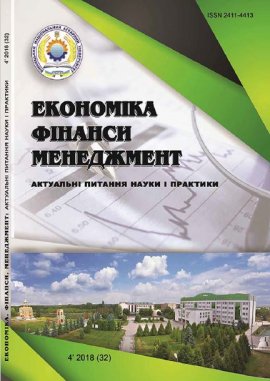
Issue №: 4 (32)
The magazine deals with the problems of the agricultural sector of the economy in the context of integration and processes of globalization. Attention is paid to the issues of development of digital economy, rural territories, technologies of enterprise management and organization of accounting, problems of legal support of economic processes, market tendencies of development of various branches of economy. Particular attention is paid to green tourism as a promising segment of the national economy.
AGRARIAN REFORM OF 1861 AND ITS CONSEQUENCES FOR THE ECONOMIC DEVELOPMENT OF UKRAINE
BOHATCHUK Svitlana Stepanivna – Candidate of Historical Sciences, Associate Professor of the Department of History of Ukraine and Philosophy, Vinnytsia National Agrarian University (21008, Vinnytsya, 3, Soniachna Str., e-mail: svetabogatchuk@ukr.net).
The development of the Ukrainian economy after the agrarian reform of 1861 is analyzed - the abolition of serfdom. The focus is on highlighting the very process of agricultural reform and development during this period. The difficult socio-economic situation of the peasantry, which in the future, prompted the authorities to make a decision on reforming the agrarian sector, is highlighted.
It was noted that the abolition of serfdom on February 19, 1861 was a turning point in the history of the Ukrainian people. The formation of private land ownership, the ability to independently manage the land and the lack of influence of the landlords changed the outlook of the peasant.
It has been investigated that the majority of landlords' farms became widespread as a form of rent. Thus, in the 1940's, in the Southwestern region, out of 408 estates, 131 serfdoms were cultivated by each peasant, and in 277 estates each yard. The peasants were forced to work it out 3-4 days a week. In the provinces of Left Bank Ukraine, more than 99% of the landlord peasants performed serfdom, the size of which reached 4-5, and in some cases, 6 days a week.
It is analyzed that the Basic Provisions of the Reform of 1861 were set out in the Manifesto of February 19, 1861 and the General Provision on Peasants Freed from Serfdom. According to these documents, the peasants became personally free.
It has been researched that agrarian reform envisaged the following measures: 1) abolition of serfdom, granting peasants rights of citizens; 2) allotting the peasants land and determining the obligations for its use; 3) redemption of peasant holdings.
It is noted that the landlords remained the owners of the whole land, and the peasants became permanent users of the land. According to the tsarist "Manifesto", the former serfs were granted permanent use of the estate and allotment of the field land. Field allotment standards were set depending on the quality of the land and terrain.
It should be recalled that the agrarian reform of 1861 led to the emergence of a large-scale peasant movement in the territory of the Ukrainian lands both before the reform and during the reform of the agricultural sector.
1. Leshhenko L.M. (1958) Selyans`ky`j rux na Ukrayini v zvyazku z ogoloshennyam Manifestu i Polozhennya 19 lyutogo 1861 r. [Peasant movement in Ukraine in connection with the declaration of the Manifesto and the Regulations of February 19, 1861]. Ukrayins`ky`j istory`chny`j zhurnal. Ukrainian Historical Magazine. 2, 39-52. [in Ukrainian].
2. Otmena krepostnogo prava na Ukray`ne: sb. dokum. y` matery`alov. (1961). [Abolition of serfdom in Ukraine: Sat documented and materials]. K.: Y`zd-vo AN USSR. [in Ukrainian].
3. Derzhavny`j arxiv Vinny`cz`koyi oblasti -F.123, opy`s 1, spr.188, ark. 4.
4.Zajonchkovsky`j P.A. (1958). Provedeny`e v zhy`zn` krest`yanskoj reformы 1861g. [Implementation of peasant reform in 1861]. M.: Soczэkgy`z.
5. Zlupko S. M. (2006). Ekonomichna istoriya Ukrayiny`: Navch. posib. [Economic History of Ukraine: Teach. Manual]. K.: Znannya. [in Ukrainian].
6. Shherby`na P.F. (1963). Selyans`ky`j rux na Podilli v period provedennya reformy` 1861 r. [Peasant movement in Podillya during the reform period of 1861]. Ukrayins`ky`j istory`chny`j zhurnal. 5, 103-107.
7. L. V. Bazhenov [etc.]. (1990). Nary`sy` istoriyi Podillya. [Tekst]: na dopomogu vchy`telyu. [ Essays on the history of Podillya. [Text]: To help the teacher] [ta in.]. – Xmel`ny`cz`ky`j: Oblpoligrafvy`dav.
8. Tsentralnyi derzhavnyi istorychnyi arkhiv Ukrainy - F. 442, op. 41, spr. 123, ark. 70-88.
9. Tsentralnyi derzhavnyi istorychnyi arkhiv Ukrainy - F. 442, op. 44, spr. 667, ark. 2,3.
10. Derzhavny`j arxiv Vinny`cz`koyi oblasti. – F. 205, op. 1, spr. 59, ark. 46.
11. Tsentralnyi derzhavnyi istorychnyi arkhiv Ukrainy - F. 442, op. 41, spr. 32, ark. 25.
12. Nesterenko AA. (1954). Ocherky` razvy`ty`ya narodnogo xozyajstva Ukray`nskoj SSR. [Essays on the development of the national economy of the Ukrainian SSR.] V 3-x t. K.: Gospoly`ty`zdat
13. Reyent O.P. (2011). Do problemy` skasuvannya kriposnogo prava v 1861 r. [To the problem of abolition of serfdom in 1861]. Ukrayins`ky`j istory`chny`j zhurnal. Ukrainian Historical Magazine. 1, 34-51. [in Ukrainian].
About the journal
С1 Economics and International Economic Relations (by specialization)
D1 Accounting and Taxation
D2 Finance, Banking, Insurance and Stock Market
D3 Management
D4 Public Management and Administration
D5 Marketing
D7 Trade
J3 Tourism and Recreation
Founded in 1997 under the name ”Bulletin of Vinnytsia State Agricultural Institute”. In 2010-2014 it was published under the name “Collection of Scientific Papers of Vinnytsia National Agrarian University”. Since 2015 “Economics, finance, management: current issues of science and practical activity” (Certificate of State Registration of Mass Media No. 21154-10954 PR dated 12/31/2014).
