

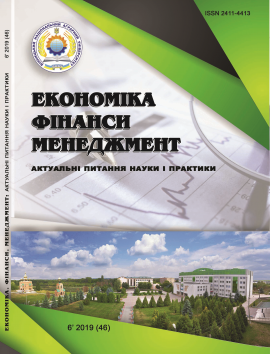
Issue №: 6 (46)
The magazine deals with the problems of the agricultural sector of the economy in the context of integration and processes of globalization. Attention is paid to the issues of development of digital economy, rural territories, technologies of enterprise management and organization of accounting, problems of legal support of economic processes, market tendencies of development of various branches of economy. Particular attention is paid to green tourism as a promising segment of the national economy.
APPLICATION OF MATHEMATICAL APPARATUS FOR SOLVING ECONOMIC PROBLEMS
DUBCHAK Viktor – Candidate of Technical Sciences, Associate Professor of the Department of
Mathematics, Physics and Computer Technologies, Vinnitsa National Agrarian University (21008, 3,
Sonyachna Str., Vinnytsia, e-mail: viktor_dubchak@rambler.ru)
PRYSHLIAK Natalia – Candidate of Economic Sciences, Associate Professor, Senior Lecturer of
the Administrative Management and Alternative Energy Sources Department, Vinnytsia National Agrarian
University (21008, 3, Sonyachna Str., Vinnytsia, e-mail: natalka.vinn@gmail.com).
The advantages of using a mathematical apparatus in solving economic problems are indicated in
the article. The development of applications of mathematical apparatus in solving important economic
problems is analyzed. The relevance of the use of mathematical models in economic planning are justified.
The characteristic features of economic information are identified. The basic requirements for effective
analysis of economic information are grouped. The stages of processing economic information are
analyzed. Features and feasibility of using the tools of the mathematical apparatus in solving problems
are characterized. The classification of the main economic and mathematical methods used to solve
problems of varying complexity in the economy are given. Mathematical concepts underlying the solution
of applied problems of the economic direction are identified. The most frequently used functions used in
solving economic problems are characterized. The main tasks for using the objective function are
highlighted and summarized. The article summarizes the spectrum of important economic problems, the
solution of which requires the use of almost all the basic classical sections of higher mathematics,
probability theory and mathematical statistics.
1. Barankevych, M.M., Antoniv, V.B. (2009). Vstup do matematychnoi ekonomiky. Fundamentalni
modeli: Navchalnyi posibnyk [Introduction to mathematical economics. Fundamental Models: Tutorial].
Drohobych: Vydavnytstvo “Kolo”, 348 p. [in Urainian].
2. Bondar, O.A. (2013). Rol ekonomiko-matematychnykh metodiv efektyvnoho upravlinnia
pidpryiemstvom [The role of economic and mathematical methods of effective enterprise management].
Efektyvna ekonomika. – Effective economy, 2. Retrieved from : http://nbuv.gov.ua/UJRN/efek_2013_2_75 [in
Urainian].
3. Bratushka, S.M. (2009) Vykorystannia spetsializovanoho prohramnoho zabezpechennia dlia
rozviazannia ekonomichnykh zadach [Use of specialized software for solving economic problems] .
Zbirnyk naukovykh prats DVNZ “Ukrainska akademiia bankivskoi spravy NBU” – Collection of scientific
works of the "Ukrainian Academy of Banking of the NBU, 9-15. [in Urainian].
4. Zamkov, O.O., Tolstopiatenko, A.V. Cheremnыkh Yu.N. (2001). Matematycheskye metodы v
эkonomyke: Uchebnyk [Mathematical Methods in Economics: Textbook]. 3- e yzd., pererab, 368 p. [in Urainian].
5. Ivashchuk , O.T. (2008). Ekonomiko-matematychne modeliuvannia: Navchalnyi posibnyk
[Economic-mathematical modeling: A manual]. Ternopil: TNEU «Ekonomichna dumka», 704 p. [in Urainian].
6. Kolemaev, V.A. (2005). Matematychne modelyuvannya ekonomichnykh protsesiv i system
[Mathematical modeling of economic processes and systems]. Pidruchnyk. M .: Yuniti, 295 p. [in Urainian].
7. Kremer, N. Sh., Putko, B.A., Tryshyn, Y.M. (2015). Vыsshaia matematyka dlia эkonomystov:
Ucheb. dlia studentov vuzov, obuchaiushchykhsia po эkonomycheskym spetsyalnostiam [Higher
Mathematics for Economists: Study. for students of higher educational institutions studying in economic
specialties], 3-e M.: YuNYTY-DANA, 479 p. [in Urainian].
8. Ohirko, I.V. Ivashchuk, O.T., Shovkun, O.Iu. (1996). Ekonomiko-matematychni metody i modeli
[Economic-mathematical methods and models]. Lviv: Ukrainska akademiia drukarstva, 148 p. [in Urainian].
9. Polishchuk N.V., Buryennikov YU.YU. Matematychni metody ekonomichnoho analizu: teoriya
i praktyka. [Mathematical methods of economic analysis: theory and practice] Navchalʹnyy posibnyk.
Vinnytsya, 2013. 292 s. [in Urainian].
10. Polishchuk, N.V. (2010). Funktsionuvannia ekonomichnykh system: modeli skladovykh
rezultatyvnosti: [monohr.] [Functioning of economic systems: models of components of performance].
Vinnytsia: VNAU, 396 p. [in Urainian].
About the journal
С1 Economics and International Economic Relations (by specialization)
D1 Accounting and Taxation
D2 Finance, Banking, Insurance and Stock Market
D3 Management
D4 Public Management and Administration
D5 Marketing
D7 Trade
J3 Tourism and Recreation
Founded in 1997 under the name ”Bulletin of Vinnytsia State Agricultural Institute”. In 2010-2014 it was published under the name “Collection of Scientific Papers of Vinnytsia National Agrarian University”. Since 2015 “Economics, finance, management: current issues of science and practical activity” (Certificate of State Registration of Mass Media No. 21154-10954 PR dated 12/31/2014).
