

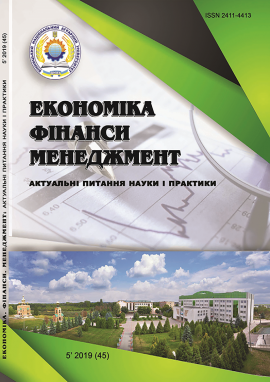
Issue №: 5 (45)
The magazine deals with the problems of the agricultural sector of the economy in the context of integration and processes of globalization. Attention is paid to the issues of development of digital economy, rural territories, technologies of enterprise management and organization of accounting, problems of legal support of economic processes, market tendencies of development of various branches of economy. Particular attention is paid to green tourism as a promising segment of the national economy.
AREAS OF STRENGTHENING ENVIRONMENTAL AND ECONOMIC COMPETITIVENESS OF THE REGIONS BASED ON ANALYSIS OF THE SYNCHRONOMY OF THE DYNAMICS OF SYSTEMATIC INDICATORS
ANDRUSYAK Natalia ‒ Candidate of Science (Economics), associate professor, department of enterprise economics, accounting and auditing, The Bohdan Khmelnytsky National University of Cherkasy (81, Shevchenko Blvd., Cherkassy, 18031, Ukraine). E-mail: andrusiak.n@gmail.com
The environmental manifestation of the course of economic processes is important because of the causal system of consequences that cause changes in all spheres of life of the country and its regions. The environmental vector of economic development, which is recognized in the world as a priority for the economy of the countries of the European community, is formed at the regional level, whose economic entities provide production, promotion and marketing of products.
Ecological and economic competitiveness of Ukrainian regions is a response to globalization challenges, reflection of transformation processes, enterprises' readiness for innovation, development of ecological production and high competition in the world market. Its manifestation has a long-term basis and a complex system of consequences, embodied in the competitive advantages of manufacturers in the world and domestic markets.
Assessment of the ecological and economic competitiveness of the territory and directions of its strengthening should be based on the analysis not only of individual indicators, which are the final result of the formation of ecological and economic competitiveness, but the dynamics and synchronicity of their interaction, which will provide concretization of the priority factors of influence on the eco-economic and economic opportunities. regional entities. At the regional level, ecological and economic competitiveness is formed through the activity of economic entities and the development of the market for environmental products.
The purpose of the article is to substantiate the directions of strengthening the ecological and economic competitiveness of the regions on the basis of the analysis of synchronous dynamics of the system-forming indicators.
The dynamics of the indices of ecological and economic competitiveness of the regions of Ukraine and ecological advantages are not synchronous in all regions, but in some they have distant positions (Odessa, Poltava, Sumy, Kharkov regions). Three groups of regions by rank index synchrony are distinguished: high level of synchrony, middle level and low level. Analysis of the synchronicity of the dynamics of groups of indicators that shape the ecological and economic competitiveness of territories shows that the index of ecological and economic competitiveness is a secondary, resultant indicator, primary groups of indicators (economic, environmental benefits, human development).
The presented approaches to assessing the ecological and economic competitiveness of a region through an analysis of the synchronicity of indices of environmental, economic benefits and human development indicate that, first, the more economically powerful regions should stimulate this property by influencing economic performance; second, the review of the synchronicity of the dynamics of the indices of ecological and economic competitiveness, environmental, economic advantages and human development indicates the increased influence of the human factor, in particular, of the social component; third, the environmental and economic competitiveness of a small number of regions is determined by indicators other than selected ones (e.g. specific services). Priority directions of formation and strengthening of their ecological and economic competitiveness should be, first of all, economic indicators: stimulation of the market of ecological products and its ecological value.
The quantitative assessment of the ecological value of economic products (services) can be made on the basis of a system of indicators proposed by the author, which reflects the social, technological, environmental, economic, etc. effects of the use of ecological-economic products (services) in the process of interaction between the participants of ecological and economic relations. Taking into account the presence in the innovative economic products or services of the environmental component allowed to offer indicators, the dynamics of which will allow to diagnose and evaluate the dynamics of the ecological value of products and to evaluate it from the point of view of ecological and economic com
- Gholjuk, V.Ja. (2016) Analiz eksportu mjasa kurjatyny v Ukrajini: stan ta tendenciji rozvytku rynku [Analysis the export of chicken meat in Ukraine: the state and trends of market development]. Infrastruktura rynku - Infrastructure of the market. № 2. S. 131–135 [in Ukrainian].
- Lipych, L. (2012) Analiz ekonomichnogho potencialu pidpryjemstv ptakhivnyctva v systemi rozvytku zovnishnjoekonomichnoji dijaljnosti [Analysis of economic potential of poultry enterprises in the development of foreign economic activity]. Ekonomist -Economist. № 9. S. 31–39 [in Ukrainian].
- Meljnyk, B.A. (2002) Stan ta rezervy zbiljshennja obsjaghiv vyrobnyctva produkciji ptakhivnyctva [Condition and reserves for increasing the volume of poultry production]. Tvarynnytstvo Ukrainy - Animal husbandry of Ukraine. № 2. S. 10–12 [in Ukrainian].
- Mesel- Veselyak, V.Y., Mazurenko, O.V., Shchepiyenko, P.V. et al. (2007), Metodychni rekomendatsii shchodo formuvannia spetsializovannykh silskogospodarskykh pidpryemstv z vyrobnytsva produktsii tvarynnytstva ta obgruntuvannia ratsionalnykh rozmiriv ferm i kompleksiv [Guidelines for the Formation of Specialized Farms with Livestock Production and Rational Justification for the Size of Farms and Complexes], ed. by V.Y. Mesel- Veselyak. Kyiv : NNTs «Instytut ahrarnoi ekonomiky». 65 s. [in Ukrainian].
- Cyghanok, Ju. V. (2010) Suchasnyj stan vyrobnyctva produkciji ptakhivnyctva v pidpryjemstvakh PivnichnoZakhidnogho reghionu Ukrajiny [The current state of poultry production in the enterprises of the North-Western region of Ukraine]. Visnyk ZhNAEU - Journal of ZNAEU.№ 2. S. 272–285 [in Ukrainian].
- Janyshyn Ja. (2013) Teoretychni osnovy efektyvnosti vyrobnyctva produkciji ptakhivnyctva [Theoretical basis of the efficiency of poultry production]. Ahrarna ekonomika - Agrarian economy. № 3–4. S. 74–80[in Ukrainian].
- Jaroshenko F.I. (2004) Ptakhivnyctvo Ukrajiny: problemy i perspektyvy rozvytku [Poultry breeding in Ukraine: problems and prospects of development]. K. : Ahrarna nauka. 500 s. [in Ukrainian].
- Lantyfudyst: gholovnyj sajt pro aghrobiznes. URL : [https://latifundist.com rating/top-7-krupnejshih-proizvoditelej-produktsii ptitsevodstva-ukrainy [in Ukrainian].
- Asociacija Sojuzu ptakhivnykiv Ukrajiny: oficijnyj sajt URL : http://www.poultryukraine.com/[in Ukrainian].
- Oficijnyj sajt Derzhavnogho komitetu statystyky Ukrajiny URL : www.ukrstat.gov.ua[in Ukrainian].
About the journal
С1 Economics and International Economic Relations (by specialization)
D1 Accounting and Taxation
D2 Finance, Banking, Insurance and Stock Market
D3 Management
D4 Public Management and Administration
D5 Marketing
D7 Trade
J3 Tourism and Recreation
Founded in 1997 under the name ”Bulletin of Vinnytsia State Agricultural Institute”. In 2010-2014 it was published under the name “Collection of Scientific Papers of Vinnytsia National Agrarian University”. Since 2015 “Economics, finance, management: current issues of science and practical activity” (Certificate of State Registration of Mass Media No. 21154-10954 PR dated 12/31/2014).
