

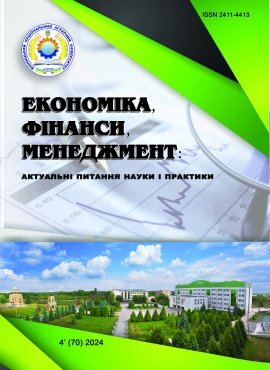
Issue №: 4 (70)
The journal deals with the issues of efficiency of functioning of the national economics and organizational forms of management of the national economy. Attention is paid to the problems of marketing, management and efficiency of production and economic activity of agrarian enterprises. The issues of public administration and administration, accounting and taxation, banking and insurance, forecasting and modeling of economic processes, foreign economic activity, commodity flows of economic entities and their infrastructure support.
ASSET TOKENIZATION AND ITS IMPACT ON THE TRANSFORMATION OF OWNERSHIP IN THE CONTEXT OF THE FORMATION OF THE DIGITAL ECONOMY
BYTSIURA Yurii – Candidate of Economic Sciences, Associate Professor of the Department of Management and Innovative Technologies of Socio-Cultural Activities, Marketing and Economics, Dragomanov Ukrainian State University (01601, Kyiv, 9, Pirogova St., е-mail: yu.v.bitsura@npu.edu.ua).
Asset tokenization is one of the key directions in the development of the digital economy, driving the transformation of the traditional system of ownership and financial relations. The rapid advancement of blockchain technology, the increasing volume of digital assets, and the expansion of decentralized financial platforms necessitate a review of the legal, economic, and technological aspects of ownership. Tokenization simplifies investment processes, enhances asset liquidity, and ensures broader accessibility. However, it also introduces risks such as market fragmentation, legal uncertainty, and the absence of the unified regulatory approaches.
The process of asset tokenization is accompanied by fundamental changes in economic relations. Decentralization of ownership, the expansion of investment mechanisms, and the globalization of financial flows create new opportunities but also pose the challenges for states, companies, and investors. On the one hand, tokenization facilitates transaction processes and increases asset accessibility; on the other hand, it raises concerns about security, regulatory oversight, and fraud risks.
The purpose of the study is to analyze the impact of asset tokenization on ownership transformation in the digital economy, identify the key advantages and risks of this process, and justify the necessity of adapting legal and economic mechanisms to new realities.
It has been substantiated that tokenization promotes the democratization of asset access while simultaneously creating legal uncertainty regarding ownership rights protection. It has been determined that countries with developed financial markets actively adapt their regulatory frameworks to tokenization, whereas in many other nations, this process remains unsystematic. It has been found that asset tokenization enhances market liquidity, reduces transaction costs, and creates new financial instruments for investors. The use of smart contracts ensures transaction automation, minimizing errors and unauthorized changes in ownership transfer processes. The further growth of the tokenized asset market will depend on the implementation of regulatory standards, the improvement of digital platform security, and the development of global strategies for investor legal protection.
Asset tokenization is a promising trend in the development of the digital economy, reshaping traditional approaches to ownership, investment, and financial relations. Its widespread implementation requires clear legal frameworks, adaptation of regulatory standards, and increased trust in blockchain technology. At the same time, tokenization unlocks new opportunities for economic growth but also demands solutions to the challenges related to financial security and regulatory barriers.
1. Swan, M. (2015). Blockchain: Blueprint for a New Economy. Sebastopol: O’Reilly Media, Inc. [in English].
2. Kaal, W.A. (2021). Digital Asset Market Evolution. jcl.law.uiowa.edu. Retrieved from: https://jcl.law.uiowa.edu/sites/jcl.law.uiowa.edu/files/2021-08/Kaal_Final_Web_0.pdf [in English].
3. Lehdonvirta, V. (2016). The blockchain paradox: why distributed ledger technologies may do little to transform the economy. oii.ox.ac.uk. Retrieved from: https://www.oii.ox.ac.uk/news-events/the-blockchain-paradox-why-distributed-ledger-technologies-may-do-little-to-transform-the-economy [in English].
4. Tapscott, D., & Tapscott, A. (2016). Blockchain Revolution: How the Technology behind Bitcoin Is Changing Money, Business, and the World. New York: Penguin [in English].
5. Makarov, I., & Schoar, A. (2020). Blockchain Analysis of the Bitcoin Market. National Bureau of Economic Research. DOI: 10.3386/w29396. Retrieved from: https://www.nber.org/papers/w29396 [in English].
6. Piketty, T. (2014). Capital in the Twenty-First Century. Cambridge, MA & London, England: Harvard University Press. DOI: https://doi.org/10.4159/9780674369542 Retrieved from: https://dowbor.org/wp-content/uploads/2014/06/14Thomas-Piketty.pdf [in English].
7. Naukovo-doslidnyi tsentr ekonomiko-pravovykh rishen u sferi zastosuvannia tekhnolohii rozpodilenoho reiestru. Kliuchovi rozrobky [Scientific Research Center for Economic and Legal Solutions in the Field of Distributed Ledger Technology. Key Developments]. blockchainukraine.org. Retrieved from: https://www.blockchainukraine.org/main-developments [in Ukrainian].
8. Belinska, Ya.V., Onyshko, S.V., & Dyuk, R.I. (2023). Tokenizatsiia finansovykh aktyviv yak innovatsiinyi napriam rozvytku finansovoho rynku [Tokenization of financial assets as an innovative direction of financial market development]. Naukovi Zapysky Natsionalnoho Universytetu «Ostrozka Akademiia». Seriia «Ekonomika» – Scientific Notes of the National University «Ostroh Academy». Series «Economics», 30 (58), 22–29. DOI: https://doi.org/10.25264/2311-5149-2023-30(58)-22-29 [in Ukrainian].
9. Pestovska, Z.S. (2022). Tokenizatsiia ekonomiky Ukrainy: mriia chy realnist. [Tokenization of Ukraines economy: dream or reality?]. Akademichnyi ohliad – Academic Review, 1 (56), 24–32. DOI: https://doi.org/10.32342/2074-5354-2022-1-56-3 [in Ukrainian].
10. Kurchenko, O. (2021). Tradytsiinyi fondovyi rynok mozhe pity v mynule. Yak pratsiuie tokenizatsiia aktyviv? [The traditional stock market may become obsolete: how does asset tokenization work?]. biz.nv.ua. Retrieved from: https://biz.nv.ua/ukr/experts/shcho-take-tokenizaciya-aktiviv-i-navishcho-ce-potribno-biznesu-ostanni-novini-50175190.html [in Ukrainian].
11. Syzonenko, V. (2018). Tokenizatsiia aktyviv – realii ta mozhlyvosti [Asset tokenization – realities and opportunities]. Yurydychna hazeta – Legal Newspaper, 19-20. Retrieved from: https://yur-gazeta.com/publications/practice/informaciyne-pravo-telekomunikaciyi/tokenizaciya-aktiviv--realiyi-ta-mozhlivosti.html [in Ukrainian].
12. Nakamoto, S. (2008). Bitcoin: A Peer-to-Peer Electronic Cash System. bitcoin.org. Retrieved from: https://bitcoin.org/bitcoin.pdf [in English].
13. Buterin, V. (2014). A Next-Generation Smart Contract and Decentralized Application Platform. ethereum.org. Retrieved from: https://ethereum.org/en/whitepaper [in English].
14. Framework for «Investment Contract» Analysis of Digital Assets. Securities and Exchange Commission (2024). sec.gov. Retrieved from: https://www.sec.gov/about/divisions-offices/division-corporation-finance/framework-investment-contract-analysis-digital-assets [in English].
15. Szabo, N. (1996). Smart Contracts: Building Blocks for Digital Free Markets. Extropy Journal of Transhuman Thought, 16. Retrieved from: https://www.truevaluemetrics.org/DBpdfs/BlockChain/Nick-Szabo-Smart-Contracts-Building-Blocks-for-Digital-Markets-1996-14591.pdf [in English].
16. Tokenization: Realizing the vision of a future financial ecosystem (2024). deloitte.com. Retrieved from: https://www2.deloitte.com/content/dam/Deloitte/us/ Documents/financial-services/us-bda-steering-tokenized-assets-pov.pdf [in English].
17. RealT. Tokenized Real Estate Platform. realt.co. Retrieved from: https://realt.co [in English].
18. World Bank. Infrastructure Tokenization: Does Blockchain Have a Role in the Financing of Infrastructure? (2023). vsemirnyjbank.org. Retrieved from: https://documents.vsemirnyjbank.org/ru/publication/documents-reports/documentdetail/099200503082329768/099200503082329768 [in English].
19. RealT. Episode 6: 3 years after launch, what is the actual performance of RealT? (2022). realt.co. Retrieved from: https://realt.co/episode-6-3-years-after-launch-what-is-the-actual-performance-of-realt [in English].
20. Primior. Real Estate Tokenization: Opportunities and Challenges (2024). primior.com. Retrieved from: https://primior.com/real-estate-tokenization-opportunities-challenges [in English].
21. Paxos. The safest way to own investment-grade gold (2023). paxos.com. Retrieved from: https://www.paxos.com/pax-gold [in English].
22. Coinmarketcap. PAX Gold (2025). coinmarketcap.com. Retrieved from: https://coinmarketcap.com/ru/currencies/pax-gold [in English].
23. NonFungible. NFT Market Report (2022). nonfungible.com. Retrieved from: https://nonfungible.com/reports [in English].
24. SuperRare. RARE and the SuperRare DAO. insights.superrare.com. Retrieved from: https://insights.superrare.com [in English].
25. tZERO. Tokenized Securities Platform (2023). tzero.com. Retrieved from: https://tzero.com/digital-securities [in English].
26. ONDO Finance. A New Era of Financial Inclusivity Onchain (2024). ondo.foundation. Retrieved from: https://ondo.foundation [in English].
27. Schueffel, P. (2021). DeFi: Decentralized Finance – An Introduction and Overview – Letter from Academia. Journal of Innovation Management, 9 (3). DOI: https://doi.org/10.24840/2183-0606_009.003_00011 [in English].
28. Hedera Hashgraph. Hedera Ecosystem. hedera.com. Retrieved from: https://hedera.com/ecosystem [in English].
29. General Data Protection Regulation (2016). gdpr-info.eu. Retrieved from: https://gdpr-info.eu [in English].
30. North, D. (1990). Institutions, Institutional Change and Economic Performance. Cambridge University Press. DOI: https://doi.org/10.1017/CBO9780511808678 Retrieved from: https://www.cambridge.org/core/books/institutions-institutional-change-and-economic-performance/AAE1E27DF8996E24C5DD07EB79BBA7EE [in English].
31. Commons, J.R. (1931). Institutional Economics. American Economic Review, 21 (4), 648–657 [in English].
32. Posner, R.A. (1977). Economic Analysis of Law (2nd ed.). Little, Brown and Company. Retrieved from: http://pi.lib.uchicago.edu/1001/cat/bib/252705 [in English].
33. Ostrom, E. (1990). Governing the Commons: The Evolution of Institutions for Collective Action. Cambridge University Press [in English].
34. Yakubenko, V.D. (2017). Tsyvilizatsiini arkhetypy ta instytutsionalni osoblyvosti vidnosyn vlasnosti [Civilizational archetypes and institutional features of property relations]. Naukovyi visnyk Dyplomatychnoi akademii Ukrainy – Scientific Bulletin of the Diplomatic Academy of Ukraine, 24, 19–25 [in Ukrainian].
35. Ovechkina, O.A. (2021). Teoretyko-metodolohichni zasady doslidzhennia suchasnykh modelei vlasnosti: vzaiemodiia osnovnykh bazysnykh pidkhodiv: monohrafiia [Theoretical and methodological foundations of the study of modern property models: interaction of basic approaches: monograph]. Sievierodonetsk: Vydavnytstvo SNU im. V. Dalia [in Ukrainian].
36. Bazylevych, V.D. (Eds.). (2007). Ekonomichna teoriia: Politekonomiia [Economic Theory: Political Economy]. 6-th ed. Kyiv: Znannia-Press [in Ukrainian].
37. Honoré, A.M. (1961). ‘Ownership’. In Guest, A.G. (Ed.). Oxford Essays in Jurisprudence (pp. 107–147). Oxford: Oxford University Press [in English].
38. Coase, R.H. (1960). The Problem of Social Cost. The Journal of Law & Economics, 3, 1–44. jstor.org. Retrieved from: http://www.jstor.org/stable/724810 [in English].
39. Demsetz, H. (1967). Toward a Theory of Property Rights. The American Economic Review, 57 (2), 347–359. jstor.org. Retrieved from: http://www.jstor.org/stable/1821637 [in English].
40. Williamson, O.E. (1985). The Economic Institutions of Capitalism: Firms, Markets, Relational Contracting. New York: Free Press [in English].
41. Narayanan, A. et al. (2016). Bitcoin and Cryptocurrency Technologies: Introduction to the Book. Princeton, NJ: Princeton University Press [in English].
About the journal
С1 Economics and International Economic Relations (by specialization)
D1 Accounting and Taxation
D2 Finance, Banking, Insurance and Stock Market
D3 Management
D4 Public Management and Administration
D5 Marketing
D7 Trade
J3 Tourism and Recreation
Founded in 1997 under the name ”Bulletin of Vinnytsia State Agricultural Institute”. In 2010-2014 it was published under the name “Collection of Scientific Papers of Vinnytsia National Agrarian University”. Since 2015 “Economics, finance, management: current issues of science and practical activity” (Certificate of State Registration of Mass Media No. 21154-10954 PR dated 12/31/2014).
