

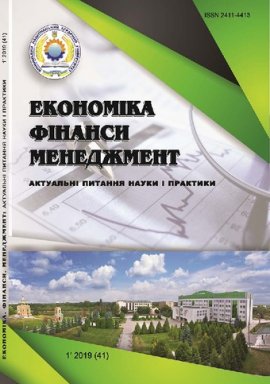
Issue №: 1(41)
The magazine deals with the problems of the agricultural sector of the economy in the context of integration and processes of globalization. Attention is paid to the issues of development of digital economy, rural territories, technologies of enterprise management and organization of accounting, problems of legal support of economic processes, market tendencies of development of various branches of economy. Particular attention is paid to green tourism as a promising segment of the national economy.
BIOLOGICAL ASSETS IN ACCOUNTING: PROBLEMATIC ASPECTS
KOVAL Olena - Candidate of Economic Sciences, Associate Professor of the Department of Accounting, Vinnytsia National Agrarian University (21008, Vinnytsia, 3 Sonyachna str., e-mail: ostapchukov@meta.ua).
The issues of accounting and information provision of management, state and social control over biological assets with genetically modified forms are considered. The method of constructing a separate account of the availability of genetically modified biological assets (GMBA) and operations on their transformations has been developed, ways of improving the quality of the P (S) "Biological Assets" and IAS 41 "Agriculture" have been identified, which lies in the rethinking of the role of agricultural activity for social and environmental and environmental factors of human development.
The analysis of accounting standards has shown that in the content of P (S) "Biological Assets" and IAS 41 "Agriculture" there is no information on the procedure for the accounting and control of biological assets and agricultural products from GMOs. In connection with this, it is necessary to find an integrated approach to building a system of accounting for biological assets with genetically modified organisms, in view of increasing public requests for accounting information in the context of sustainable development.
Since GMOs are the assets of all agricultural enterprises in the form of biological assets and agricultural products, for the "transparent" accounting of the enterprise it is necessary to reflect them as separate objects of accounting.
Mandatory allocation of relevant analytical accounts leads to the introduction of additional articles on genetically modified biological assets in the accounting registers of accounting and statistical reporting.
The accounting of biological assets with genetically modified organisms should ensure that accurate information is obtained about the quality and quantity of these assets, and the basis for their reliable assessment.
More responsibly should be placed on the disclosure of information on genetically modified biological assets in the Notes to the Financial Statements. We suggest that the accumulated information on biological assets from GMOs be reflected in a separate section in section 16 entitled "Financial Results from Primary Acceptance and Marketing of Agricultural Products from GMOs and Additional Biological Assets with GMOs".
The introduction of a separate section in the notes on genetically modified assets will allow obtaining the necessary operational information on these assets for management needs and for the state as a whole.
Information on the biological assets of the enterprise and their biological transformations, as well as agricultural products, are reflected in the Form 50-s. "Basic economic indicators of agricultural enterprises".
We consider it expedient to supplement it with another section, which will reflect the information on the composition of production and marketing of agricultural products from GMOs.
The financial statements of agricultural enterprises require changes in the reflection of the reassessment of biological assets and information on the production and sale of genetically modified assets. Information on GMO biological assets is currently absent from P (S) "Biological Assets" and IAS 41, although it is significant both at the enterprise level and on the basis of the country as a whole. Therefore, we consider it expedient to supplement the contents of the provisions with the section "Environmental safety", which will specify the method of constructing a separate accounting for biological assets with GMOs.
Solving the problems of accurately displaying information in accounting and reporting regarding genetically modified biological assets and their biological transformations requires the adoption of new, regulatory and legal decisions by the state.
Taking into account the harmonization of Ukraine's legislation with the EU, this statement is quite logical. In this regard, we propose the standard of accounting for agricultural activities to be supplemented with the section "State support", which, in addition to the norms reflected in IAS 41, found a place and provisions to stimulate the production of biological assets and agricultural products without genetically modified organisms.From the above, we believe that at the state level, companies should be required to account for biological assets and agricultural products from GMOs in accounting and reporting.
The real steps in this regard are to create, with the help of economic incentives (taxes, loans, privileges, etc.), state support to companies that provide true information on the availability of biological assets from GMOs, the quantity of GM products grown and markets for its sales.
Consequently, taking into account the advantages and disadvantages of a new accounting of agricultural activity, having identified the problems of its application in practice, we propose to finalize P (S) 30 "Biological Assets".
The revised standard will facilitate more realistic accounting in agriculture and achievement of higher end results of activities in order to ensure the management of reliable and truthful information about the results of activities.
Improvement of P (S) 30 "Biological Assets" lies in the rethinking of the role of agricultural activity for social and environmental and environmental factors of human development. The issue of "State support" and "Environmental safety" require separate disclosure in agricultural sectoral standards. The world standardization of accounting and reporting of the production of genetically modified products is also very important.
- Holov S.F. (2000). Bukhhalterskyi oblik ta finansova zvitnist v Ukraini [Accounting and financial reporting in Ukraine]. Dnipropetrovsk: TOV «Balans-Klub» [in Ukrainian].
- Mizhnarodni standarty finansovoi zvitnosti 2004/Perekl. z anhliiskoi za red. S.Holova [International Financial Reporting Standards 2004]. K.: Federatsiia profesiinykh bukhhalteriv i audytoriv Ukrainy, 2005. Part II, 1232.
- Silske hospodarstvo. Mizhnarodnyi standart bukhhalterskoho obliku 41 // Mizhnarodni standarty finansovoi zvitnosti 2004/Perekl. z anhliiskoi za red. S.Holova [Agriculture: IAS 41 / International Accounting Standards 2004]. K.: Federatsiia profesiinykh bukhhalteriv i audytoriv Ukrainy, 2005. Part II,1232.
- Bila L.M. (2005). Formuvannia systemy finansovoi zvitnosti silskohospodarskykh pidpryiemstv [Formation of the system of financial reporting of agricultural enterprises]. Extended abstract of candidate’s thesis. Kуiv: B.v [in Ukrainian].
- Bryk M. (2017). Otsinka biolohichnykh aktyviv ta osoblyvosti vyznachennia finansovoho rezultatu ahrarnykh pidpryiemstv rehionu [Assessment of biological assets and features of determining the financial result of agrarian enterprises in the region]. Rehionalni aspekty rozvytku produktyvnykh syl Ukrainy - Regional aspects of the development of the productive forces of Ukraine, 22, 56-60. Retrieved from http://rarrpsu.tneu.edu.ua/index.php/rarrpsu/article/viewFile/211/209 [in Ukrainian].
- Kantsedal N.A. Instytutsialnyi pidkhid do formuvannia v obliku informatsii pro biolohichni aktyvy ta silskohospodarsku diialnist [Institutional Approach to the Formation of Information on Biological Assets and Agricultural Activities]. EKONOMIKA. FINANSY. MENEDZhMENT: aktualni pytannia nauky i praktyky – ECONOMY. FINANCES. MANAGEMENT: topical issues of science and practical activity, 2018, 1, 44-55 [in Ukrainian].
- Marchenko L.Iu. & Prydatchenko V.V. Otsiniuvannia ta oblik potochnykh biolohichnykh aktyviv roslynnytstva [Estimation and accounting of current biological assets of crop production]. Ekonomika i rehion – Economy and region, 2015, 2 (51), 54-57 [in Ukrainian].
- Ostapchuk O.V. Udoskonalennia obliku potochnykh biolohichnykh aktyviv [Improving the accounting of current biological assets]. Oblik i finansy APK – Accounting and finance of agroindustrial complex, 2010, 1, 66-69 [in Ukrainian].
- Kucherenko Ye. Problemy vyznannia dokhodiv i vytrat u konteksti pryntsypiv bukhhalterskoho obliku [The problems of recognition of income and expenses in the context of accounting principles]. Retrieved from: http://udau.edu.ua/library.php?pid=933 [in Ukrainian].
- Biolohichni aktyvy [Biological assets]. Polozhennya (standart) bukhhaltersʹkoho obliku from from November 18th. 2005. Derzhstandart Ukraine [in Ukrainian].
- Rohoznyi S. & Karpachova O. Oblik biolohichnykh aktyviv za MSFZ: rozkryvayemo informatsiyu u finzvitnosti [Accounting for biological assets under ISFR: we disclose information in financial reporting]. Vse pro bukhhalterskyi oblik – All about accounting, 2017, 80, 9-12 [in Ukrainian].
- Ostapchuk O.V. & Shipulya O.V. Problemy vidobrazhennia informatsii pro biolohichni aktyvy u finansovii zvitnosti [Problems of displaying information about biological assets in financial statements]. Retrieved from www.rusnauka.com [in Ukrainian].
- Maksymova V. F. (2013). Bukhhalterskyi oblik. Chastyna 2 [Accounting. Part 2]. Odesa : ONEU [in Ukrainian].
About the journal
С1 Economics and International Economic Relations (by specialization)
D1 Accounting and Taxation
D2 Finance, Banking, Insurance and Stock Market
D3 Management
D4 Public Management and Administration
D5 Marketing
D7 Trade
J3 Tourism and Recreation
Founded in 1997 under the name ”Bulletin of Vinnytsia State Agricultural Institute”. In 2010-2014 it was published under the name “Collection of Scientific Papers of Vinnytsia National Agrarian University”. Since 2015 “Economics, finance, management: current issues of science and practical activity” (Certificate of State Registration of Mass Media No. 21154-10954 PR dated 12/31/2014).
