

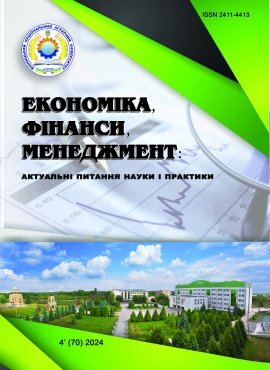
Issue №: 4 (70)
The journal deals with the issues of efficiency of functioning of the national economics and organizational forms of management of the national economy. Attention is paid to the problems of marketing, management and efficiency of production and economic activity of agrarian enterprises. The issues of public administration and administration, accounting and taxation, banking and insurance, forecasting and modeling of economic processes, foreign economic activity, commodity flows of economic entities and their infrastructure support.
COMMODITY EXPERTISE IN E-COMMERCE
VOLOSHYN Roman – Candidate of Economic Sciences, Associate Professor of the Department of Entrepreneurship and Trade, West Ukrainian National University (46009, Ternopil, 11, Lvivska Str., e-mail: roman_vol@ukr.net).
The article addresses the pressing issue of ensuring high product quality in the context of the rapid development of e-commerce. It explores the features of commodity expertise as a crucial tool for quality control, analyzing the factors influencing such expertise in both traditional and online trade. The study identifies the key challenges associated with conducting commodity expertise in remote sales conditions, including indirect contact with the examined object, difficulties in product identification, limited capabilities of commodity research methods, and the increasing impact of subjective evaluations, marketing, and social tools on consumers' perceptions of product quality.
The research employs the general scientific methods and approaches, including systematic analysis, observation, comparison, generalization, dialectical methods, as well as control and synthesis techniques. Through comparative analysis, the differences between traditional and e-commerce approaches to commodity expertise are identified, demonstrating the dependence of quality control in e-commerce on informal assessment tools such as ratings, consumer reviews, blogger recommendations, and expert reviews. The study highlights the shortcomings of these mechanisms due to their low objectivity, susceptibility to manipulation, and lack of professionalism.
The article proposes ways to improve the methodology of commodity expertise in e-commerce by leveraging digital technologies that can compensate for the limitations of traditional quality control methods. Key recommendations emphasize the potential of blockchain to enhance transparency in product origin and movement, the Internet of Things (IoT) for real-time monitoring of product parameters, big data analytics and artificial intelligence for detecting fraudulent reviews, ratings, and sellers, as well as 3D scanning for remote evaluation of product characteristics. Based on the findings, the study concludes that there is a need to revise the methodological foundations of commodity expertise to better regulate quality control processes in online trade.
1. Bozulenko, O.Ya. (2021). Teoretychni zasady tovaroznavchoi ekspertyzy [Theoretical foundations of commodity expertise]. Proceedings from MIIM ‘12: I Mizhnarodna naukovo-praktychna konferentsiia «Rol i perspektyvy rozvytku tovaroznavchykh ta ekonomichnykh ekspertyz u derzhavnomu i pryvatnomu sektorkh» – I International Scientific and Practical Conference «The role and prospects for the development of commodity and economic expertise in the public and private sectors». (pp. 26–29). Odessa: Vydavnychyi dim «Helvetyka» [in Ukrainian].
2. Vasylets, K.K., Sokolova, Ye.B., & Trembach, L.I. (2017). Ekspertyza v mizhnarodnii torhivli: Metodychni vkazivky ta zavdannia dlia praktychnykh zaniat dlia studentiv [Expertise in international trade: Methodological guidelines and practical tasks for students]. Kharkiv: KhDUKhT [in Ukrainian].
3. Kalinskyi, Ye.O., & Drazhnytsia, S.A. (2024). Osoblyvosti provedennia tovaroznavchykh ekspertyz iz vyznachennia kodiv tovaru zghidno z UKT ZED [Peculiarities of conducting commodity expertise to determine product codes according to the Ukrainian Classification of Goods for Foreign Economic Activity]. Visnyk Khersonskoho natsionalnoho tekhnichnoho universytetu – Bulletin of the Kherson National Technical University, 2 (89), 169–172. DOI: https://doi.org/10.35546/kntu2078-4481.2024.2.38 [in Ukrainian].
4. Nove doslidzhennia vstanovylo, shcho 91% spozhyvachiv pereviriaie vidhuky pered pokupkoiu [A new study found that 91% of consumers check reviews before purchasing]. (2024). proidei.com. Retrieved from: https://www.proidei.com/reviews-1808/ [in Ukrainian].
5. Pro zatverdzhennia Instruktsii pro pryznachennia ta provedennia sudovykh ekspertyz ta ekspertnykh doslidzhen ta Naukovo-metodychnykh rekomendatsii z pytan pidhotovky ta pryznachennia sudovykh ekspertyz ta ekspertnykh doslidzhen: Nakaz Ministerstva yustytsii Ukrainy № 53/5 [On approval of the Instructions on the appointment and conduct of forensic examinations and expert studies and Scientific and Methodological Recommendations on the preparation and appointment of forensic examinations and expert studies: Order of the Ministry of Justice of Ukraine № 53/5]. (1998, October 8). zakon.rada.gov.ua. Retrieved from: https://zakon.rada.gov.ua/go/z0705-98 [in Ukrainian].
6. Pro zakhyst prav spozhyvachiv: Zakon Ukrainy № 1023-XII [On the Protection of Consumer Rights: Law of Ukraine № 1023-XII]. (1991, May 12). zakon.rada.gov.ua. Retrieved from: https://zakon.rada.gov.ua/laws/show/1023-12#Text [in Ukrainian].
7. Tovaroznavcha ekspertyza. Zakhidno-Ukrainskyi Ekspertno-Konsultatyvnyi Tsentr [Commodity Expertise. Western Ukrainian Expert and Consultative Center]. (2023). zuekc.com.ua. Retrieved from: https://zuekc.com.ua/sudovi-ekspertyzy-ta-doslidzhennia/tovaroznavcha-ekspertyza [in Ukrainian].
8. Shostak, L.V. (2023). Ekspertyza tovariv ta posluh: Konspket lektsii [Expertise of goods and services: Lecture notes]. Lutsk: Volynskyi natsionalnyi universytet imeni Lesi Ukrainky [in Ukrainian].
9. Filieri, R. (2015). What makes online reviews helpful? A diagnosticity-adoption framework to explain informational and normative influences in e-WOM. Journal of Business Research, 68 (6), 1261–1270. DOI: https://doi.org/10.1016/j.jbusres.2014.11.006 [in English].
10. Gajewska, T., Zimon, D., Kaczor, G., & Madzík, P. (2020) The impact of the level of customer satisfaction on the quality of e-commerce services, International Journal of Productivity and Performance Management, 69 (4), 666–684. DOI: https://doi.org/10.1108/IJPPM-01-2019-0018 [in English].
11. He, S., Hollenbeck, B., & Proserpio, D. (2022). The market for fake reviews. Marketing Science, 41 (5), 896–921. DOI: http://dx.doi.org/10.2139/ssrn.3664992 [in English].
12. Liu, M. (2022). Analysis of cross-border e-commerce commodities in Internet of Things based on semantic traceability algorithm. Mathematical Problems in Engineering, 2022 (1), 2017827. DOI: https://doi.org/10.1155/2022/2017827 [in English].
13. What is e-commerce? McKinsey & Company. (2023). mckinsey.com. Retrieved from: https://www.mckinsey.com/~/media/mckinsey/featured%20 insights/mckinsey%20explainers/what%20is%20e%20commerce/what-is-e-commerce_final.pdf [in English].
14. Peña-García, N., Losada-Otálora, M., Pérez Auza, D., & Cruz, M. (2024). Reviews, trust, and customer experience in online marketplaces: The case of Mercado Libre Colombia. Frontiers in Communication, 9, 1460321. DOI: https://doi.org/10.3389/fcomm.2024.1460321 [in English].
15. Román, S., Riquelme, I.P., & Iacobucci, D. (2023). Fake or credible? Antecedents and consequences of perceived credibility in exaggerated online reviews. Journal of Business Research, 156, 113466. DOI: https://doi.org/10.1016/j.jbusres.2022.113466 [in English].
16. Hlobalna elektronna komertsiia: kliuchovi tsyfry ta trendy e-commerce 2024 [Global e-commerce: key figures and e-commerce trends 2024]. rau.ua. Retrieved from: https://rau.ua/novyni/trendi-e-com-2024/ [in Ukrainian].
About the journal
С1 Economics and International Economic Relations (by specialization)
D1 Accounting and Taxation
D2 Finance, Banking, Insurance and Stock Market
D3 Management
D4 Public Management and Administration
D5 Marketing
D7 Trade
J3 Tourism and Recreation
Founded in 1997 under the name ”Bulletin of Vinnytsia State Agricultural Institute”. In 2010-2014 it was published under the name “Collection of Scientific Papers of Vinnytsia National Agrarian University”. Since 2015 “Economics, finance, management: current issues of science and practical activity” (Certificate of State Registration of Mass Media No. 21154-10954 PR dated 12/31/2014).
