

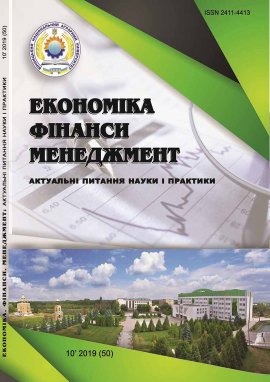
Issue №: 10 (50)
The magazine deals with the problems of the agricultural sector of the economy in the context of integration and processes of globalization. Attention is paid to the issues of development of digital economy, rural territories, technologies of enterprise management and organization of accounting, problems of legal support of economic processes, market tendencies of development of various branches of economy. Particular attention is paid to green tourism as a promising segment of the national economy.
CONTENT AND SIGNIFICANCE OF THE THEORY OF INSTITUTIONALISM AS A FACTOR OF THE AGRARIAN FAMILY FARM DEVELOPMENT
MAZUR Kateryna – Candidate of Economics Sciences, Associate Professor, Head of the
Department of Agrarian Management, Vinnytsia National Agrarian University (3 Soniachna Str.,
Vinnytsia, 21008).
MAZUR Anatolii – Doctor of Economic Sciences, Professor, Professor of the Department of
Agrarian Management, Vinnytsia National Agrarian University (3 Soniachna Str., Vinnytsia, 21008).
The main problem of the current state of the agrarian economy is that with the intensification and expansion of the agricultural export potential, the destruction of the rural way of life and the gradual decline of the rural territories are observed. These processes are flourishing against the backdrop of large-scale landowners who accumulate large tracts of land in the agrarian sector, and by virtue of monopolizing the production of export-oriented food products, are effectively eliminating agriculture from profit sharing. The peasantry thus becomes a primitive and underdeveloped sector of the economy, which operates on the basis of self-survival. The situation is exacerbated by governmental support for large-scale production as the main direction of increasing agricultural potential in the national economy. At the same time, there is no awareness in the society that rural economy, which is predominantly based on farms and agriculture, is a holistic socio-economic system, which includes: production of safe food, recreational activity, conservation of nature and landscapes, protection of traditional Ukrainian identity, traditions. Thus, problems remain that require in-depth study, in particular, of establishing effective institutions to prevent potential risks; research on institutional changes and their impact on the development of public relations; development of methodology for empirical measurement of transaction costs in the existing institutional system.
This requires the search for theoretical approaches to substantiate the conceptual provisions of the feasibility of existence and multiplication of activities of farms and farms. The essence and place of the theory of institutionalism in the development of rural agrarian relations are determined. It is emphasized that the basis of industrial relations should determine the person, his needs and quality growth of human potential in the countryside. The basic factors of promoting the introduction of institutional principles in the development of the rural economy are outlined, and the substantiation of directions and content of the institutionally oriented influence on the activity of small forms of farming in rural areas is provided. The article formulates the author's proposals concerning the main directions of institutional support of family farms in rural territories and emphasizes the need to increase the role of the state in the formation of the institutions necessary for the agrarian market, including the means of state protectionism.
- Borodina O., Prokopa I. (2009). Silskyi rozvytok v Ukraini: problem stanovlennia [Rural Development in Ukraine: Problems of Formation]. Ekonomika Ukrainy
- - Economy of Ukraine, 5, 62-68 [in Ukrainian].
- Hamilton W.H. (2007). Institutsionalnyj podkhod k ekonomicheskoi teorii. [Institutional Approach to Economic Theory]. Ekonomicheskiy vestnik Rostovskogo gosudarstvennogo universiteta -Economic bulletin of the Rostov State University, vol. 5, No.2. P. 110-117 [in Russian].
- Heiets V.M. (2010). Novyi kurs reform v Ukraini. Natsionalna dopovid [New course of reforms in Ukraine. National report]. Kyiv, NVTs NBUV, 145-146 [in Ukrainian].
- Hrytsenko A.A. (2006). Institutsionalnaia arkhitektonika: predmet, osnovnyie zakony, metodolohiya [Institutional Architecture: Subject, Basic Laws, Methodology]. Nauchnie trudy DonNTU. Servia: ekonomicheskaia - Scientific works of DonNTU. Series:economic, Issue 103-1, Pp. 31-37 [in Russian].
- Kaletnik H.M., Mazur A.H. (2015). Stan ta perspektyvy rozvytku liudskoho potentsialu Ukrainy ta yii rehioniv [Status and prospects of development of human potential of Ukraine and its regions]. Ekonomika. Finansy. Menedzhment: aktualni pytannia nauky i praktyky -- Economy. Finances Management: topical issues of science and practice, No. 4, pp.7-22 [in Ukrainian].
- Commons J. (2007). Institutsionalnyj podkhod k ekonomicheskoi teorii [Institutional Approach to Economic Theory]. Ekonomycheskiy vestnik Rostovskogo gosudarstvennogo universiteta - Economic bulletin of the Rostov State University, vol. 5, No.4. P. 59-70 [in Russian).
- Lopatynskyi Yu.M. (2006). Transformatsiia ahrarnoho sektora: instytutsiini zasady [Transformation of the agrarian sector: institutional foundations]. Chernivtsi: Ruta, Pp.22-24 [in Ukrainian].
- Mazur A.H. (2007). Rehionalna paradyhma suspilnoho rozvytku: monohrafiia [Regional paradigm of social development: monograph]. Vinnytsia, «Knyha-Veha», 160 p. [in Ukrainian].
- Malik M.I. (2005). Struktura ta rozvytok ahrarnykh formuvan. Ahropromyslovyi kompleks Ukrainy: stan, tendentsii ta perspektyvy rozvytku [Structure and development of agrarian units. Agro- industrial complex of Ukraine: state, trends and prospects of development]. Kyiv, NTC UIA, 292 p. [in Ukrainian].
- Prokopa I.V., Berkuta T.V. (2011). Hospodarstva naselennia v suchasnomu ahrarnomu vyrobnytstvi [Households in modern agrarian production]. NAN Ukrainy. In- t ekon. i prohnoz. Kyiv, 240 p. [in Ukrainian].
- Sabluk P. (2001). Ahrarna ekonomika i polityka v Ukraini: pidsumky mynuloho i pohliad u maibutnie [Agrarian Economics and Politics in Ukraine: the Results of the Past and the View into the Future]. UAle, 482 p. [in Ukrainian].
- Svynous I.V. (2010). Ekonomichni aspekty funktsionuvannia osobystykh selianskykh hospodarstv. Monohrafivia [Economic aspects of the functioning of private peasant farms. Monograph]. Kyiv, TOV «AhroMediaHrup», P. 275 [in Ukrainian].
- Tochylin V.O., Ostashko T.O., Pusovoit O.V. (2009). Rynky realnoho sektora ekonomiky Ukrainy: strukturno-instytutsionalnyi analiz [Markets of the real sector of the economy of Ukraine: structural and institutional analysis]. Kyiv, NAN Ukrainy, In-t ekon. i prohnoz, Pp. 307-327 [in Ukrainian].
- Tsymbal V. (2009). Udoskonalennia rynkovykh vidnosyn na seli [Improvement of market relations in the countryside]. Ekonomika APK - Economy of agroindustrial complex, 8,114 [in Ukrainian].
- Moroz O.O. Institutional system of agrarian economy. Monograph [Instytutsiina systema ahrarnoi ekonomiky. Monographiia] [Moroz О.О.]. ̶ Vinnytsia: UNIVERSUM: 2006, 438 p. [in Ukrainian]
- Shpykuliak O.H. (2009). Instytutsii ahrarnoho rynku: monohrafia [Agrarian Market Institutions: Monograph]. Kyiv, NNTs UAIe, 480 [in Ukrainian].
About the journal
С1 Economics and International Economic Relations (by specialization)
D1 Accounting and Taxation
D2 Finance, Banking, Insurance and Stock Market
D3 Management
D4 Public Management and Administration
D5 Marketing
D7 Trade
J3 Tourism and Recreation
Founded in 1997 under the name ”Bulletin of Vinnytsia State Agricultural Institute”. In 2010-2014 it was published under the name “Collection of Scientific Papers of Vinnytsia National Agrarian University”. Since 2015 “Economics, finance, management: current issues of science and practical activity” (Certificate of State Registration of Mass Media No. 21154-10954 PR dated 12/31/2014).
