

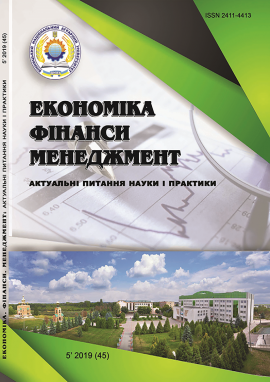
Issue №: 5 (45)
The magazine deals with the problems of the agricultural sector of the economy in the context of integration and processes of globalization. Attention is paid to the issues of development of digital economy, rural territories, technologies of enterprise management and organization of accounting, problems of legal support of economic processes, market tendencies of development of various branches of economy. Particular attention is paid to green tourism as a promising segment of the national economy.
ECONOMETRIC MODELING IN FORMATION OF OPTIMAL PRICE FOR IMPLEMENTATION OF AGRICULTURAL PRODUCTS
VOLONTYR Ludmila – Сandidate of Тechnical Sciences, Аssociate Professor, Аssociate Professor of the Department of Мodelling and Іnformation Тechnologies in Economics, Vinnytsia National Agrarian University (21008, Vinnytsia, 3 Soniachna str., Е-mail vm@vsau.vin.ua)
ZELINSKA Oksana – Сandidate of Тechnical Sciences, Аssociate Professor, Аssociate Professor of the Department of Мodelling and Іnformation Тechnologies in Economics, Vinnytsia National Agrarian University (21008, Vinnytsia, 3 Soniachna str., Е-mail zeloksanavlad@gmail.com)
POTAPOVA Nadiya - Candidate of Economic Sciences, Associate Professor, Department of Modeling and Information Technologies in Economics of Vinnytsia National Agrarian University (Vinnytsia, Ukraine, E mail: potapova.nadin@gmail.com)
Ukraine is a predominantly agricultural country, and this branch has been recently demonstrating relatively high efficiency.
Vegetable growing is a specific branch of crop production, which includes a large set of vegetables grown according to different technologies, with different shelf life of vegetable products, their different cost and production efficiency.
The analysis of the situation on the vegetable market of Ukraine showed that there is a certain correlation between production volumes, sales and products sales prices. The price market environment on the vegetable market in recent years is largely determined by the ratio of supply and demand on the market. Thus, sales volumes increase when the supply on the market is the highest and the price level on the market is the lowest.
The absence of permanent wholesale distribution channels also leads to an increase in the hidden market for vegetable products. According to experts of the Ukrainian Agrarian Confederation, the hidden market for fruit and vegetables is about $ 14 billion, or about 60% of the total turnover of vegetable products in Ukraine.
Due to the moratorium on the sale of agricultural land, businesses are not able to buy land on their own and develop their business in the long-term prospects.
Today, government support in the vegetable sector is limited to preferential lending and to individual funding programs, most often in collaboration with international donors. Much of the support for agro-industrial farms goes to grain and pulse plant producers, which significantly limits the opportunity for developing crop producers with higher marginality.
The conditions in which the agrarian sector operates have a high degree of changeable uncertainty, and this circumstance requires agricultural producers to find ways to obtain reliable information about the state of the agricultural market, organizational and functional links between the subjects of the agricultural market, prices for agricultural products. etc.
The purpose of this study is to: analyze the price of vegetable sales in Ukraine; substantiation of the use of the AGMEMOD partial equilibrium model for forecasting vegetable production in Ukraine; establish dependence of demand and supply of vegetable production on their sales price; determine the point of equilibrium of supply and demand and calculate of the optimal selling price of vegetables in Ukraine; justify the optimal costs for vegetable production; analyze of the price of selling vegetables in Ukraine and determine the optimal price according to supply and demand, as well as the optimal cost of vegetable production.
Now, there are 12 key vegetable crops in Ukraine. These are potatoes, cucumbers, tomatoes, cabbage, beets, carrots, onions, garlic, peppers, zucchini, eggplants and pumpkin. Of these 12 cultures, 9 showed an increase in the period 2010-2016, even without taking into account the uncontrolled Crimea and Donbass. This increase has been driven by two crucial factors:
- yield increase. This was made possible due to improving the quality of the seed and natural technological progress in the processing and the use of crop protecting agents.
- increase in export demand for products. The demand, for example, for Ukrainian carrots and onions has increased, and therefore the opportunities for their cultivation have become greater.
Price is a complex economic category, practically the only element of marketing that enables an enterprise to earn real income. Without proper economic justification of the price level, the normal functioning of economic entities and entire sectors of the economy is impossible, which in turn has a significant impact on the material well-being of the population. The level of market price depends on the value of other marketing elements, as well as on the level of competition on the market and the general state of the economy. As a rule, other marketing elements also change (for example, with increasing product differentiation in order to maximize price or at least the difference between price and cost).
The price formation strategy allows determining the price level and marginal prices for individual product groups. The price formation should always be carried out taking into account the nomenclature and quality of products, their usefulness, importance and purchasing power of consumers and prices of the competitors.
The strategy of price formation management is a set of measures to maintain conditional prices while actually regulating them in accordance with the variety and characteristics of demand, competition in the market.
The AGMEMOD model is an example of the partial equilibrium (PE) models used in agriculture. The main advantages of partial equilibrium models are: the simplicity of the implemented algorithms, the operation of which is quite easily traced; relative availability of necessary data; the calculations are amenable to adequate economic interpretation, making it possible to quickly analyze the consequences of making a decision in the agricultural sector. However, partial equilibrium models are not without their disadvantages. In particular, they do not permit to assess macroeconomic effects such as changes in national income or employment levels, the effects that may be obtained from the redistribution of resources (labor, capital, etc.) into more efficient sectors.
For national researchers, it is advisable to use these models, because they have a module of Ukraine, but it is necessary to supplement the program with statistics on vegetables.
The demand is a function of price changes in the current period, and the supply is a function of price changes in previous periods. Econometric models of supply and demand dependence of vegetable production on the price of their sale are constructed. The equilibrium of the system is observed at the price of 6558 UAH. for 1 ton of vegetables under the given conditions of consumption, the demand is equal to supply and is 9321 thousand tons.
Econometric models of price dependence on material costs, labor costs and depreciation have been constructed. By the first model, it can be determined that the content of unaccounted factors is estimated at 99.82 UAH. per hectare; with an increase in material costs by 1 hectare by 1 UAH, selling price increases by 0.9 UAH. per ton. Based on the Fisher's ratio test, the model is adequate, the relationship between the indicators is tight. The relationship between the indicators of the second model is weak, the calculated correlation coefficient can be trusted, but in general, the adequacy of the model conclusion cannot be made. The model shows that with an increase in labor costs by 1 UAH per hectare, the price increases by 10.03 UAH per ton. The third model based on the Fisher's ratio test is adequate, the relationship between the indicators is average. With the increase in depreciation costs per hectare by 1 UAH, the selling price will increase by 12.42 UAH per ton. The value of the linear correlation coefficient other than zero is statistically significant.
Based on the calculated models, we will determine the optimal cost per hectare: material – 7144.2 UAH, labor costs – 689.4 UAH, depreciation costs – 543.4 UAH.
- Voskobiynik, Y.P. (2014). Problemnyie aspektyi razvitiya i derzhavnogo regulirovaniya optovyih ryinkov selskohozyaystvennoy produktsii: opyit Ukrainyi. [Problematic aspects of the development and sovereign regulation of the wholesale markets for agricultural products: the experience of Ukraine.] Biznes. Obrazovanie. Pravo. Vestnik Volgogradskogo instituta biznesa 1 (26), 73-77 [in Russia].
- Kopystko, O.V. (2010). Teoretychni osnovy konkurentospromozhnosti silskohospodarskoi produktsii. [Theoretical bases of competitiveness of agricultural products] Ekonomika APK 1, 61- 63 [in Ukrainian].
- Khyzha, N.M. (2008). Dysparytet tsin: chynnyky i sfery formuvannia ta shliakhy podolannia. [Price Disparity: Factors and Areas of Formation and Ways to Overcome] Naukovyi visnyk NLTU Ukrainy. 189, 265-269 [in Ukrainian].
- Shubotovych, T.A. Teoretychni osnovy konkurentospromozhnosti ahrarnykh pidpryiemstv. [Theoretical bases of competitiveness of agricultural enterprises] Stalyi rozvytok ekonomiky, 1, 84- 87 [in Ukrainian].
- Stasinevych, S.A., Voloshyn, C.V. (2013). Udoskonalennia zakonodavchoho zabezpechennia tsinoutvorennia v Ukraini na suchasnomu etapi. [Improving the legislative support of pricing in Ukraine at the present stage] Naukovyi visnyk NUBiP Ukrainy. Seriia «Ekonomika, ahrarnyi menedzhment, biznes», 181, 4, 298-304 [in Ukrainian].
- Cherven, I.I., Burkovskyi, I.D., Burkovska, A.V. (2007). Ahrarnyi rynok vymahaie zvazhenoi tsinovoi polityky. [The agricultural market requires a sound pricing policy] Ekonomika APK, 3, 99 - 104 [in Ukrainian].
- Shpykuliak, O.H. (2009). Problemy ekonomichnykh vidnosyn v mekhanizmi tsinoutvorennia ahrarnoho rynku. [Shpikuliak OG Problems of economic relations in the mechanism of pricing of the agrarian market.] Ekonomika APK, 10, 77-82 [in Ukrainian].
- Electronic resource. Available at: https://agravery.com/ uk/ posts/ show/ comu-ukraina-ne-stala-liderom-na-rinku-ovociv-sist-pricin-ta-plani-na-majbutne [in Ukrainian].
- Hamulczuk Mariusz, Hertel Katarzyna. (2009). AGMEMOD MODEL – structure and application for analysis and simulation of polish agricultural sector. Metody ilościowe w badaniach ekonomicznych x. 88-98.
- Nehrei, M.V., Chabanenko, I. C. (2018).Modeli chastkovoi rivnovahy yak instrument doslidzhennia aharnoho sektoru. [Partial equilibrium models as a tool for agar sector research] Prychornomorski ekonomichni studii.. Vypusk 36, 158-162 [in Ukrainian].
- Romakin, V.V. (2006). Kompiuternyi analiz danykh: Navchalnyi posibnyk. [Romakin VV Computer analysis of data: Textbook.] Mykolaiv: Vyd-vo MDHU im. Petra Mohyly, 144 [in Ukrainian].
- Berzlev, O.Yu. (2013). Suchasnyi stan informatsiinykh system prohnozuvannia chasovykh riadiv. [The current state of information systems for forecasting time series] Upravlinnia rozvytkom skladnykh system.. 13, 78-82 [in Ukrainian].
- Kremen, V.M., Kremen, O. I. (2014). Finansova statystyka: navchalnyi posibnyk. [Financial statistics: a textbook. ] K.: Tsentr uchbovoi literatury, 368 Available at:https:// pidruchniki.com/1334020362696/statistika/statistichni_metodi_analizu_fondovogo_rinku
- Hrabovetskyi, B.Ie. (2000). Osnovy ekonomichnoho prohnozuvannia: Navchalnyi posibnyk. [Basics of economic forecasting: A textbook] Vinnytsia: VF TANH, 209 [in Ukrainian].
- Statystychnyi zbirnyk «Silske hospodarstvo Ukrainy 2018 rik» [Statistical collection "Agriculture of Ukraine 2018"] Available at:www.ukrstat.gov.ua
About the journal
С1 Economics and International Economic Relations (by specialization)
D1 Accounting and Taxation
D2 Finance, Banking, Insurance and Stock Market
D3 Management
D4 Public Management and Administration
D5 Marketing
D7 Trade
J3 Tourism and Recreation
Founded in 1997 under the name ”Bulletin of Vinnytsia State Agricultural Institute”. In 2010-2014 it was published under the name “Collection of Scientific Papers of Vinnytsia National Agrarian University”. Since 2015 “Economics, finance, management: current issues of science and practical activity” (Certificate of State Registration of Mass Media No. 21154-10954 PR dated 12/31/2014).
