

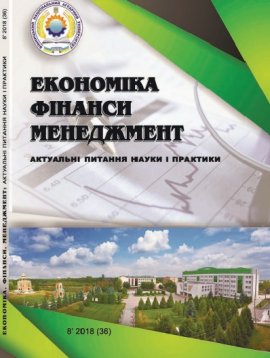
Issue №: 8 (36)
The magazine deals with the problems of the agricultural sector of the economy in the context of integration and processes of globalization. Attention is paid to the issues of development of digital economy, rural territories, technologies of enterprise management and organization of accounting, problems of legal support of economic processes, market tendencies of development of various branches of economy. Particular attention is paid to green tourism as a promising segment of the national economy.
ECONOMIC NATURE OF INVENTORIES, THEIR VALUATION AND ACCOUNTING
RABOKON Yuliya – Graduate Studet of the Faculty of Accounting and Auditing,
Vinnytsia National Agrarian University (21008, Vinnytsia, 3 Soniachna str., e-mail:
yulchik.rabokon@gmail.com).
As a component of the framework of resource potential of enterprises, production
reserves are one of the most important components of current assets.They are defined as
the availability of appropriate material resources, which include the means of production,
consumption items and other values necessary to ensure expanded reproduction, servicing
the sphere of intangible production and meeting the needs of the population. The study of
scientific approaches to the economic essence of the investigated category points to a
number of contradictions in the interpretation of the term "inventaryes".
The article presents the approaches of scientists to the use of terms to define the
concept of "stocks", and it is determined that they are also characterized as "commodity-material values", "tangible assets", "material stocks", "inventory", "material and industrial
stocks," " commodity-production reserves ".
The research of contemporary economists has also been analyzed and it has been
found that scientific literature and normative documents do not have a single approach to
the content of production stocks. This made it possible to determine that disclosure of the
essence of any economic category depends on the chosen approach to its definition.
The established that an important method in the inventory accounting system is to
evaluate them when they are received, written off and as of the reporting date.
The confirmed that for proper organization of accounting in the work plan of the
accounts of economic entities, it is advisable to delineate the relevant analytical accounts
taking into account the specifics of their activities.
1. Podolianchuk O.A. (2018). Vyrobnychi zapasy: ekonomichna sutnistʹ ta oblik
[Industrial stocks: economic essence and accounting]. Ekonomika. Finansy. Menedzhment:
aktualʹni pytannya nauky i praktyky – Economy. Finances. Management: topical issues of
science and practice. No 5 [in Ukrainian].
2. Phylypiv N., Borysovskiy M. (2013) Ponyattya i sutnistʹ tovarno-vyrobnychykh
zapasiv [The notion and essence of inventory]. Ekonomichnyy analiz – Economic analysis.
12, 3 [in Ukrainian].
3. Polozhennya standart) bukhhaltersʹkoho obliku 9 “Zapasy” [Regulation of the
standard) of accounting 9 "Reserves" [Electronic resource]: Order of the Ministry of
Finance of Ukraine dated 20.10.1999 number 246 ]. (n.d.) zakon3.rada.gov.ua. Retrieved
from http://zakon3.rada.gov.ua/laws/show/z0751-99 [in Ukrainian].
4. Koval N.I. (2017) Sutnistʹ vyrobnychykh zapasiv yak ekonomichnoyi katehoriyi:
oblikovyy ta upravlinsʹki aspekty [Essence of industrial stocks as economic category:
accounting and managerial aspects]. Ekonomika. Finansy. Menedzhment: aktualʹni
pytannya nauky i praktyky – Economy. Finances. Management: topical issues of science
and practice. No 7 [in Ukrainian].
5. Fedak L.M. (2012) Zapasy pidpryyemstva sutnistʹ ta klasyfikatsiya [Inventories
of the entity essence and classification]. Visnyk Khmelʹnytsʹkoho natsionalʹnoho
universytetu – Bulletin of the Khmelnytsky National University. No 1 [in Ukrainian].
6. Dmytrenko A.V. (2016) Ekonomichna sutnistʹ ponyattya vyrobnychi zapasy
[Economic essence of the concept of industrial stocks]. Ekonomika i rehion – Economy and
region. No 2 (57) [in Ukrainian].
7. Lopatina V.V. Ekonomichna sutnistʹ vyrobnychykh zapasiv [Economic essence
of production stocks]. Naukovi pratsi [Chornomorsʹkoho derzhavnoho universytetu imeni
Petra Mohyly kompleksu “Kyyevo-Mohylyansʹka akademiya”]. Seriya : Ekonomika -Scientific works [Black Sea State University named after Petro Mohyla of the Kyiv-Mohyla
Academy complex]. Series: Economics. Т. 189. Retrieved from
http://nbuv.gov.ua/UJRN/Npchduec_2012_189_177_15 [in Ukrainian].
8. Pro zatverdzhennya Planu rakhunkiv bukhhaltersʹkoho obliku ta Instruktsiyi pro
yoho zastosuvannya: Nakaz Ministerstva finansiv Ukrayiny vid 30.11.1999 za №291[On
Approval of the Accounting Account Plan and Instructions for its Application : Order of
the Ministry of Finance of Ukraine dated November 30, 1999, No. 291]. Retrived from
http//www.mfu.gov.ua [in Ukrainian].
9. Metodychni rekomendatsiyi shchodo zapovnennya form finansovoyi zvitnosti:
Nakaz Ministerstva finansiv Ukrayiny 28.03.2013 r. №433 [Methodical recommendations
for completing the forms of financial reporting: Order of the Ministry of Finance of Ukraine
dated 03/28/2013, No. 433.]. Retried from http://minfin.kmu.gov.ua /control/uk/
publish/article/main?art_id=382876&search_param=%EE%E1%B3%E3&searchPublishi
ng=1 [in Ukrainian]
10. Ohiychuk M.F.(Ed), Plakyenko V.Ya., Panchenko L.G. (2010) Bukhhaltersʹkyy
oblik na silʹsʹkohospodarsʹkykh pidpryyemstvakh [Accounting at agricultural enterprises].
Kyiv: Vyshcha osvita [in Ukrainian].
About the journal
С1 Economics and International Economic Relations (by specialization)
D1 Accounting and Taxation
D2 Finance, Banking, Insurance and Stock Market
D3 Management
D4 Public Management and Administration
D5 Marketing
D7 Trade
J3 Tourism and Recreation
Founded in 1997 under the name ”Bulletin of Vinnytsia State Agricultural Institute”. In 2010-2014 it was published under the name “Collection of Scientific Papers of Vinnytsia National Agrarian University”. Since 2015 “Economics, finance, management: current issues of science and practical activity” (Certificate of State Registration of Mass Media No. 21154-10954 PR dated 12/31/2014).
