

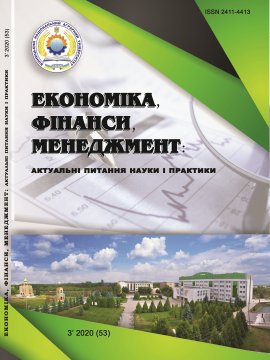
Issue №: 3 (53)
The journal deals with the issues of efficiency of functioning of the national economics and organizational forms of management of the national economy. Attention is paid to the problems of marketing, management and efficiency of production and economic activity of agrarian enterprises. The issues of public administration and administration, accounting and taxation, banking and insurance, forecasting and modeling of economic processes, foreign economic activity, commodity flows of economic entities and their infrastructure support.
GLOBAL PRINCIPLES OF MANAGERIAL ACCOUNTING AND THEIR APPLICATIONS AT ENTERPRISES
LEPETAN Іnna – PhD in Economics, Associate Professor, Associate Professor of Accounting Department, Vinnytsia National Agrarian University (21008, Vinnytsia, 3 Soniachna st., e-mail: lepetan_inna@i.ua)
The article describes the list and essence of accounting principles and focuses on the principles of accounting, since not all generally accepted accounting principles are suitable for application in management accounting. The basic principles of management accounting are combined with the integration of different aspects, which are distinguished by different scientists.
The Global Principles of Management, developed by international organizations and identifying best practices in accounting that help to make complex decisions that deliver value, are described in more detail.
The article describes the components of the principles and ways of their application. Attention is paid to the principle “Communication generates influential information”, which means that management accounting begins and ends with communication. The main purpose of this principle is to make effective decisions about the strategy and its implementation at all levels.
The “Information is relevant” principle directs management records to provide managers with relevant information when necessary, identifying past, current, and future information, including financial and non-financial data from internal and external sources. This includes social, environmental and economic data. The purpose of this principle is to provide the enterprise with information support in planning and developing strategy, tactics and their implementation.
The principle of “Impact analysis”, management accounting links the strategy of the organization with its business model. This principle helps to work out different scenarios to understand their impact on value creation and conservation. The main purpose of this principle is to simulate different scenarios that demonstrate cause and effect relationships between activity factors and outcomes.
The purpose of the principle of “Smart management builds trust” is formulated as the need to actively manage relationships and resources to protect the financial and non-financial assets of the company, its reputation and value.
Attention is drawn to the core competencies that management accounting professionals must possess to help an organization create, implement, and refine their strategies. The competency model covers four areas: specialized and business skills, communication skills and leadership.
The application of Global Principles in the fields of activity: cost transformation and management, external reporting, financial strategy, internal control, evaluation of investment efficiency, management and budgetary control, prices, discounts and product decisions, project management, regulatory compliance, management resources, risk management, strategic tax control, financial management, internal audit.
1. Hlobal'ni pryntsypy upravlins'koho obliku. Amerykans'kyj instytut sertyfikovanykh publichnykh bukhhalteriv; Instytut pryvilejovanykh upravlins'kykh bukhhalteriv [Global principles of management accounting. American Institute of Certified Public Accountants; Institute of Privileged Management Accountants]. cgma.org. Retrieved from https://www.cgma.org/content/dam/cgma/resources/reports /downloadabledocuments/ukranian-full-gmaps-document.pdf [in Ukrainian].
2. Ivashkevich, V. B. (2011). Buhgalterskij upravlencheskij uchet [Accounting Management Accounting]. Moscow: INFRA-M [in Russian].
3. Krasova, O.S. (2006). Upravlencheskij uchet v SShA [Management Accounting in the United States]. Moscow: OOO «Zhurnal «Gorjachaja linija buhgaltera» [in Russian].
4. Napadovskaya, L.V. (2010). Upravlins'kyj oblik [Managerial Accounting]. Kyiv: KNTEU [in Ukrainian].
5. Podborka materialov dlja pressy po Sammitu po ustojchivomu razvitiju 2015 goda: Vremja global'nyh dejstvij v interesah ljudej i planet [Press kit for the 2015 Sustainable Development Summit: A Time for Global Action for People and the Planet]. un.org. Retrieved from http://www.un.org/sustainabledevelopment/ru/wp-content/uploads/sites/5/2015/08/FAQs_Sustainable_Development_Summit.pdf [in Russian].
6. Nikolaev, O.E., & Shishkova, T.V. (2004). Upravlencheskij uchet: oficial'naja terminologija CIMA [Management Accounting: CIMA Official Terminology] . Moscow: ID FBK– PRESS [in Russian].
7. Zakon Ukrayiny «Pro bukhhaltersʹkyy oblik ta finansovu zvitnistʹ v Ukrayini» [The Law of Ukraine “On Accounting and Financial Reporting in Ukraine”. zakon.rada.gov.ua. Retrieved from http:// https://zakon.rada.gov.ua/laws/show/996-14.
About the journal
С1 Economics and International Economic Relations (by specialization)
D1 Accounting and Taxation
D2 Finance, Banking, Insurance and Stock Market
D3 Management
D4 Public Management and Administration
D5 Marketing
D7 Trade
J3 Tourism and Recreation
Founded in 1997 under the name ”Bulletin of Vinnytsia State Agricultural Institute”. In 2010-2014 it was published under the name “Collection of Scientific Papers of Vinnytsia National Agrarian University”. Since 2015 “Economics, finance, management: current issues of science and practical activity” (Certificate of State Registration of Mass Media No. 21154-10954 PR dated 12/31/2014).
