

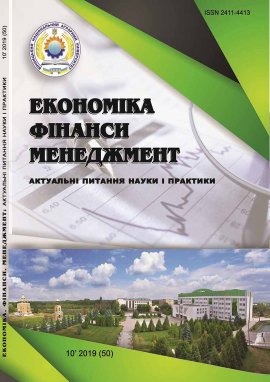
Issue №: 10 (50)
The magazine deals with the problems of the agricultural sector of the economy in the context of integration and processes of globalization. Attention is paid to the issues of development of digital economy, rural territories, technologies of enterprise management and organization of accounting, problems of legal support of economic processes, market tendencies of development of various branches of economy. Particular attention is paid to green tourism as a promising segment of the national economy.
GROWING OF BIOENERGY CULTURES AS RAW MATERIALS FOR BIOFUELS
DORONIN Andrii – Candidate of Economic Sciences, Senior Researcher, Head of the Department
of Agriculture, Melioration and Mechanization, National academy of agrarian sciences of Ukraine (02068,
Кyiv, Dragomanova Str. 15-A, h. 61, e-mail: doronin_av@ukr.net).
The article analyzes the share of energy from renewable sources in the gross final energy consumption of developed countries of the world and Ukraine. The energy problem in the world is aggravated year by year due to the constant depletion of energy sources, forcing intensive introduction of renewable energy sources, the leading place among which is plant biomass. It has been determined that in the structure of biofuels in Ukraine the largest share is given to waste and biofuel.
At the same time, the share of biofuels and waste in Ukraine has been increasing over the years in the structure of renewable energy consumption. The prospects of using crop production for alternative fuel production are investigated. In Ukraine, there are large areas of low-productive land where bioenergy crops can be grown, such as energy willow, miscanthus and others. Ecological and economic aspects of production of alternative fuels in Ukraine are described.
The proposals to increase the efficiency of production of alternative fuels from agricultural products are substantiated. The necessity and economic feasibility of production and use of biofuels has been proved. Compared to crops, bioenergy plantations require fewer fertilizers and herbicides and grow well on land that is unsuitable for agriculture [14]. Since there is no annual tillage, the energy balance of such bioenergy crops is improving compared to traditional crops. They have the potential that not only provide energy security through the use of biomass for renewable energy, but also to meet other ecosystem needs. The most popular in Ukraine is the energy willow. It should be noted that at first it is necessary to go through the stages of preparation, planting, energy section (so that the plant looks like a bush, not a tree, and in future it could be collected with special equipment). That is, you need to make a capital investment once and then make a profit for about 25 years. Manufacturers indicate that they have a steady demand for wood chips, which is already a ready-made resource for burning in boilers, or process it into fuel pellets or briquettes.
1. Blium Ya. B., Heletukha H. H., Hryhoriuk H. P. ta in (2010). Biolohichni resursy i tekhnolohii
vyrobnytstva biopalyva [Biological resources and technologies for biofuel production]. Kyiv: Ahrar Mediia
Hrup. [in Ukrainian].
2. Ihnatenko O. P. (2016). Rozvytok ta komertsializatsiia bioenerhetychnykh tekhnolohii u
munitsypalnomu sektori v Ukraini. Vykorystannia biomasy u munitsypalnomu sektori [Development and
commercialization of bioenergy technologies in the municipal sector in Ukraine. Utilization of biomass in
the municipal sector]. Kyiv [in Ukrainian].
3. Directive 2009/28/EC of the european parliament and of the council of 23 April 2009 on the
promotion of the use of energy from renewable sources and amending and subsequently repealing
Directives 2001/77/EC and 2003/30/EC. URL: http://eurlex.europa.eu/LexUriServ/LexUriServ.do?uri=
OJ:L:2009:140:0016:0062:EN:PDF
4. Enerhospozhyvannia na osnovi vidnovliuvalnykh dzherel za 2007 – 2016 roky [Energy from
renewable energy sources for 2007-2016]: Derzhavna sluzhba statystyky Ukrainy [State Statistics Service
of Ukraine]. URL http://www.ukrstat.gov.ua [in Ukrainian].
5. REPORT FROM THE COMMISSION TO THE EUROPEAN PARLIAMENT, THE COUNCIL,
THE EUROPEAN ECONOMIC AND SOCIAL COMMITTEE AND THE COMMITTEE OF THE
REGIONS : Renewable Energy Progress Report. URL: https://ec.europa.eu/transparency/regdoc/rep/
1/2017/EN/COM-2017-57-F1-EN-MAIN-PART-1.PDF
6. Roik M.V., Hanzhenko O.M., Tymoshchuk V.L. Kontseptsiia vyrobnytstva i vykorystannia
tverdykh vydiv biopalyva v Ukraini [The concept of production and use of solid biofuels in Ukraine].
Bioenerhetyka [Bioenergy]. 2015. №1. P. 5–8 [in Ukrainian].
7. Enerhetychnyi balans Ukrainy za 2017 rik [Energy balance of Ukraine for 2017]. Derzhavna
sluzhba statystyky Ukrainy [State Statistics Service of Ukraine]. URL http://www.ukrstat.gov.ua
/operativ/operativ2018/energ/en_bal/arh_2017.htm [in Ukrainian].
8. Pro vnesennia zmin do Zakonu Ukrainy «Pro elektroenerhetyku» shchodo stymuliuvannia
vyrobnytstva elektroenerhii z alternatyvnykh dzherel enerhii [On Amendments to the Law of Ukraine «On
Electricity» on the promotion of electricity production from alternative energy sources]. Zakon Ukrainy
[Law of Ukraine]. URL: https://zakon.rada.gov.ua/laws/show/5485-17 [in Ukrainian].
9. Ivakhiv V. Enerhetychna verba yak rishennia dlia malykh mist Ukrainy [Energy willow as a
solution for small cities of Ukraine]. Ukrainska enerhetyka [Ukrainian Energy]. URL: http://ua-energy.org/post/27476 [in Ukrainian].
10. Instytut bioenerhetychnykh kultur i tsukrovykh buriakiv NAAN [Institute of Bioenergy Crops
and Sugar Beet of NAAS]. URL: http://bio.gov.ua [in Ukrainian].
11. Connor D. J. & Hernandez C. G. (2009) Crops for Biofuel: Current Status and Prospects for the
Future in R. W. Howarth and S. Bringezu, eds., Biofuels: Environmental Consequences and Interactions with
Changing Land Use. Scientific Committee on Problems of the Environment, Cornell University. P. 70.
12. Keoleian G. A., Volk T. A. (2005). Renewable Energy from Willow Biomass Crops: Life Cycle
Energy, Environmental and Economic Performance. Critical Reviews in Plant Sciences. P. 385–406. doi:
10.1080/07352680500316334
13. Lewandowski I., Schmidt U. (2006). Nitrogen, energy and land use efficiencies of miscanthus,
reed canary grass and triticale as determined by the boundary line approach. Agriculture, Ecosystems and
Environment. P. 335–346. doi:10.1016/j.agee.2005.08.003
14. Njakou Djomo S., El Kasmioui O., et.al. (2013). Energy and climate benefits of bioelectricity
from low-input short rotation woody crops on agricultural land over a two-year rotation. Appl Energy. Vol.
111. P. 862–870.
15. Sinchenko V.M. Enerhetychna verba: tekhnolohiia vyroshchuvannia ta vykorystannia [Energy
willow: technology of cultivation and use]. Pid zah. red. doktora s.-h. nauk V.M. Sinchenka. Vinnytsia :
TOV Niland-LTD. 2015. 340 s. [in Ukrainian].
About the journal
С1 Economics and International Economic Relations (by specialization)
D1 Accounting and Taxation
D2 Finance, Banking, Insurance and Stock Market
D3 Management
D4 Public Management and Administration
D5 Marketing
D7 Trade
J3 Tourism and Recreation
Founded in 1997 under the name ”Bulletin of Vinnytsia State Agricultural Institute”. In 2010-2014 it was published under the name “Collection of Scientific Papers of Vinnytsia National Agrarian University”. Since 2015 “Economics, finance, management: current issues of science and practical activity” (Certificate of State Registration of Mass Media No. 21154-10954 PR dated 12/31/2014).
