

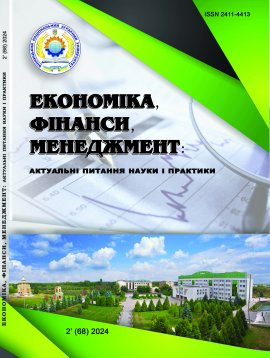
Issue №: 2 (68)
The journal deals with the issues of efficiency of functioning of the national economics and organizational forms of management of the national economy. Attention is paid to the problems of marketing, management and efficiency of production and economic activity of agrarian enterprises. The issues of public administration and administration, accounting and taxation, banking and insurance, forecasting and modeling of economic processes, foreign economic activity, commodity flows of economic entities and their infrastructure support.
JUSTIFICATION OF THE BASIC THEORETICAL DEFINITIONS OF THE ACCOUNTING OF BIOLOGICAL ASSETS OF ORGANIC PRODUCTION
ISHCHENKO Yana – Candidate of Economic Sciences, Associate Professor of the Department of Accounting and Taxation, Vinnytsia National Agrarian University (21008, Vinnytsia, 3, Soniachna Str., e-mail: jana_2006@ukr.net).
PODOLIANCHUK Olena – Candidate of Economic Sciences, Associate Professor, Head of the Department of Accounting and Taxation, Vinnytsia National Agrarian University (21008, Vinnytsia, 3, Soniachna Str., e-mail: podolianchuk_l@i.ua).
SERHIEIEV Yaroslav – Postgraduate Student of the First Year of Study of the Department of Accounting and Taxation, Vinnytsia National Agrarian University (21008, Vinnytsia, 3, Soniachna Str., e-mail: Eco.que.teran@gmail.com).
It was determined that there is currently no systematic accounting of objects of organic production, particularly biological assets, in Ukrainian and in international accounting practice. The conducted research revealed the inconsistency of the terms and categories related to the accounting of biological assets of organic production of the natural and economic essence of this type of property and discrepancies and ambiguity in the interpretation of terminology in regulatory legal acts.
The peculiarities of agricultural lands as the main component of the agroecosystem are considered; as property that does not have a period of use and which, unlike other fixed assets, does not wear out; as a specific asset in which biological processes and transformations occur, on which its fertility depends; as parts of natural capital capable of biological assimilation. The expediency of classifying agricultural lands as biological assets is substantiated, which will make it possible to develop the methodology for evaluating this type of property and other biological assets, taking into account their positive impact on the agroecosystem and the natural environment as a whole.
The need to standardize the accounting of organic production and the formation and approval of a separate accounting standard "Organic production" has been established, where, in particular, the definition of the main terms, the procedure for recognizing biological assets of organic production, and the development of a methodology for their assessment and accounting should be formed.
A proper definition of biological assets of organic production is proposed as a set of biological elements of the agroecosystem (land, plants, animals), which are controlled by the operator of organic production and in the process of biological transformations are capable of producing finished agricultural products and/or additional biological assets that meet the principles and requirements of organic production.
Criteria for recognition of biological assets of organic production have been determined, including: implementation of control over them by the operator of organic production; biological transformations taking place with them meet the requirements of the legislation in the field of organic production; management of biological transformations by the economic entity; the probability of receiving economic and other benefits associated with their use in the future; the possibility of their reliable assessment.
1. Kaletnik, G.M., & Lutkovska, S.M. (2022). Ekolohichna modernizatsiia ta orhanichne vyrobnytstvo v systemi ekolohichnoi bezpeky [Ecological modernization and organic production in the system of environmental security]. Vinnytsia: VNΑU [in Ukrainian].
2. Honcharuk, I.V., Kovalchuk, S.Ya., Tsytsiura, Ya.H., & Lutkovska, S.M. (2020). Dynamichni protsesy rozvytku orhanichnoho vyrobnytstva v Ukraini [Dynamic processes of development of organic production in Ukraine]. Vinnytsia: TOV «TVORY» [in Ukrainian].
3. Zhuk, V.M., & Bezdushna, Yu.S. (2019). Kapitalizatsiia natsionalnoho bahatstva Ukrainy: zemli silskohospodarskoho pryznachenni [Capitalization of Ukraine's national wealth: agricultural land]. Kyiv: TsP «Komprynt» [in Ukrainian].
4. Kireitsev, H.H. (2015). Neobkhidnist onovlennia teorii obliku: vyklyk chasu [The need to update accounting theory: the challenge of time]. ІХ Mizhnarodna naukovo-praktychna konferentsiia «Rozvytok bukhhalterskoho obliku: teoriia, profesiia, mizhpredmetni zviazky» – IX International Scientific and Practical Conference «Development of accounting: theory, profession, interdisciplinary connections». (pp. 13-15). Kyiv: NNTs «IAE» [in Ukrainian].
5. Maliuha, N.M., & Zamula, I.V. (2010). Pryrodnyi kapital: identyfikatsiia ta bukhhalterskyi vymir [Natural capital: identification and accounting measurement]. Visnyk ekonomichnoi nauky Ukrainy – Herald of economic science of Ukraine, 1, 66-71 [in Ukrainian].
6. European project GrapeBreed4IPM has started. fibl.org. Retrieved from: https://www.fibl.org/en/info-centre/news/european-project-grapebreed4ipm-has-started [in English].
7. In 2022, more than 10 percent of the European Unions farmland was organic. fibl.org. Retrieved from: https://www.fibl.org/en/info-centre/news/2022-more-than-10-percent-eu-farmland-organic [in English].
8. Organic in Europe. organicseurope.bio. Retrieved from: https://www.organicseurope.bio/about-us/organic-in-europe/ [in English].
9. The World of Organic Agriculture Statistics and Emerging Trends 2024. organic-world.net. Retrieved from: http://www.organic-world.net/yearbook/yearbook-2024.html [in English].
10. Orhanik v Ukraini [Organic in Ukraine]. organic.com.ua. Retrieved from: https://organic.com.ua/organic-v-ukraini/ [in Ukrainian].
11. Natsionalne polozhennia (standart) bukhhalterskoho obliku 30 «Biolohichni aktyvy»: Nakaz Ministerstva finansiv Ukrainy № 790 [National regulation (standard) of accounting 30 «Biological assets»: Order of the Ministry of Finance of Ukraine № 790]. (2005, November 18). zakon.rada.gov.ua. Retrieved from: https://zakon.rada.gov.ua/laws/show/z1456-05#Text [in Ukrainian].
12. Mizhnarodnyi standart bukhhalterskoho obliku 41 «Silske hospodarstvo» [International accounting standard 41 «Agriculture»]. mof.gov.ua. Retrieved from: https://mof.gov.ua/storage/files/IAS-41_ukr_2016.pdf [in Ukrainian].
13. Natsionalne polozhennia (standart) bukhhalterskoho obliku 1 «Zahalni vymohy do finansovoi zvitnosti»: Nakaz Ministerstva finansiv Ukrainy № 73 [National regulation (standard) of accounting 1 «General requirements for financial reporting»: Order of the Ministry of Finance of Ukraine № 73]. (2013, February 7). zakon.rada.gov.ua. Retrieved from: https://zakon.rada.gov.ua/laws/show/z0336-13#Text [in Ukrainian].
14. Mizhnarodnyi standart bukhhalterskoho obliku 38 «Nematerialni aktyvy» [International accounting standard 38 «Intangible assets»]. zakon.rada.gov.ua. Retrieved from: https://zakon.rada.gov.ua/laws/show/929_ 050#Text [in Ukrainian].
About the journal
С1 Economics and International Economic Relations (by specialization)
D1 Accounting and Taxation
D2 Finance, Banking, Insurance and Stock Market
D3 Management
D4 Public Management and Administration
D5 Marketing
D7 Trade
J3 Tourism and Recreation
Founded in 1997 under the name ”Bulletin of Vinnytsia State Agricultural Institute”. In 2010-2014 it was published under the name “Collection of Scientific Papers of Vinnytsia National Agrarian University”. Since 2015 “Economics, finance, management: current issues of science and practical activity” (Certificate of State Registration of Mass Media No. 21154-10954 PR dated 12/31/2014).
