

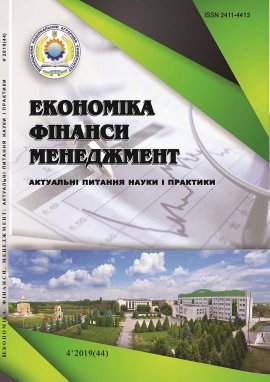
Issue №: 4 (44)
The magazine deals with the problems of the agricultural sector of the economy in the context of integration and processes of globalization. Attention is paid to the issues of development of digital economy, rural territories, technologies of enterprise management and organization of accounting, problems of legal support of economic processes, market tendencies of development of various branches of economy. Particular attention is paid to green tourism as a promising segment of the national economy.
MANAGEMENT ANALYSIS: THE ESSENCE AND SIGNIFICANCE IN DECISION-MAKING
TOMCHUK Olena – Candidate of Economic Sciences, Associate Professor, Associate Professor of the analysis and statistics Department 21008, Vinnytsia, 3, Soniachna str., e-mail: olenatomchuk@ ukr.net).
MULYK Tetiana - Candidate of Economic Sciences, Associate Professor, Head of the Analysis and Statistics Department, Vinnytsia National Agrarian University (21008, Vinnytsia, Sonyachna Str. 3, e-mail: mulyk_t_o@ukr.net).
FEDORYSHYNA Lydia – Candidate of History Sciences, Associate Professor, Associate Professor of analysis and statistics Department (21037, Vinnytsia, Sonyachna Str. 3, e-mail: fedorishina@i.uа).
The financial crisis experienced by the Ukrainian economy has a negative impact on the financial and economic activity of enterprises, the results of which are of interest both for external and internal users. Under these conditions, the role of management analysis, which is intended to transform economic and non-economic information into suitable for decision-making, is growing.
The analysis is closely related to all management functions and ensures their implementation, and therefore it is a general management function.
In the economic literature there are different interpretations of the definition of “management analysis” depending on the basic characteristics. Thus, one of the most common features is managerial, according to which three components of management analysis can be distinguished, i.e. perspective (predictive) analysis, operational analysis and current (retrospective) analysis, each of which is inherent in the solution of their own tasks.
A market economy requires differentiation of analysis into internal managerial and external financial. Consumers of analytical information for the management and financial analysis have different user groups, but their content can only have characteristics that correspond their interest and protect commercial secrets. The subjects of internal management analysis are the administration, as well as the auditors and consultants involved by it.
The subjects of financial analysis are the administration of the economic entity and external users.
In addition, it should be noted that management analysis includes in its system not only production, but also financial analysis, without which enterprise’s management cannot implement the financial strategy of the enterprise. We believe that it is advisable to introduce such a concept as a comprehensive management analysis. This type of managerial analysis is designed to justify managerial decisions that are made at the enterprise, which operates under conditions of globalization of the market processes.
The main features of managerial analysis are orientation towards internal users; comprehensive study of all aspects of the enterprise's activities; integration of accounting, analysis, planning and decision-making at the enterprise; lack of regulation from the outside; use of all available sources of information; orientation of analytical procedures for the assessment of business activities; justification of managerial decisions based on the identification of unused opportunities; confidential nature; perspective orientation of results of the analysis; industry orientation.
Management analysis is the analysis of business activity aimed at making optimal managerial decisions. Correctness and effectiveness of managerial analysis affects the main results such as the profit, which subsequently becomes the object of financial analysis, so that each of these types of analysis solves its own problem of a single strategy of analysis at the enterprise.
The place of analysis in the management process can be characterized by its objectives. There arises a need to combine quantitative and qualitative analysis of managerial processes, as well as to improve analytical support of the decision-making process.
The correctness of the decisions made depends on the full access of managers to analytical data that reveal the state of financial and economic activity of the enterprise and the lack of which negatively affects different levels of management. Accounting information for the management purposes at any level should be properly prepared and interpreted on the basis of certain methods of analysis.
In general, the technological process of making managerial decisions can be represented in the form of a sequence of stages and procedures that have direct and reciprocal links that form an information flow. At the same time, in the process of adoption and implementation of managerial decisions, it is a general practice to distinguish the following steps: setting of goals; support of the solution complexity; provision of information sources for the decision-making; verification of consequences of implementation of possible variants; evaluation of results.
The timeliness of managerial decisions is achieved through constant and systematic analytical processing of information, which enables to identify quickly negative or positive trends in the activities of enterprises, their possible consequences and factors that affect them.
The effectiveness of the decision made depends both on its optimality and the form of transfer to the executors (construction of decisions and personal qualities of executives and performers).
Fuller and most accurate definition of the management analysis is to be specified. Management analysis is the analysis that is confidential, oriented to internal users, prospect-oriented and conducted taking into account the industry specificity of the analyzed object.
The term “managerial analysis” refers to the interrelations of the management analysis with management accounting and economic analysis. On the one hand, it is based on the data of management accounting, and on the other hand, it uses methods and procedures of economic analysis (qualitative, quantitative, fundamental, marginal, economic and mathematical, express analysis).
- Andrieieva, H.I., & Andrieieva, V.A. (2009) Orhanizatsiia i metodyka ekonomichnoho analizu [Organization and methods of economic analysis]. Sumy: DVNZ «UABS NBU» [in Ukrainian].
- Seredynska, V.M., Zahorodna, O.M., & Fedorovych R.V. (2010) Ekonomichnyi analiz [Economic analysis]. Ternopil: Aston [in Ukrainian].
- Luchko, M.R., Zhukevych, S.M., & Farion, A.I. (2016) Finansovyi analiz [Financial analysis]. Ternopil: TNEU [in Ukrainian].
- Shkolnyk, I.O., Boiarko, I.M., & Deineka O.V. ta in. (2016) Finansovyi analiz [Financial analysis]. Kyiv: Tsentr uchbovoi literatury [in Ukrainian].
- Kaletnik, H.M., & Tsikhanovska, V.M. (2010) Finansovyi menedzhment [Financial management]. Kyiv: “Khai-Tek Pres” [in Ukrainian].
- Mnykh, Ye.V. (2005) Ekonomichnyi analiz [Economic analysis]. Kyiv: Tsentr navchalnoi literatury [in Ukrainian].
- Nykyforova, N. A., & Tafyntseva, V.N. (2018) Upravlencheskyi analyz [Administrative analysis]. Moskva: Yurait [in Russian].
- Vakhrushyna, M.A. (2010) Upravlencheskyi analyz [Administrative analysis]. Moskva: OmehaL [in Russian].
- Mulyk, T.O., & Hordiienko, M.I. (2017) Metodychni pidkhody do upravlinskoho analizu v umovakh intehratsiinykh protsesiv. [Methodical approaches to the management of the analysis in terms of integration processes]. EKONOMIKA. FINANSY. MENEDZhMENT: aktualni pytannia nauky i praktyky, 7, 7-19 [in Ukrainian].
- Haidaienko, O. M., & Shevchuk N.S. (2015) Upravlinskyi analiz [Management analysis]. Odesa: ONEU [in Ukrainian].
- Marushchak, L. (2014) Kontseptulni zasady pobudovy upravlinskoho obliku. [Konceptulnì principles of construction of managerial accounting]. Halytskyi ekonomichnyi visnyk, Tom 45, 2, 122-127 [in Ukrainian].
- Honcharuk, I.V., Plakhtii, T.F., & Starosud, V.I. (2017) Systema obliku ta opodatkuvannia na doslidno-selektsiinii stantsii IBK i TsB NAAN Ukrainy: stan ta napriamy udoskonalennia. [The system of accounting and taxation at the experimental station selection CLAIM and the CENTRAL BANK of Ukraine: the State and directions of perfection ] EKONOMIKA. FINANSY. MENEDZhMENT: aktualni pytannia nauky i praktyky, 11, 17-30. [in Ukrainian].
- Lahovska, O.L., Lehenchuk, S.F., Kuz V.I., & Kucher S.V. (2017). Bukhhalterskyi oblik v upravlinni pidpryiemstvom [Accounting in business management]. Zhytomyr: Zhytomyrskyi derzhavnyi tekhnolohichnyi universytet. [in Ukrainian].
- Tomchuk, O.F., & Tomchuk, V.V. (2015) Upravlinski rishennia ta yikh analitychne zabezpechennia [Management solutions and their analytical support]. Rozvytok bukhhalterskoho obliku: teoriia, profesiia, mizh predmetni zv’iazky: zb. materialiv IKh Mizhnar. nauk.-prakt. konf. (pp. 445-448). Kyiv: NNTs “IAE” [in Ukrainian].
- Shcheblykina, I.O., & Hrybova, D.V. (2015) Osnovy menedzhmentu [Fundamentals of management]. Melitopol: Vydavnychyi budynok Melitopolskoi miskoi drukarni [in Ukrainian].
About the journal
С1 Economics and International Economic Relations (by specialization)
D1 Accounting and Taxation
D2 Finance, Banking, Insurance and Stock Market
D3 Management
D4 Public Management and Administration
D5 Marketing
D7 Trade
J3 Tourism and Recreation
Founded in 1997 under the name ”Bulletin of Vinnytsia State Agricultural Institute”. In 2010-2014 it was published under the name “Collection of Scientific Papers of Vinnytsia National Agrarian University”. Since 2015 “Economics, finance, management: current issues of science and practical activity” (Certificate of State Registration of Mass Media No. 21154-10954 PR dated 12/31/2014).
