

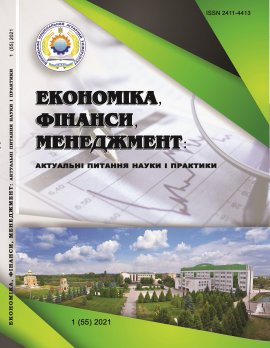
Issue №: 1 (55)
The journal deals with the issues of efficiency of functioning of the national economics and organizational forms of management of the national economy. Attention is paid to the problems of marketing, management and efficiency of production and economic activity of agrarian enterprises. The issues of public administration and administration, accounting and taxation, banking and insurance, forecasting and modeling of economic processes, foreign economic activity, commodity flows of economic entities and their infrastructure support.
MODEL OF BIOENERGY CLUSTER FOR RENEWABLE FUELS MANUFACTURING FROM CROPS AND WASTE
KALETNIK Grygorii – Doctor of Economic Sciences, Professor, Academician of NAAS of Ukraine, Head of the Department of Administrative Management and Alternative Energy Sources, Vinnytsia National Agrarian University (21008, Vinnytsia, 3 Soniachna str., e-mail: rector@vsau.org).
PRYSHLIAK Natalia – Candidate of Economic Sciences, Associate professor of the Administrative Management and Alternative Energy Sources Department, Vinnytsia National Agrarian University (21008, Vinnytsia, 3 Sonyachna str., e-mail: pryshliaknatalia@vsau.vin.ua).
The implementation of the cluster approach is quite relevant in connection with the need to ensure economic and energy security of the state in general and the fuel and energy complex of the country in particular. A promising area for strengthening the energy security of the state is the development of bioenergy. One of the main problems of bioenergy is the uneven distribution and redistribution of raw materials and products of bioenergy. Both problems are most clearly manifested in territorial aspects. But at the same time, they lead to another serious problem - the inconsistency of production and sale of bioenergy products, and hence the impossibility of implementation and development of bioenergy.
The article reveals the taxonomy of cluster formations in the economy. The question of the possibility of forming bioenergy clusters of biofuel production from bioenergy crops and wastes is described. It is established that the founder of the cluster approach was A. Marshall. Approaches to the interpretation of the concept of «cluster» of leading world and domestic scientists, as well as international organizations have been studied. The general structure of the cluster is described and the groups of interacting subjects of the bioenergy cluster are determined. The model of the territorial bioenergy cluster of biofuel production from agricultural crops and wastes is formed, its features and reconfiguration are determined. The advantages of creating bioenergy clusters are identified. All links of the cluster should increase the profitability and competitiveness of the industry’s products, ensure the sale of bioenergy products and find the most optimal and most profitable options for the production and sale of products. A PEST matrix of analysis of bioenergy clusters formation is constructed. The main bases of state support of bioenergy clusters are determined. The All-Ukrainian Research and Training Consortium Educational Research and Production Complex is described as an example of a cluster that ensures the development of bioenergy. Prospects for the formation of bioenergy clusters for the production of biofuels from crops and waste in Ukraine are identified.
1. Kaletnik, G., & Pryshliak, N. (2019). Bioenergy potential development of the agrarian sector as a component of sustainable development of Ukraine. Management mechanisms and development strategies of economic entities in conditions of institutional transformations of the global environment: col. monog. ISMA University. Riga: Landmark SIA, 2019, 96-104 [in English].
2. Kaletnik, G., Pryshliak, V., & Pryshliak, N. (2019). Public Policy and Biofuels: Energy, Environment and Food Trilemma. Journal of Environmental Management and Tourism, X, 3(35), 479-487. https://doi.org/10.14505/jemt.v10.3(35).01 [in English].
3. Kulyk, M., Kalynychenko, O., Pryshliak, N., & Pryshliak, V. (2020). Efficiency of using biomass from energy crops for sustainable bioenergy development. Journal of Environmental Management & Tourism, 11, 5, 1040-1053. https://doi.org/10.14505/jemt.v11.5(45).02 [in English].
4. Marshall, A. (1993). Principles of economic science. Moscow: Progress [in English].
5. Porter, M. (1998). Clusters and the new economics of competition. Harvard Business Review, 76, 6, 77-90 [in English].
6. Pryshliak, N., & Tokarchuk, D. (2020). Socio-economic and environmental benefits of biofuel production development from agricultural waste in Ukraine. Environmental & Socio-economic Studies, 8, 1, 18-27. Retrieved from: https://doi.org/10.2478/environ-2020-0003 [in English].
7. UNIDO (2001) “Development of Clusters and Networks of SMEs: The UNIDO Programme”. unido.org. Retrieved from: http://www.unido.org/ doc/351428.htmls [in English].
8. Zulauf, C., Prutska, O., Kirieieva, E., & Pryshliak, N. (2018). Assessment of the potential for a biofuels industry in Ukraine. Problems and Perspectives in Management, 16, 4, 83-90. Retrieved from: http://dx.doi.org/10.21511/ppm.16(4).2018.08 [in English].
9. Burkovsky, A.P. (2012). Klasterna forma orhanizatsiyi ta mekhanizm yiyi diyi v suchasnykh umovakh hospodaryuvannya [Cluster form of organization and mechanism of its action in modern economic conditions]. Visnyk Kamyanets-Podilskoho natsionalnoho universytetu imeni Ivana Ohiyenka. Ekonomichni nauky – Bulletin of Kamyanets-Podilsky National University named after Ivan Ogienko. Economic sciences, 6, 67-73 [in Ukrainian].
10. Voynarenko, M., & Bereza, A. (2013). Klasterni obyednannya: mizhnarodnyy dosvid ta ukrayinski realiyi [Cluster associations: international experience and Ukrainian realities]. Ekonomist – Economist, 10, 27-30 [in Ukrainian].
11. Honcharuk, I.V. (2020). Klasteryzatsiya vyrobnytstva biopalyv u formuvanni enerhetychnoyi nezalezhnosti ahropromyslovoho kompleksu [Clustering of biofuels production in the formation of energy independence of the agro-industrial complex]. Investytsiyi: praktyka ta dosvid – Investments: practice and experience, 19-20, 64-73 [in Ukrainian].
12. Kaletnik, H.M., Honcharuk, I.V., Yemchyk, T.V., & Lutkovska, S.M. (2020). Ahrarna polityka ta zemelni vidnosyny [Agrarian policy and land relations]. Vinnytsia: VNAU [in Ukrainian].
13. Komar, N. (2014). Kontseptsiya formuvannya ta derzhavnoyi pidtrymky klasternykh struktur v Yevropi [The concept of formation and state support of cluster structures in Europe]. Visnyk Ternopilskoho natsionalnoho tekhnichnoho ekonomichnoho universytetu – Bulletin of Ternopil National Technical Economic University, 2. 53-64 [in Ukrainian].
14. Melnychenko, V.V. (2018). Klasterne modelyuvannya rozvytku bioenerhetychnoho potentsialu silskohospodarskykh pidpryyemstv [Cluster modeling of development of bioenergy potential of agricultural enterprises]. Ekonomika ta derzhava – Economy and state, 2, 124-128 [in Ukrainian].
15. Talavyrya, M.P., Koval, O.M., & Dobrivska, M.V. (2017). Rozvytok bioenerhetychnoho potentsialu v Ukrayini [Development of bioenergy potential in Ukraine]. Visnyk KHNAU. Seriya: Ekonomichni nauky – Bulletin of KhNAU. Series: Economic Sciences, 3, 229-238 [in Ukrainian].
16. Ofitsiynyy sayt Vinnytskoho natsionalnoho ahrarnoho universytetu – Official website of Vinnytsia National Agrarian University (2021). Retrieved from: https://vsau.org/pro-universitet/nnvk-vseukraiinskij-naukovo-navchalnij-konsorczium [in Ukrainian].
About the journal
С1 Economics and International Economic Relations (by specialization)
D1 Accounting and Taxation
D2 Finance, Banking, Insurance and Stock Market
D3 Management
D4 Public Management and Administration
D5 Marketing
D7 Trade
J3 Tourism and Recreation
Founded in 1997 under the name ”Bulletin of Vinnytsia State Agricultural Institute”. In 2010-2014 it was published under the name “Collection of Scientific Papers of Vinnytsia National Agrarian University”. Since 2015 “Economics, finance, management: current issues of science and practical activity” (Certificate of State Registration of Mass Media No. 21154-10954 PR dated 12/31/2014).
