

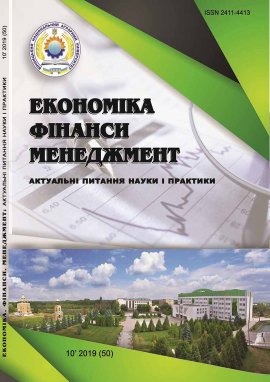
Issue №: 10 (50)
The magazine deals with the problems of the agricultural sector of the economy in the context of integration and processes of globalization. Attention is paid to the issues of development of digital economy, rural territories, technologies of enterprise management and organization of accounting, problems of legal support of economic processes, market tendencies of development of various branches of economy. Particular attention is paid to green tourism as a promising segment of the national economy.
NON-FORMAL EDUCATION AFLATEEN: ROLE OF INTERDISCIPLINARITY AND ACQUISITION OF PRACTICAL SKILLS RELATED TO ECONOMICS
YATSENKO Oksana Vasilivna – PhD (History), Head of the Education Department, Vinnytsia
City Council (21100, Vinnytsia, 59 Soborna St., e-mail: vmuo@vmr.gov.ua).
CHORNYI Oleh Vitaliyovich – PhD (Philosophy), Doctorate of the Marketing and Agrarian
Business Department, Vinnytsia National Agrarian University (21018, Vinnytsia, 3 Pirogov St., e-mail:
phd.chornyi@gmail.com).
The article deals with the problems related to the development of non-formal education and its connection with the acquisition of economic knowledge and skills. Some aspects related to the development of non-formal education in Europe and Ukraine are analyzed. Considerable attention is paid to the game method of the Aflateen program. Lessons and tasks in the form of didactic games contributes to better comprehension of a large number of diverse knowledge, that is acquired during lessons. It is explored that Aflateen's non-formal education program has strong interdisciplinary character that borders with transdisciplinary. The Aflateen program's holistic approach relates to the acquisition and improvement of the skills needed in modern society. Within the program, particular attention is paid to economic problems, that affect lives of young people. Economic knowledge is an integral part of the Aflateen program and it helps to understand complex contemporary economic and social problems.
Modern dynamic life creates new conditions of existence for the whole society and individual person. The problem of teenagers' education has special place among the problems related to the development of the society. Acquisition of useful knowledge and practical skills, by Ukrainian young people, is a prerequisite for success in adult life. That is why the acquisition of financial and social education should be seen as important problem in modern conditions.
In many European countries, non-formal education has become a necessary and indispensable part, that complements formal education (school and university). At the moment, Ukraine needs to develop a network of non-formal education and recognize it at all levels. Scientists and governors must take into account different levels related to the development of non-formal education. Non-formal education connected with acquisition of financial and social skills needs special attention. With this purpose, we chose the Aflateen non-formal education program, headquartered in the Netherlands, as a subject of our exploration.
Particular attention should be paid to the involvement of various stakeholders and their ability to improve and promote non-formal education. For example, within the Aflateen program, interaction with local communities, entrepreneurs, and social groups is encouraged. Thus, Aflateen non-formal education, helps to facilitate young people orientation in the complex socio-economic environment. Within the program, students learn to interact with their families, friends, classmates, organizations, entrepreneurs, etc. This is one of the main futures of non-formal education.
Consequently, the need for non-formal education is indisputable. Interdisciplinary content is an important thing, but we need to take into consideration teaching method as well. To do this, we take the example of the Aflateen program. Within this program, most of the lessons are divided into several exercises that are conducted in the form of a game. It should be noted that the game form is considered as one of the most effective forms of education for children and young people. If we consider some features that relate to the use of the game as an educational method, we find out that it helps students to be aware, independent and proactive.
If we look at the structure of the Aflateen curriculum, we can see that it is quite diverse. The very large number of scientific knowledge areas is used to create the program. In general, Aflateen uses knowledge from several dozens of different academic disciplines.
The knowledge from various social disciplines, that received by students during primary lessons, serves as the basis for understanding of economic reality. Within the program, understanding of religious, cultural, social and legal peculiarities of the country's life is directly linked to the possibility of student’s personal finances and private business organization.
Problems of non-formal education are very important for the Ukrainian educational system. Non-formal education provides many benefits, both for the education of children and adolescents. Non-formal education is practical and teaches adolescents to be independent and proactive. Informal education Aflateen allows, in the form of a game, to acquire knowledge about many spheres of social life. The combination of terms and concepts from numerous academic disciplines helps to form the practical skills necessary for a real life. One of the most effective manifestations of such combination is the ussage of economic and sociological knowledge for the development of financial competence. The issues discussed in this article are quite promising. Problems of non-formal education improvement must be discussed on various levels with the support of all the main stakeholders.
1. Aflateen. Aflatoun International. Retrieved from https://www.aflatoun.org/curricula/aflateen/
2. Derkach, Yu. (2008). Neformalna osvita yak umova neperervnoho navchannia molodi [Non- formal
education as a condition for the continuous education of young people]. Visnyk Lvivskoho universytetu. Ceriia
pedahohichna – Herald of Lviv University. Series: pedagogical., 23, 17-22 [in Ukrainian].
3. Zaiarna, V. S. (2015). Problema neformalnoi osvity diteyy i molodi v YeEs u konteksti
doslidnytskykh tendentsiyy ukrainskoi pedahohichnoi nauky [The problem of non-formal education of
children and young people in the EU in the context of research trends of Ukrainian pedagogical science].
Science and Education a New Dimension. Pedagogy and Psychology, 34(69), 39-41 [in Ukrainian].
4. Kovalenko, M. O. (2015). Teoretyko-metodychni aspekty derzhavnoho rehuliuvannia rozvytku
neformalnoi osvity v Ukraini [Theoretical and methodical aspects of state regulation of the development of non-formal education in Ukraine]. Naukovyy visnyk Khersonskoho derzhavnoho universytetu. Seriia: Ekonomichni
nauky – Scientific Herald of Kherson State University. Series: Economic Sciences, 10, 186- 189 [in Ukrainian].
5. Horlenko, V. M. (2017). Neformalna osvita yak chynnyk rozvytku informatsiyno-komunikatsiynoi kompetentnosti vykhovateliv doshkilnoho navchalnoho zakladu [Non-formal education
as a factor in the development of information and communication competence of preschool educational
institutions]. Naukovyy visnyk uzhhorodskoho universytetu. Seriia: «Pedahohika. Sotsialna robota» –
Scientific Herald of Uzhgorod University. Series: "Pedagogy. Social work", 1(40), 67-73 [in Ukrainian].
6. Tkach, T. V. (2008). Rozvytok osobystosti zasobamy neformalnoi osvity [The development of
personality by means of non-formal education]. Aktualni problemy psykholohii – Actual Problems of
Psychology, 7(15), 287-291 [in Ukrainian].
7. Andrushchenko, V. P. (2013). Filosofiia neformalnoi osvity: problemy ta perspektyvy rozvytku
[Philosophy of non-formal education: problems and prospects of development]. Vyshcha osvita Ukrainy –
Higher Education of Ukraine, 4, 5-9 [in Ukrainian].
8. Surovytska, M. (2014). Vplyv hry na rozvytok osobystosti molodshykh shkoliariv [The influence
of the game on the development of the personality of junior schoolchildren], Molod i rynok – Youth and
Market, 2(109), 170-173 [in Ukrainian].
9. Tolmachova, I. M., & Oliynyk, K. O. (2016). Zmistova kharakterystyka dydaktychnoi hry yak
metodu navchannia [The content description of the didactic game as a learning method]. Molodyy vchenyy
– Young Scientist, 2(29), 334-347 [in Ukrainian].
10. Holovko, N. (2015). Ihrovi tekhnolohii yak zasib aktyvizatsii piznavalnoi diialnosti studentiv
[Gaming technologies as a means of activating cognitive activity of students]. Visnyk Kyivskoho
natsionalnoho universytetu imeni Tarasa Shevchenka. Seriia: Pedahohika – Bulletin of the Taras
Shevchenko National University of Kyiv. Series: Pedagogy, 1(1), 17-20 [in Ukrainian].
11. Borodina, O. S. (2015). Pryntsyp komplementarnosti v mizhdystsyplinarnykh doslidzhenniakh
ekonomiky [Principle of complementarity in interdisciplinary studies of economy]. Ekonomika i
prohnozuvannia – Economy and Forecasting, 2, 47-58 [in Ukrainian].
12. Darbellay, F. (2012). The circulation of knowledge as an interdisciplinary process: traveling
concepts, analogies and metaphors. Issues in integrative studies, 30, 1-18.
13. Neves, V. (2017). Economics and interdisciplinarity: an open-systems approach. Brazilian
journal of political economy, 37(147), 343-362.
About the journal
С1 Economics and International Economic Relations (by specialization)
D1 Accounting and Taxation
D2 Finance, Banking, Insurance and Stock Market
D3 Management
D4 Public Management and Administration
D5 Marketing
D7 Trade
J3 Tourism and Recreation
Founded in 1997 under the name ”Bulletin of Vinnytsia State Agricultural Institute”. In 2010-2014 it was published under the name “Collection of Scientific Papers of Vinnytsia National Agrarian University”. Since 2015 “Economics, finance, management: current issues of science and practical activity” (Certificate of State Registration of Mass Media No. 21154-10954 PR dated 12/31/2014).
