

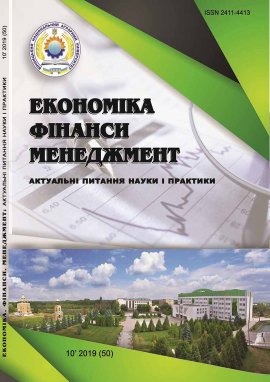
Issue №: 10 (50)
The magazine deals with the problems of the agricultural sector of the economy in the context of integration and processes of globalization. Attention is paid to the issues of development of digital economy, rural territories, technologies of enterprise management and organization of accounting, problems of legal support of economic processes, market tendencies of development of various branches of economy. Particular attention is paid to green tourism as a promising segment of the national economy.
PECULIARITIES OF CONDUCTING THE LAND REFORM ON THE ZAKARPATHY IN 1918-1938.
PIKOVSKA Tetiana Valentinivna - Candidate of Historical Sciences, Senior Lecturer of the
Department of Law, Vinnytsia National Agrarian University (21008, Vinnytsia, 3, Solyaschyna St., e-mail:
Tetiana261285@i.ua)
The economic and social situation of the Transcarpathian peasantry before the land reform was analyzed. It is determined that Transcarpathia, due to geopolitical changes on the map of Europe after the First World War, became part of the First Czechoslovak Republic. Inherited from the Austro-Hungarian monarchy of Transcarpathia, a heavy economic burden lay on the shoulders of the young republic. The lack of education, poverty, colorful national composition of the local population, lack of infrastructure, schools and hospitals are the main characteristics of the region, which in 1918 became part of Czechoslovakia under the name of Subcarpathian Rus. Features of Czechoslovak legislative support of land reform were identified: specially authorized services were created, which had to describe the land subject to confiscation and divide the land between landless and landless peasants. The features of the reform in Subcarpathian Rus are characterized: creation of a wide network of cooperative societies, colonization (relocation of representatives of the dominant nation to the territory of national minorities), misunderstanding of the local population about the essence of land reform. The actual implementation of land reform began in early 1921. The total area of land subject to confiscation was about 239 thousand hectares. These lands were owned by large landowners who owned 36,000 hectares under the land reform law. Thus, the area of about 203 thousand hectares should actually be distributed. Territorially, these lands covered 230 counties of Subcarpathian Rus, that is, they were located in almost half of the villages of the region. As of June 1, 1930, 20 691 hectares of arable land were distributed, 15 733 persons acquired small plots of land with an area of 13 635 hectares, 15 persons - estates with an area of 1680 hectares, 63 persons - plots up to 68 hectares. It is proved that land reform in Transcarpathia in 1918-1938 was half-finished and unfinished.
Evidence of incomplete land reform is statistics showing that only 10% of the land to be distributed has received new owners among landless and landless peasants.
1. Iyrkovskii,I.(1936)Zemelnaia reforma na Podkarpatskoi Rusy [Land reform in Subcarpathian
Russia]. Uzhhorod. [in Ukrainian] 115, 47-50
2. Vehesh, M. (2010) Zakarpattia 1919–2009 rokiv: istoriia, polityka, kultura [Transcarpathia
1919–2009: history, politics, culture] .Uzhhorod. [in Ukrainian]
3. Barnovský M. (1997) Niekolko poznámok k sranicko-polickej štrukturre na Podkarpatskej Rusi
[Some questions about party-political structure in Subcarpathian Russia] / Cesko-Slovenská Historicka
Ročenka, 1, 83-93. Praha [in Czech Republic]
4. Pop, Y.Y.(2001) Entsyklopedyia Podkarpatskoi Rusy [ Encyclopedia of Subcarpathian Rus] .
Uzhhorod. [in Ukrainian]
5. Olashyn, A.V.(2009) Istoriia Zakarpattia. Posibnyk z kraieznavstva [History of Transcarpathia
[Handbook of local history].Mukachevo: Karpatska Vezha. [in Ukrainian]
6. Bachinsky, E.S. (Ed.).(1995) Narysy istorii Zakarpattia v 3-kh tomakh – T II (1918-1945)
[Sketches of Transcarpathian History in 3 volumes (Vols.2).Uzhhorod [in Ukrainian]
7. Kravchuk, O.M.(2008) Natsionalna polityka Chekhoslovatskoi respubliky. 1918-1929 rr.
[National policy of the Czechoslovak Republic. 1918-1929] / .Vinnytsia [in Ukrainian]
8. Kornovenko, S.V.(2018) Revoliutsiini potriasinnia pochatku KhKh st.: ahrarne zakonodavstvo
krain Tsentralnoi ta Pivdenno-Skhidnoi Yevropy [Revolutionary upheavals of the early twentieth century:
agrarian legislation of the countries of Central and Southeastern Europe]. Ukrainskyi selianyn. Ukrainian
peasant 19, 45–49 [in Ukrainian]
9. Bohatchuk, S.S.(2018) Ahrarna reforma 1861 r. ta yii naslidky dlia ekonomichnoho rozvytku
Ukrainy [The agrarian reform of 1861 and its consequences for the economic development of Ukraine].
Ekonomika. Finansy. Menedzhment: aktualni pytannia nauky i praktyky. Economics.Finance.Management:
topical issues of science and practice. 4, 129–138. [in Ukrainian]
About the journal
С1 Economics and International Economic Relations (by specialization)
D1 Accounting and Taxation
D2 Finance, Banking, Insurance and Stock Market
D3 Management
D4 Public Management and Administration
D5 Marketing
D7 Trade
J3 Tourism and Recreation
Founded in 1997 under the name ”Bulletin of Vinnytsia State Agricultural Institute”. In 2010-2014 it was published under the name “Collection of Scientific Papers of Vinnytsia National Agrarian University”. Since 2015 “Economics, finance, management: current issues of science and practical activity” (Certificate of State Registration of Mass Media No. 21154-10954 PR dated 12/31/2014).
