

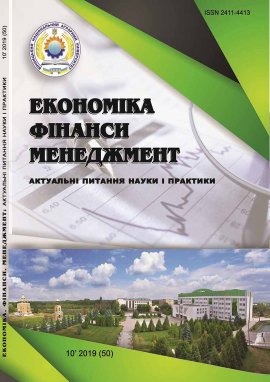
Issue №: 10 (50)
The magazine deals with the problems of the agricultural sector of the economy in the context of integration and processes of globalization. Attention is paid to the issues of development of digital economy, rural territories, technologies of enterprise management and organization of accounting, problems of legal support of economic processes, market tendencies of development of various branches of economy. Particular attention is paid to green tourism as a promising segment of the national economy.
PERSONNEL POTENTIAL AS A TOOL FOR THE DEVELOPMENT OF ENTREPRENEURIAL ACTIVITY IN THE AGRARIAN SECTOR
OKHOTA Yuliia – postgraduate student of the Department of Administrative Management and
Alternative Energy Sources, Vinnytsia National Agrarian University (21008, 3 Sonyachna str, Vinnytsia,
е-mail: yuliaokhota2017@gmail.com)
The article details the essence of the concept of "human potential of an agricultural enterprise", outlines a system of key factors for the development of human resources. The analysis of the dynamics of changes in the number of employed people in agriculture and the needs of employers in the agrarian sector workers during the last 5 years has been analyzed on the basis of official data of the State Statistics Service of Ukraine. A number of acute problems that directly influence the development of human resources and entrepreneurial activity of the agro-industrial complex (AIC) of the country as a whole are investigated. On the basis of the research, conclusions were drawn about the necessity of direct participation of the state in solving problems of strengthening and developing the personnel potential of the agro-industrial complex.
The purpose of the article is to study the theoretical and practical aspects of human resources as an instrument for ensuring the development of entrepreneurial activity in the agrarian sector, its current state and problems that arise during the formation of human resources, as well as analysis of the dynamics of changes in the number of agricultural workers who directly form the personnel potential agrarian sphere.
Personnel potential of an agricultural enterprise is a set of individual, psychological, professional, qualification and other characteristics of the personnel of the enterprise, their complex of knowledge, skills, abilities, abilities, experience and reserve of opportunities that are involved in the labor activity, taking into account the specifics of the industry for the realization of the set goals and objectives production or achievement of a social effect.
Today, the important problem is the low level of provision of agricultural enterprises by highly skilled personnel. Over the past decades, significant changes have occurred in the formation and use of rural labor resources. After the collapse of the former collective farms, hundreds of thousands of highly skilled specialists lost their jobs. The lack of jobs and cultural and living conditions of the rural population, the decline of social infrastructure in the countryside are causing the decline of rural areas, the outflow of rural youth in the city. In rural areas there is an active process of reducing the rural population and worsening its quantitative and qualitative characteristics. A large part of the population consists of people of retirement age, with a lower level of education than in the industrial sector, without proper motivation to work. There is a massive transfer of labor resources to private peasant farms with a predominance of hard manual labor and a low level of its
productivity [1].
In the conditions of the formation of modern agrarian production, for the more detailed study of the question of the assessment and use of human resources, factors influencing its formation and development at different levels of management were analyzed.
Such a system of key factors for the development of the personnel potential of the agrarian sector is grouped according to the object of their development:
- the following factors of influence can be noted on the personnel potential of the worker, depending on the form of implementation and level of development: level of education and qualifications, skills and experience, abilities and skills, level of knowledge and ability to study and develop;
- the personnel potential of the company, as a rule, develops under the influence of internal and external factors. Internal factors are related to the improvement of its qualitative characteristics and the use of personnel in the process of labor activity. External factors have a greater impact on the quantitative characteristics of the personnel potential of the enterprise;
- the personnel potential of the industry depends on factors that can be divided into two groups: general factors of development and specific sectoral development factors having different organizational and technological tools for functioning (for example, the specifics of plant production and livestock production) [2].
In the process of studying the state of modern human resources, an analysis was made of the dynamics of changes in the number of employed in agriculture during 2013-2017, which confirmed that there is a steady decrease in the number of personnel in the agrarian sphere. Comparing the indicators in 2017 with 2013, the number of employees decreased by 716.8 thousand people. And if you take into account the number of people employed in agriculture in 1991, which was about 5 million people, then the reduction was enormous [3].
A number of problems were provoked that provoke "human hunger" in agriculture and increase the need for relevant staff every year, in particular:
1. The level of qualification of graduates of higher education institutions in the agrarian sector does not quite correspond to market needs, insufficient level of practical training of a graduate specialist.
2. Low wages. The level of remuneration in the village of. the enterprise depends on the final result of its work, that is, on the gross profit. The relationship between the degree of labor and its payment is through forms and systems of remuneration, which depend on the peculiarities of the village. production.
3. The opening of a visa-free regime between Ukraine and the EU has a significant impact on the labor market in the agrarian sector, including.
4. The mechanization and automation of production processes in agriculture reduces the need for enterprises in low-skilled workers, while increasing the need for specialists with secondary and high qualification.
5. The social infrastructure in the village is underdeveloped, which causes considerable losses of skilled workers and workers.
1. Hnybidenko, O.M. Problemy zabezpechennia kadramy [Problems of providing agricultural enterprises
with personnel], 239-246. URL: http://ir.kneu.edu.ua/bitstream/2010/12256/1/239-246.pdf [in Ukrainian].
2. Khaianok, T.M. (2015). Formuvannia kadrovoho potentsialu silskohospodarskoho pidpryiemstva
[Formation of personnel potential of an agricultural enterprise]. Ahrosvit – Agrarian world, 9, 65 - 68 [in Ukrainian].
3. Slovnyk ukrainskoi movy. Akademichnyi tlumachnyi slovnyk [Dictionary of the Ukrainian
language. Academic Explanatory Dictionary]. URL: http://sum.in.ua/ [in Ukrainian].
4. Potreba pidpryiemstv u pratsivnykakh za vydamy ekonomichnoi diialnosti [The need for
enterprises in workers by types of economic activity]. Ofitsiinyi sait Derzhavnoi Sluzhby Statystyky
Ukrainy – Official site of the State Service of Statistics of Ukraine. URL: https://ukrstat.org/uk/operativ
/operativ2007/rp/sz_br/sz_br_u/arh_pp_g_u.htm [in Ukrainian].
5. Silske hospodarstvo Ukrainy 2017 [Agriculture of Ukraine 2017]. Statystychnyi shchorichnyk
Derzhavnoi Sluzhby Statystyky Ukrainy. Kyiv – Statistical Yearbook of the State Service of Statistics of Ukraine.
Kiev, 245. URL: http://www.ukrstat.gov.ua/druk/publicat/kat_u/2018/zb/09/zb_sg2017_pdf.pdf [in Ukrainian].
6. Kaletnik, H.M., Bulhakov, V.M. (2013). Suchasnyi stan ta perspektyvy kadrovoho i naukovoho
zabezpechennia haluzi mekhanizatsii silskoho hospodarstva [Current state and perspectives of personnel
and scientific support of the agricultural mechanization industry]. Mekhanizatsiia ta elektryfikatsiia
silskoho hospodarstva – Mechanization and electrification of agriculture, 97, 24-35 [in Ukrainian].
7. Serednomisiachna zarobitna plata u silskomu hospodarstvi [Average monthly wages in agriculture].
UKRINFORM. Ekonomika – UKRINFORM. Economy. URL: https://www.ukrinform.ua/ rubric- economy/
2630964-zarplata- u- silskomu- gospodarstvi- torik - zrosla- na- 244 minagro.html [in Ukrainian].
8. Lakhai, P. (2018). Zarobitna plata u silskomu hospodarstvi hospodarstvi [Wages in agriculture].
Agroportal – Agroportal. URL: http://agroportal.ua/ua/views/blogs/zarabotnaya-plata-v-selskom-khozyaistve-dvoinoi-rost-za-2-goda/# [in Ukrainian].
9. Kharchyshyna, O.V. Formuvannia kadrovoho potentsialu silskohospodarskykh pidpryiemstv v
umovakh tranzytyvnoi ekonomiky [Formation of personnel potential of agricultural enterprises in the
conditions of a transitory economy]. URL: https://core.ac.uk/download/pdf/12087059.pdf [in Ukrainian].
10. Dyskina, A.A. (2018). Kadrovyi potentsial – vazhlyvyi chynnyk ekonomichnoho rozvytku
pidpryiemstva [Personnel potential – an important factor in the economic development of the enterprise].
Natsionalna ekonomika. Intelekt XXII – National economy. Intellect XXII, 2, 67-70 [in Ukrainian].
About the journal
С1 Economics and International Economic Relations (by specialization)
D1 Accounting and Taxation
D2 Finance, Banking, Insurance and Stock Market
D3 Management
D4 Public Management and Administration
D5 Marketing
D7 Trade
J3 Tourism and Recreation
Founded in 1997 under the name ”Bulletin of Vinnytsia State Agricultural Institute”. In 2010-2014 it was published under the name “Collection of Scientific Papers of Vinnytsia National Agrarian University”. Since 2015 “Economics, finance, management: current issues of science and practical activity” (Certificate of State Registration of Mass Media No. 21154-10954 PR dated 12/31/2014).
