

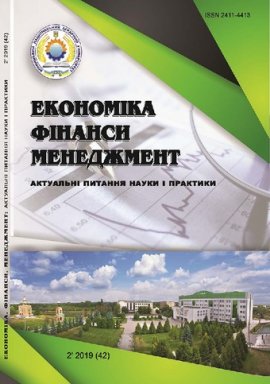
Issue №: 2(42)
The magazine deals with the problems of the agricultural sector of the economy in the context of integration and processes of globalization. Attention is paid to the issues of development of digital economy, rural territories, technologies of enterprise management and organization of accounting, problems of legal support of economic processes, market tendencies of development of various branches of economy. Particular attention is paid to green tourism as a promising segment of the national economy.
PROGNOSTIC VALIDITY OF THE COMPETITION SELECTION OF GRADUATES OF ECONOMIC COLLEGES
SHEVCHUK Oleksandr – Candidate of Physical and Mathematical Sciences, Associate Professor of the Department of Mathematics, Physics and Computer Technologies, Vinnytsia National Agrarian University (21008, Vinnytsia, 3 Soniachna Str., e-mail: shevchuk177@gmail.com).
One of the topical challenges facing higher educational establishments (HEE) is to build the most optimal model for competitive selection of entrants. Based on the results of the external independent assessment (EIA) and the average score of the entry certificate, the institution of higher education, by varying weights, tries to build such a rating list, which places in the first place exactly those applicants who are able to study better in the relevant specialty. Evaluation of the applied model of competitive selection is investigated by the indicator of the predictive validity of the competitive score. Predictive validity is the correlation coefficient between the indicator by which competitive selection is made and the student's performance during the first year of study. Therefore, by assessing the value of predictive validity, it is possible to examine the statistical relationships of EIA results in different subjects or their respective weights with student performance and to build optimal competitive selection models based on them. In this case, the effectiveness of the HEE entry system based on EIA is recognized as high, if the correlation coefficient (R) is greater than 0.5; sufficient, if the correlation coefficient is in the range [0,3, 0,5] and low, if the correlation coefficient is less than 0,3.
Since 2018, analytical procedures for EIA have begun to be introduced gradually for college graduates, but only as a state final certification. Subsequently, the results of the EIA will be taken into account in the admission of junior specialists to the bachelor's degree. But now, enrollment in the HEE is based on the grade point average of the school certificate and the results of the university entrance examination. Therefore, the study of the prognostic validity index of competitive selection of college graduates is relevant both in terms of evaluating the existing model of admission to the HEE, and for the search of directions for its improvement.
In order to evaluate the predictive value of competitive selection and its components, the results of the calculation of correlation indicators between the students' grades and the students' success in the subjects studied in the HEE during the first semester of the third year are presented. The data obtained indicate a sufficiently high prognostic validity (R>0,5) of the competition score. At the same time, a significant level of correlation was observed both with the average rates of students' education in the first semester and with success in almost every discipline (only for the discipline "Information Systems and Technologies of Accounting and Audit" the correlation coefficient is slightly less than 0.5). It should also be noted that the competition score is better correlated with the results of the current academic performance of students in the 1st semester (before the test session), than with the results of the overall success after the 1st session. As it turns out, this tendency to decrease correlation is due to the fact that several students did not participate in the exam and therefore their average learning outcomes are very different from the main group of observations.
Also indicative for predicting student learning outcomes in the HEE are the data from the average score of the school certificate. This indicator, as shown by the correlation coefficient calculations, has high predictive validity to the average results of the first semester (R = 0.73 and R = 0.67) and to each individual discipline (R>0.5). Therefore, when introducing external independent assessment for college graduates, it is also advisable to enter the average score of the education document into the formula for calculating the competition score.
On the other hand, a proficiency test of university applicants is a weak predictor of student performance during the first semester (R<0.5 for all HEE subjects without exception). The slight correlation between these criteria is related to the introduced professional test evaluation methodology and therefore requires further improvement.
By analyzing the standardized values of deviations between the competition grade and the average success rate of a student in the first semester, the presence of abnormal levels of evaluation within the sample was investigated. It is shown that the Spirman rank correlation coefficient is less dependent on the presence of such anomalies and is more rational when estimating the prognostic validity of small samples.
- Kovtunets, V.V. &. Rakov, S.A. (Eds.). (2015). Doslidzhennia yakosti konkursnoho vidboru studentiv vyshchykh navchalnykh zakladiv za rezultatamy zovnishnoho nezalezhnoho otsiniuvannia: analitychni materialy [Investigation of the quality of competitive selection of students of higher educational institutions for the results of external independent evaluation: analytical materials]. K.: Nora-Druk, Retrieved from: https://ihed.org.ua/images/biblioteka/yakist_vidboru_studentiv_za_ ZNO_Kovtunec-Rakova_2015_160p.pdf [in Ukrainian].
- Kleper, D., Turvall, E. and Oren, C. (2014). Predictive validity of the PET in predicting higher first year GPA. Jerusalem: National Institute for Testing & Evaluation (in Hebrew), RR 403.
- Carmel Oren, Tamar Kennet-Cohen, Elliot Turvall and Avi Allalouf. (2014). Demonstrating the validity of three general scores of PET in predicting higher education achievement in Israel. Psicothema, 26 (1), 117-126. doi: 10.7334/psicothema2013.257.
- Beard Jonathan & Marini Jessica. (2018). Validity of the SAT for Predicting First-Year Grades: 2013 SAT Validity Sample. College Board Research Report. Retrieved from: https://files.eric.ed.gov/fulltext/ED582459.pdf.
- Donnon, T. Oddone-Paolucci, E.O. and Violato, C. (2007). The predictive validity of the MCAT for medical school performance and medical board licensing examinations: A meta-analysis of the published research. Acad Med, 82:100-106. DOI: 10.1097/01.ACM.0000249878.25186.b7
- Kotvitska, A.A., Zhyvora, N.V., Pohorielov, S.V., Krasovskyi, I.V. and Vislous, O.O. (2017). Vyvchennia vplyvu vahovykh koefitsiientiv na prohnostychnu validnist konkursnoho bala vstupnykiv haluzi znan «Okhorona zdorovia» [Study of the influence of employed coefficients on prognostic validity of the competitive grade of the applicants for the speciality “Health development”]. Farmatsevtychnyi chasopys – Pharmaceutical review, 4, 129-135. doi: 10.11603/2312-0967.2017.4.8341 [in Ukrainian].
- Motsnyi, F.V., & Sinytskyi M.Ye. (2017). Statystychne porivniannia rezultativ ZNO z otsinkamy studentiv-pershokursnykiv [Statistical comparison of EIA results with first-year students]. Porivnialni statystychni doslidzhennia rozvytku sotsialno-ekonomichnykh system: Materialy XV mizhnarodnoi naukovo-praktychnoi konferentsii z nahody dnia pratsivnykiv statystyky – Comparative statistical studies of development of socio-economic systems: XV International scientific and practical conference on the occasion of the Day of Statistics (pp. 279-282). K.: "Informatsiino-analitychne ahentstvo" [in Ukrainian].
- Shevchuk, O.F. (2018). Vyvchennia vplyvu silskoho koefitsiienta na prohnostychnu validnist konkursnoho bala studentiv-pershokursnykiv [Study of the influence of the rural coefficient on prognostic validity of the competitive balance of students-permitters]. Suchasni informatsiini tekhnolohii ta innovatsiini metodyky navchannia u pidhotovtsi fakhivtsiv: metodolohiia, teoriia, dosvid, problemy – Modern information technologies and innovation methodologies of education in professional training: methodology, theory, experience, problems, 52, 439-443 [in Ukrainian].
- Shevchuk, O.F. (2018). Prognosty`chna validnist` konkursnogo bala studentiv-pershokursny`kiv ekonomichnogo napryamku [The competitive grade prognostic validity of first-year students of economic direction]. Ekonomika. Finansy. Menedzhment: aktualni pytannia nauky i praktyky – Eсonomy. Finanсes. Management: Topical issues of science and practical activity, 7, 65-78 [in Ukrainian].
- Podolian, O.M. (2018). Analiz yakosti konkursnogo vidboru abituriyentiv pry’ vstupi na inzhenerni special’nosti u zaklady vyshhoyi osvity [The quality analysis of the competitive selection of abiturients in accordance with the engineering specialty in higher education]. Visny’k Cherkas’kogo universy’tetu : Pedagogichni nauky’ – Cherkasy university bulletin: Pedagogical sciences, 16, 23-30. DOI: 10.31651/2524-2660-2018-16-23-30. https://doi.org/10.31651/2524-2660-2018-16-23-30 [in Ukrainian].
- Veb-sait “Informatsiina systema “Konkurs” [Web-site “Information system "Competition"]. vstup.info Retrieved from: http://www.vstup.info/ [in Ukrainian].
- Grubbs, Frank E. (1969). Procedures for Detecting Outlying Observations in Samples. Technometrics, Vol. 11 (1), 1-21. https://doi.org/10.1080/00401706.1969.10490657
About the journal
С1 Economics and International Economic Relations (by specialization)
D1 Accounting and Taxation
D2 Finance, Banking, Insurance and Stock Market
D3 Management
D4 Public Management and Administration
D5 Marketing
D7 Trade
J3 Tourism and Recreation
Founded in 1997 under the name ”Bulletin of Vinnytsia State Agricultural Institute”. In 2010-2014 it was published under the name “Collection of Scientific Papers of Vinnytsia National Agrarian University”. Since 2015 “Economics, finance, management: current issues of science and practical activity” (Certificate of State Registration of Mass Media No. 21154-10954 PR dated 12/31/2014).
