

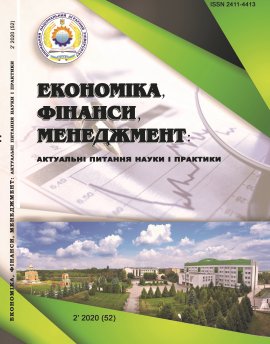
Issue №: 2 (52)
The journal deals with the issues of efficiency of functioning of the national economics and organizational forms of management of the national economy. Attention is paid to the problems of marketing, management and efficiency of production and economic activity of agrarian enterprises. The issues of public administration and administration, accounting and taxation, banking and insurance, forecasting and modeling of economic processes, foreign economic activity, commodity flows of economic entities and their infrastructure support.
THE IMPACT OF THE DIGITAL ECONOMY ON GLOBALIZATION
KOLIADENKO Svitlana – doctor of Economic Sciences, Professor of the department of computer science and economic cybernetics. Vinnitsa national agrarian university (21008, Vinnitsa, Soniachna st. 3, е-mail: kolyadenkosv@ukr.net).
The article explores the main directions and trends of the modern economy – digital and its impact on globalization processes taking place in the modern world. Digital economy entered the modern definition is not so long ago, having gone through the difficult path of becoming both in the world and in Ukraine. Forming as a modern science, digital economy is becoming a feature of modern times: new terms, categories, concepts, tools are emerging and being introduced into scientific modernity.
Some terms have been proposed for use in modern economic science, including: digital co-working center, cross-platform with digital industry, digital hub studio, hub association, hackathon, internet of things; some of them have been interpreted by the author. The contemporary impact of the digital economy on globalization has been investigated and some trends, implications, which can positively affect the further development of the IT industry in the economy of the world and Ukraine, especially the development of small and medium-sized enterprises basis of economic development for the coming period, especially as the next wave of the global economic crisis approaches.
Although the term "digital economy" has long been used in the economic community of the world, not all its characteristics have been described in terms of theoretical economics, and even more so, those specific terms that accompany it in the economic studies of scientists.
The digital economy is determined by a number of aspects in the technological, global, digitized, social fields. This article shows and substantiates ways to form some terms used in this direction and justifies (in some cases propose own) the formulation of terms that are either used in foreign-language sources or come from other fields, especially technical terms, economic substantiation of which is necessary for modern theoretical thought.
1. Koliadenko, S. V. (2016). Tsyfrova ekonomika: peredumovy ta etapy stanovlennia v Ukraini i u sviti. [The digital economy: preconditions and stages of formation in Ukraine and in the world.]. Ekonomika. Finansy. Menedzhment: aktualni pytannia nauky i praktyky. Retrieved from file:///C:/Users/admin/Downloads/efmapnp_2016_6_11%20(1).pdf [in Ukrainian].
2. Voinarenko, M. P., Skorobohata, L. V. (2015). Merezhevi instrumenty kapitalizatsii informatsiino-intelektualnoho potentsialu ta innovatsii. [Networking tools for capitalization of information and intellectual potential and innovation]. Visnyk Khmelnytskoho natsionalnoho universytetu. Ekonomichni nauky, 3. 18-24 [in Ukrainian].
3. Tapscott, Donald. 1996. The Digital Economy. McGraw-Hill.
4. Malyk, I. P. (2013). Tendentsii rozvytku informatsiinoi ekonomiky v Ukraini. [Trends in Information Economy Development in Ukraine]. Visnyk Skhidnoievropeiskoho universytetu ekonomiky i menedzhmentu, 1 (14). 25-34 [in Ukrainian].
5. Norets, N. K., Stankevich, A. A. (2017). Tsifrovaya ekonomika : sostoyanie i perspektivyi razvitiya. [Digital economy: state and development prospects]. Innovatsionnyie klasteryi v tsifrovoy ekonomike: teoriya i praktika : trudyi nauchno-prakticheskoy konferentsii s mezhdunarodnyim uchastiem 17–22.05.2017. SPb. : Izd-vo Politehn. un-ta, 173–179 [in Ukrainian].
6. Kraus, N. M. & Kraus, K. M. (2018). Tsyfrovizatsiia v umovakh instytutsiinoi transformatsii ekonomiky: bakhovi skladovi ta instrumenty tsyfrovykh tekhnolohii. [Digitalization in the Conditions of Institutional Transformation of the Economy: Highlights and Instruments of Digital Technologies]. Biznes ta intelektualnyi kapital. Intelekt KhKhI. 1, 211-214 [in Ukrainian].
7. Husieva, O. Yu. (2018). Napriamy realizatsii kontseptsii tsyfrovoi ekonomiky Ukrainy. [Directions of realization of the concept of digital economy of Ukraine]. Ekonomika. Menedzhment. Biznes. № 2 (24), 97-102 [in Ukrainian].
8. Liashenko, V.I., Vyshnevskyi; O.S. (2018). Tsyfrova modernizatsiia ekonomiky Ukrainy yak mozhlyvist proryvnoho rozvytku: monohrafiia [Digital modernization of the Ukrainian economy as an opportunity for breakthrough development: monograph]. NAN Ukrainy, In-t ekonomiky prom-sti. Kyiv, 252 [in Ukrainian].
9. Levitt T. The globalozationof Markets. Harvard Businass Review. May-June 1983.
10. Joseph, E. (2002). Stiglitz. Globalization and its Discontents. New York-London: W.W. Norton & Company.
11. Rainert Erik S. (2015). Yak bahati krainy zabahatily i chomu bidni krainy lyshaiutsia bidnymy. [How rich countries got rich ... and why poor countries remain poor]. Per. z anhl. Pereklad z anhliiskoi Petra Tereshchuka. Kyiv: Tempora, 444 [in Ukrainian].
12. Kovorkynh: bolshye perspektyvы malenkoho formata. [Coworking: Big prospects for small format]. Retrieved from http://www.arendator.ru/articles/5/art/63751/
13. Istoriya kovorkinga. [History of coworking] Retrieved from http://www.tikitoki.com/timeline/entry/156192/The-History-Of-Coworking-PresentedBy Deskmag#vars !date= 1995-05-28_08:55:49
14. Snihur, Kh. (2017). Kovorkinh: perevahy ta nedoliky a orhanizatsii robochykh mists [Coworking: the advantages and disadvantages of organizing jobs]. Visnyk Ternopilskoho natsionalnoho ekonomichnoho universytetu. 4, 117-124 [in Ukrainian].
15. Lytvynova, S. H. Virtualnyi klas yak kompiuterno-oriientovne navchalne seredovyshche vchytelia zahalnoosvitnoho navchalnoho zakladu [Virtual Classroom as a Computer-Oriented Educational Environment for a Primary School Teacher]. Retrieved from http://lib.iitta.gov.ua/197/1/statja-4.pdf
16. Tsentr Interneta veschey Azure [Azure Internet Hub]. Retrieved from https://azure.microsoft.com/ruru/services/iot-hub/
17. Oksfordskyi instytut Internetu, Oksfordskyi universytet (2014 r.), “Chym ye v pryntsypi tekhnolohichnyi innovatsiinyi khab” [Oxford Institute of the Internet, University of Oxford (2014), “What is a technological innovation hub in principle”] Retrieved from http://cii.oii.ox.ac.uk/2014/09/16/what-is-a-tech-innovation-hub-anyway
18. Vikipediia [Wikipedia]. Retrieved from https://zakon.rada.gov.ua/rada/term/1207
19. Vikipediia [Wikipedia]. Retrieved from https: //uk.wikipedia.org/wiki/%D0%A5%D0%B0%D0%BA%D0%B0%D1%82%D0%BE%D0%BD
About the journal
С1 Economics and International Economic Relations (by specialization)
D1 Accounting and Taxation
D2 Finance, Banking, Insurance and Stock Market
D3 Management
D4 Public Management and Administration
D5 Marketing
D7 Trade
J3 Tourism and Recreation
Founded in 1997 under the name ”Bulletin of Vinnytsia State Agricultural Institute”. In 2010-2014 it was published under the name “Collection of Scientific Papers of Vinnytsia National Agrarian University”. Since 2015 “Economics, finance, management: current issues of science and practical activity” (Certificate of State Registration of Mass Media No. 21154-10954 PR dated 12/31/2014).
