

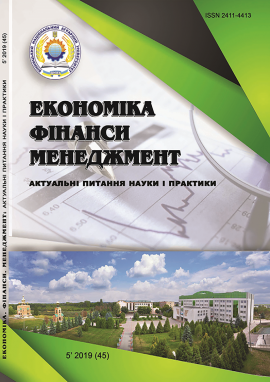
Issue №: 5 (45)
The magazine deals with the problems of the agricultural sector of the economy in the context of integration and processes of globalization. Attention is paid to the issues of development of digital economy, rural territories, technologies of enterprise management and organization of accounting, problems of legal support of economic processes, market tendencies of development of various branches of economy. Particular attention is paid to green tourism as a promising segment of the national economy.
COMPOSITION AND ASSESSMENT OF BIOLOGICAL ASSETS ACCORDING TO NATIONAL ACCOUNTING STANDARDS (PUBLIC SECTOR ACCOUNTING STANDARDS) 136 “BIOLOGICAL ASSETS”
KYTAICHUK Tatiana - Candidate of Economic Sciences, Associate Professor of the Accounting and Taxation, Vinnytsia Institute of Trade and Economic оf Kyiv National University of Trade and Economics (Vinnytsia)
In particular, a number of concepts that underpin ISFRPS are not used in Ukraine. These include: the priority of the economic content of operations over their juridical form, the concept of future economic benefits and utility of potential. The differences in requirements to accounting and reporting preparation related a different classification of assets and liabilities, income and expenses, as well as the lack of requirements and practices for the application of some accounting methods adoptedin ISFRPS.
In Ukraine, the process of reforming the accounting and financial reporting system in the public sector is under way. Taking into account the requirements of the international accounting standards for the public sector are being introduced the national provisions (standards) of accounting in the public sector (hereinafter referred to as "NP" (S) "APS"), which have been developed on the basis of international standards.
The Ministry of Finance of Ukraine, by its latest order dated 15.11.17, number 943, approved "NP" (S) "APS" 136 "Biological Assets". The standard came into force on 01.01.18. There was no specialized national standardin the budget sector that would regulate the accounting in agricultural operations.
The article deals with the actual problems of implementation of the national provision (standard) of accounting in the public sector 136 "Biological Assets". The essence of the concept of "biological assets" in various scientific and literary sources was investigated.In accordance with paragraph 4 of section І "NP" (S) "APS" 136, a biological asset is an animal or plant that, in the process of biological transformation, is capable of producing agricultural products and / or additional biological assets, andalsoin another way contributes to the economic benefits.
For the purposes of accounting, biological assets, depending on the length of the production process and the period of receipt of agricultural products, are classified into two groups: long-term and current biological assets.
The accounting of long-term biological assets used in non-agricultural activities (eg watch dogs, ornamental plants, etc.) is regulated by "NP" (S) "APS" 121 "Fixed assets". Also, fruiting plants related with agricultural activities, the peculiarities of accounting which are determined by other "NP" (S) "APS", should be accounted as part of fixed assets. Such plants include such perennial plantations as vineyards, gardens, plantations of berry crops and hops. It should also be taken into account that if a fruit plant produces fruits and its use in agricultural activities is planned in future accounting periods, then it is accountedas part of fixe dassets.
The typical correspondence of subaccounts of accounting for the display of transactions with assets, capital and liabilities of budgetary funds and statet rust funds does not include correspondence related to biological assets. Consequently, budget institutions need to develop their own view on the reflection in the accounting of biological assets "NP" (S) "A 136 "Biological Assets" has introduced concerning the biological assets of agricultural and agricultural products, the model of valuation at fair value. Peculiarities of estimation of biological assets depending on their receipt were investigated; the main problems arising from the public sector entities during their assessment were highlighted, in particular, in aspects of determining the fair value of such assets, the main deficiencies of estimation at fair value are indicated.
In the IFRS system, the valuation at fair value is one of the priorities. In the world practice, there are three possible approaches to the valuation of fair value: market, income, and expense. In the Ukrainian practice, the market approach is predominantly used. In the domestic practice of the account the peculiarities of the assessment of biological assets was formed taking into account the ways of receipt of biological assets, their classification and the date of evaluation in accordance with certain economic transactions in the course of the movement of these objects of accounting. Nowadays, most of budgetary institutions do not apply the innovations and record in accounting the posting of finished products according to the old method, that is, according to the planned cost, which leads to deformation of information in the financial reporting.
Evaluate long-term, current and additional biological assets at initial recognition and at each reporting date. Agricultural products are valued only at initial recognition. The evaluation at fair value provides calculation the sales costs.
Current biological assets and additional biological assets whose fair value can not reliably be determined at balance sheet date, can be recognized and displayed at cost of production, in addition to current biological plant production assets which are recognized and displayed as work in progress.
Regarding the initial recognition of agricultural products (grain, milk, honey, litter, etc.), it should be reflected in the reporting period in which it was separated from the biological asset. After initial recognition, it is evaluated and reflected in accordance with "NP" (S) "APS"123 "Funds".
According to the results of the research, the relevant conclusions are made. Evaluation is a rather complicated process, due to the informational needs of different groups of users, a large number of methods for determining the fair value of accounting objects. Taking into account all the above-mentioned aspects, budget institutions should, by choosing methods for determining the fair value of biological assets, independently determine the method for determining the value of biological assets and approve it in the order about the accounting policy.
- Kalyuha, YE. V. (2014). Oblik biolohichnykh aktyviv u derzhavnomu sektori [Accounting for biological assets in the public sector]. Ekonomichnyy analiz – Economic analysis. T. 18(2). 16-22. Retrieved from http://nbuv.gov.ua/UJRN/ecan_2014_18(2)__4 [in Ukrainian].
- Zhuk, V. M. (2009). Kontseptsiya rozvytku bukhhalters’koho oblik u v ahrarnomu sektori ekonomiky [Concept of development of accounting in the agrarian sector of the economy]. Kyiv : NNTS IAE [in Ukrainian].
- Zamula, I.V. & Cherevko, L.P. (2012). Sutnist’ i klasyfikatsiya biolohichnykh aktyviv yak ob’yekta bukhhalters’koho obliku [Essence and classification of biological assets as an object of accounting]. Visnyk Zhytomyrs’koho derzhavnoho tekhnichnoho universytetu – Bulletin of Zhytomyr State Technical University,1(59), 74–76 [in Ukrainian].
- Koval, O.V. (2018). Oblik henno-modyfikovanykh biolohichnykh aktyviv [Accounting for genetically modified biological assets]. Ekonomika. Finansy. Menedzhment: aktual’ni pytannya nauky i praktyky – Economy. Finances. Management: topical issues of science and practice, 7, 118–128 [in Ukrainian].
- Perevoznyk, N. V. (2007). Biolohichni aktyvy yak oblikovo-analitychna ta ekonomichna katehoriya [Biological assets as accounting, analytical and economic category]. Formuvannya rynkovykh vidnosyn v Ukrayini – Formation of market relations in Ukraine, 6 (73), 115-118 [in Ukrainian].
- Natsional’ne polozhennya (standart) bukhhalters’koho obliku v derzhavnomu sektori 136 “Biolohichni aktyvy” [National accounting Standard (Standard) in the public sector 136 “Biological Assets”]. Order of the Ministry of Finance of Ukraine dated November 15, 2017, No 943. Retrieved from https://zakon.rada.gov.ua/laws/show/z1478-17 7 [in Ukrainian].
- Slobodyan, V.D. (2007). Osoblyvosti obliku biolohichnykh aktyviv [Features of the accounting of biological assets]. Zbirnyk naukovykh prats’ Podil’s’koho derzhavnoho ahrarno-tekhnichnoho universytetu – Collection of scientific works of the Podilsky state agricultural and technical university, 15, T.2, 8–10 [in Ukrainian].
- Ostapchuk, O.V. (2007). Problemy zastosuvannya analitychnoho obliku biolohichnykh aktyviv [Problems of analytical accounting of biological assets]. Oblik i finansy APK – Accounting and finance of agroindustrial complex, 11-12, 52-55 [in Ukrainian].
- Holovachko, V. M. (2015). Ponyattya, klasyfikatsiya ta otsinka biolohichnykh aktyviv [The concept, classification and evaluation of biological assets]. Naukovyy visnyk Mukachivs’koho derzhavnoho universytetu: Seriya “Ekonomika” - Scientific herald of Mukachevo State University: Series “Economics”, 1, 201-206. Retrieved from http://nbuv.gov.ua/UJRN/nvmdue_2015_1_37 [in Ukrainian].
- Yanenko, O. V. (2012). Aktualnist’ obliku biolohichnykh aktyviv v Ukrayini [The Relevance of Accounting for Biological Assets in Ukraine]. Visnyk Zhytomyrs’koho derzhavnoho tekhnichnoho universytetu. Seriya: Ekonomichni nauky – Bulletin of Zhytomyr State Technical University. Series: Economic Sciences, 1(59), 66-73[in Ukrainian].
- Typova korespondentsiya subrakhunkiv bukhhalters’koho obliku dlya vidobrazhennya operatsiy z aktyvamy, kapitalom ta zobov’yazannyamy rozporyadnykamy byudzhetnykh koshtiv ta derzhavnymy tsil’ovymy fondamy [Typical correspondence of subaccounting books for displaying transactions with assets, capital and liabilities by managers of budget funds and state trust funds]. Order of the Ministry of Finance of Ukraine dated December 29, 2015, No 1219. Retrieved from https:// zakon.rada.gov.ua/ laws/show/z0086-16 [in Ukrainian].
- Hlushko, O.V. (2013). Metodychni osnovy otsinky dovhostrokovykh biolohichnykh aktyviv: teoriya ta praktyka otsinky [Methodological basis for estimation of long-term biological assets: theory and practice of assessment]. Naukovyy visnyk Natsionalnoho universytetu bioresursiv i pryrodokorystuvannya Ukrayiny – Scientific herald of the National University of Bioresources and Nature Management of Ukraine, 181, ch.3, 268 [in Ukrainian].
- Len, V.S. & Starodub, I.L. (2008). Otsinka ta oblik potochnykh biolohichnykh aktyviv roslynnytstva [Assessment and accounting of current biological plant production assets]. Visnyk Chernihivs’koho derzhavnoho tekhnichnoho universytetu – Bulletin of the Chernihiv State Technical University, No 33,172-178 [in Ukrainian].
- Holotyuk, L. S. (2014). Problemy otsinky biolohichnykh aktyviv tvarynnytstva za spravedlyvoyu vartistyu v sils’kohospodars’kykh pidpryyemstvakh [Problems of estimation of biological assets of livestock at fair value in agricultural enterprises]. Efektyvna ekonomika – Effective economy, No12.Retrieved from //www.economy.nayka.com.ua/?op=1 z=3699 [in Ukrainian].
- Hutsalenko, L.V. (2012). Mozhlyvosti zastosuvannya spravedlyvoyi vartosti u vitchyznyaniy oblikoviy systemi [Possibilities of applying fair value in the national accounting system]. Zbirnyk naukovykh prats’ Vinnyts’koho natsionalnoho ahrarnoho universytetu – Collection of scientific works of Vinnytsia National Agrarian University,3, 2, 40-46 [in Ukrainian].
- Plan schetov bukhgalterskogo ucheta v gosudarstvennom sektore [Public sector accounts accounting plan] Order of the Ministry of Finance of Ukraine dated December 31, 2013, No 1203. Retrieved from https:// zakon2.rada.gov.ua/laws/show/z0161-14 [in Ukrainian].
About the journal
С1 Economics and International Economic Relations (by specialization)
D1 Accounting and Taxation
D2 Finance, Banking, Insurance and Stock Market
D3 Management
D4 Public Management and Administration
D5 Marketing
D7 Trade
J3 Tourism and Recreation
Founded in 1997 under the name ”Bulletin of Vinnytsia State Agricultural Institute”. In 2010-2014 it was published under the name “Collection of Scientific Papers of Vinnytsia National Agrarian University”. Since 2015 “Economics, finance, management: current issues of science and practical activity” (Certificate of State Registration of Mass Media No. 21154-10954 PR dated 12/31/2014).
