

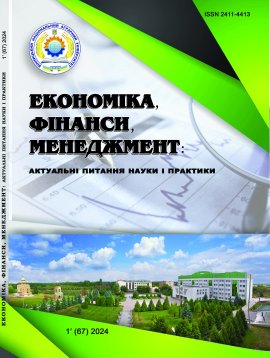
Issue №: 1 (67)
The journal deals with the issues of efficiency of functioning of the national economics and organizational forms of management of the national economy. Attention is paid to the problems of marketing, management and efficiency of production and economic activity of agrarian enterprises. The issues of public administration and administration, accounting and taxation, banking and insurance, forecasting and modeling of economic processes, foreign economic activity, commodity flows of economic entities and their infrastructure support.
ARTIFICIAL INTELLIGENCE AS A CATALYST FOR TRANSFORMATIONAL PROCESSES IN ACCOUNTING
PRAVDIUK Nataliia − Doctor of Economic Sciences, Professor, Professor of the Department of Accounting and Taxation, Vinnytsia National Agrarian University (21008, Vinnytsia, 3, Soniachna Str., e-mail: npravduyk@gmail.com).
PRAVDIUK Maryna – Candidate of Economic Sciences, Associate Professor of the Department of Accounting and Taxation, Vinnytsia National Agrarian University (21008, Vinnytsia, 3, Soniachna Str., e-mail: a.pravd4449@gmail.com).
The article examines the essence, classifies and highlights the historical aspects of the development of artificial intelligence technologies, identifies the trends and outlines the prospects for using the potential of modern information technologies in various spheres of public life. It is substantiated that the application of the capabilities of artificial intelligence-based systems in accounting practice makes it possible to automate certain accounting operations, in particular, processing and analysis of large amounts of accounting information, verification of accounting data and detection of errors, prevention of fraud, and also saves material and human resources for accounting, and increases the efficiency of the accounting process in general. Despite the significant advantages of integrating artificial intelligence into the accounting process, it is established that the use of the intelligent information technologies has risks for the accounting industry, which are associated with the release of a significant number of jobs, insufficient confidentiality and security of accounting data, the complexity of implementing an intelligent accounting system, and the lack of regulatory regulation of the procedure for using artificial intelligence systems in the accounting process. It is determined that the potential of artificial intelligence-enabled systems is gradually being used in accounting and this process will only intensify due to the rapid development of information technology and the trend towards automation of business processes, but there is still no talk of full integration of artificial intelligence into accounting practice. In order to ensure widespread implementation of artificial intelligence in the field of accounting, the author proposes a set of measures which include cultivation of a positive attitude towards intelligent information technologies, development of a national policy and strategy for implementation of artificial intelligence systems, professional development of practitioners, and development of information systems for automation of accounting based on artificial intelligence technologies.
1. Artificial Intelligence Market Size & Trends. grandviewresearch.com. Retrieved from: https://www.grandviewresearch.com/industry-analysis/artificial-intelligence-ai-market [in English].
2. Sutton, S.G., Holt, M., & Arhold, V. (2016). «The reports of my death are greatly exaggerated» – Artificial intelligence research in accounting. International Journal of Accounting Information Systems, 22, 60-73. DOI: 10.1016/j.accinf.2016.07.005 [in English].
3. Koval, O., & Tomchuk, O. (2024). Bukhhalterskyi oblik v umovakh tsyfrovizatsii [Accounting in the conditions of digitalization]. Ekonomika, finansy, menedzhment: aktualni pytannia nauky i praktyky – Economy, finances, management: topical issues of science and practical activity, 1 (67), 23-37. DOI: 10.37128/2411-4413-2024-1-2 [in Ukrainian].
4. Dovbush, A.V., & Belova, I.M. (2023). Rozvytok bukhhalterskoho obliku v umovakh tsyfrovizatsii ekonomiky [Development of accountingin conditions of digitization of the economy]. Innovaziina ekonomika – Innovative economy, 2 (94), 176-181. DOI: 10.37332/2309-1533.2023.2.23 [in Ukrainian].
5. Zakharchenko, V.I. (2022). Yaki hroshi stanut meinstrymom hroshovoho obihu – elektronni chy virtualni? [What money will become a mainstream cash flow – electronic or virtual?]. Ekonomika, finansy, menedzhment: aktualni pytannia nauky i praktyky – Economy, finances, management: topical issues of science and practical activity, 2 (60), 22-36. DOI: 10.37128/2411-4413-2022-2-2 [in Ukrainian].
6. Khaled AlKoheji, A., & Al-Sartawi, A. (2023). Artificial intelligence and its impact on accountingsystems. In: Musleh Al-Sartawi A.M.A., Razzaque A., Kamal M.M. (eds.) From the Internet of Things to the Internet of Ideas: The Role of Artificial Intelligence: Prossesings of EAMMIS 2022 (Lecture Notes in Networks and Systems, vol. 557). 1-st ed. Springer, Cham. DOI: 10.1007/978-3-031-17746-0_51 [in English].
7. Liakhovych, G.I., & Vakun, O.V. (2023). Vykorystannia shtuchnoho intelektu dlia pidvyshchennia efektyvnosti systemy upravlinskoho obliku [Use of artificial intelligence to increase the efficiency of the management accounting system]. Problemy teorii ta metodolohii bukhhalterskoho obliku, kontroliu i analizu – Problems of the theory and methodology of accounting, control and analysis, 3 (56), 28-33. DOI: 10.26642/pbo-2023-3(56)-28-33 [in Ukrainian].
8. Kryukova, I.O. (2021). Innovatsiini instrumenty bukhhalterskoho obliku ta yikh implementatsiia v ahrarnii sferi [Innovative instruments in accounting and their implementation in the agrarian sphere]. ebbsl.com.ua. Retrieved from: https://www.ebbsl.com.ua/index.php/visnuk/article/view/7/5 [in Ukrainian].
9. Jin, H., Jin, L., Qu, Ch., Xiao, W., & Fan, Ch. (2022). The Role of Artificial Intelligence in the Accounting Industry. Proceedings of the 2022 International Conference on Artificial Intelligence, Internet and Digital Economy (ICAID 2022), 9, 248-257. Retrieved from: https://www.atlantis-press.com/proceedings/icaid-22/125977074 [in English].
10. Li, Ch., Haohao, S., & Ming, F. (2020). Research on the Impact of Artificial Intelligence Technology on Accounting. Journal of Physics: Conference Series, 1486, 3, 032042. DOI: 10.1088/1742-6596/1486/3/032042 [in English].
11. Future of Professionals Report How AI is the Catalyst for Transforming Every Aspect of Work. thomsonreuters.com. Retrieved from: https://www.thomsonreuters.com/content/dam/ewp-m/documents/thomsonreuters/en/pdf/reports/future-of-professionals-august-2023.pdf?fbclid=IwAR39sq-mbax4zjnN4NlX3I-GLEdCyWa29579-QjQghXhNJnnk_xO3qg38R8 [in English].
12. Hasan, A. (2022). Artificial Intelligence (AI) in Accounting & Auditing: A Literature Review. Open Journal of Business and Management, 10, 440-465. DOI: 10.4236/ojbm.2022.101026 [in English].
13. Holmes, A.F., & Douglass, A. (2022). Artificial Intelligence: Reshaping the Accounting Profession and the Disruption to Accounting Education. Journal of Emerging Technologies in Accounting, 19 (1), 53-68. DOI: 10.2308/JETA-2020-054 [in English].
14. Damerji, H., & Salimi, A. (2021). Mediating effect of use perceptions on technology readiness and adoption of artificial intelligence in accounting. Accounting Education, 30 (2), 107-130. DOI: 10.1080/09639284.2021.1872035 [in English].
15. Wang, Z., He, Y., Jiang, H., & Yu, C. (2023). Enterprise Intelligent Accounting System Structure and Intelligent Accounting Algorithm. In: Hung, J.C., Yen, N.Y., Chang, JW. (eds) Frontier Computing. Lecture Notes in Electrical Engineering, 1031. DOI: 10.1007/978-981-99-1428-9_140 [in English].
16. Chen, S., & Williams, A. (2022). Intelligent Accounting System Structure and Intelligent Accounting Algorithm Based on Computer Vision. In: Xu, Z., Alrabaee, S., Loyola-González, O., Zhang, X., Cahyani, N.D.W., Ab Rahman, N.H. (eds) Cyber Security Intelligence and Analytics. Lecture Notes on Data Engineering and Communications Technologies, 125. DOI: 10.1007/978-3-030-97874-7_12 [in English].
17. Shtuchnyi intelekt v bukhhalterskomu obliku ta finansakh [Artificial intelligence in accounting and finance]. buhgalter911.com. Retrieved from: https://buhgalter911.com/uk/news/news-1049080.html [in Ukrainian].
18. Rol shtuchnoho intelektu v bukhhalterskomu obliku [The role of artificial intelligence in accounting]. buhgalter911.com. Retrieved from: https://buhgalter911.com/uk/news/news-1044623.html [in Ukrainian].
About the journal
С1 Economics and International Economic Relations (by specialization)
D1 Accounting and Taxation
D2 Finance, Banking, Insurance and Stock Market
D3 Management
D4 Public Management and Administration
D5 Marketing
D7 Trade
J3 Tourism and Recreation
Founded in 1997 under the name ”Bulletin of Vinnytsia State Agricultural Institute”. In 2010-2014 it was published under the name “Collection of Scientific Papers of Vinnytsia National Agrarian University”. Since 2015 “Economics, finance, management: current issues of science and practical activity” (Certificate of State Registration of Mass Media No. 21154-10954 PR dated 12/31/2014).
