

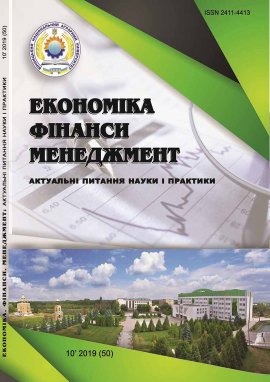
Issue №: 10 (50)
The magazine deals with the problems of the agricultural sector of the economy in the context of integration and processes of globalization. Attention is paid to the issues of development of digital economy, rural territories, technologies of enterprise management and organization of accounting, problems of legal support of economic processes, market tendencies of development of various branches of economy. Particular attention is paid to green tourism as a promising segment of the national economy.
SCIENTIFIC AND APPLIED BASES OF SUSTAINABLE DEVELOPMENT FOR A VILLAGE-PRESERVING MODEL OF THE AGRARIAN SYSTEM
ZHUK Valerij - Chief Researcher of the Accounting and Taxation Department of the National
Science Center "Institute of Agrarian Economics" (Kyiv), Doctor of Economics, Professor, Academician
of the National Academy of Agrarian Sciences of Ukraine. e-mail: zhuk@faaf.org.ua
SIGAJOV Andrij - Professor of the Department of Economics and Entrepreneurship of the
National Technical University of Ukraine "Kyiv Polytechnic Institute named after Igor Sikorsky" (Kyiv),
Doctor of Economics, Professor. e-mail: a.sigayov@kpi.ua
Excessive consolidation of self-government and business contradicts rural development from both the theory of spatial economy and the theory of behavioral economics, the theory of fiscal federalism, and contradicts the practice of countries where there is a sustainable development of rural territories. The purpose of the article is to formulate the scientific and applied foundations of sustainable development based on the model of the agrarian system, taking into account the settlement and behavioral features of Ukraine, the problem of growth in the country of the "vicious circle" of the agrarian oligarchy.
A systematic analysis of the problems of the countryside and agrarian policy in Ukraine is carried out, and thanks to an axiomatic and hypothetical method, a model of rural development is presented, which corresponds to the current socio-economic status of national institutions and their opportunities for change. In particular, the analysis of problems of rural entrepreneurship and rural self-government was carried out. Self-government and business activity of villages in different models are presented. The proposals that form the village-based entrepreneurship - the economic, social, environmental basis of rural development - are presented.
The main problem of domestic agrarian reforms is the uncertainty of executive power institutions with the model of agrarian system. The model as the construction of the desired achievements is a guide, the ideology of reforms. The model sets out the framework of what rural entrepreneurship and rural areas should be. And, since there is a model uncertainty with the agrarian system in Ukraine, we have not only tolerance to all forms of economic management (which is good), but also oligarchic agroholding, work of business "in the shadow", almost zero entrepreneurial proactiveness of peasants social and environmental protection of villages.
The village-based model of entrepreneurship and rural development differs from the farmer-cooperative model. We call it so because everything has to be connected with the village. There is a peasant living there, he should be able to earn his own money both in cooperatives and in hiring. At the same time, the basis of the village conservation model is the rural environment itself, and new “rules of the game” are being realized, enforced and controlled, both by businesses and peasants.
Not only the state authorities, not only the leadership of the united territorial communities, which seem to be close, but also far from the villages (with centers and district towns), should be involved in sustainable development. It is in the village that this environment is created, the self-governing and proactive involvement of the peasants to everything in their territory is formed. In the united territorial community, every self-sufficient village functions according to its statute. Each village is involved with everything in its surrounding area, including also involvement through transformations from the top to business.
1. Borodina O. M., Heiets V. M., Hutorov A. O. et al. (2012). Ukrainska model ahrarnoho rozvytku
ta yii sotsioekonomichna pereoriientatsiia [Ukrainian model of agrarian development and its
socioeconomic reorientation] Kyiv: NAN Ukrainy, In-t ekon. ta prohnoz [in Ukrainian].
2. Lupenko Yu. O. (ed.), Kropyvko M. F. (ed.). (2017). Ahrarnyi ustrii Ukrainy [Agrarian system
of Ukraine]. Kyiv: NNTs «IAE»[in Ukrainian].
3. Lupenko Yu. O. (ed.), Malik M. Y., Bulavka O.H. (ed.) et al. (2013). Stratehichni napriamy
staloho rozvytku silskykh terytorii na period do 2020 roku [Strategic directions of sustainable development
of rural territories for the period till 2020]. Kyiv: NNTs «IAE» [in Ukrainian].
4. Lupenko Yu. O. (2012). Formuvannia perspektyvnoi modeli silskoho hospodarstva Ukrainy
[Formation of a perspective model of agriculture in Ukraine]. Ekonomika APK, (11), 10- 14 [in Ukrainian].
5. Khodakivska O. V., Mohylnyi O. M. (2017). Modeli obihu zemel u zabezpechenni staloho
rozvytku silskykh terytorii [Land-use patterns in ensuring sustainable development of rural territories]. In
Suchasni problemy ta perspektyvy staloho rozvytku silskykh terytorii: zb. materialiv 16 konhresu
vchenykh ekonomistiv-ahrarnykiv ta Mizhnar. nauk.-prakt. konf. Kyiv: NNTs «IAE» [in Ukrainian].
6. Zhuk V. M. (2017). Obih zemel silskohospodarskoho pryznachennia v selozberihaiuchii modeli
ahrarnoho ustroiu Ukrainy [The circulation of agricultural land in the rural-preservation model of the agrarian
system of Ukraine] Kyiv: Natsionalnyi naukovyi tsentr «Instytut ahrarnoi ekonomiky» [in Ukrainian].
7. Lupenko Yu. O., Kropyvko M. F. (2013). Ahrokholdynhy v Ukraini ta posylennia sotsialnoi
spriamovanosti yikh diialnosti [Agroholdings in Ukraine and strengthening the social orientation of their
activities]. Ekonomika APK, (7), 5-21 [in Ukrainian].
8. Lupenko Yu. O. (ed.), Mesel-Veseliak V. Ya., Shpykuliak O. H. et al. (2018). Rozvytok form
hospodariuvannia v silskomu hospodarstvi: problemy i rishennia [Development of forms of management
in agriculture: problems and solutions]. Kyiv: NNTs «IAE» [in Ukrainian].
9. Zhuk V. M. (ed.), Melnychuk B. V., Bezdushna Yu. S. et al. (2013). Oblikove zabezpechennia
investytsiinoi pryvablyvosti ta bezpeky pidpryiemstva y ahrarnoi haluzi [Accounting guarantee of
investment attractiveness and safety of enterprise and agrarian sector]. Kyiv: TOV «Vseukrainskyi
instytut prava i otsinky» [in Ukrainian].
10. Hadzalo Ya. M., Zhuk V. M. (2015). Naukovi osnovy rozvytku ahrarnoho pidpryiemnytstva ta
silskykh terytorii za selozberihaiuchoiu modelliu [Scientific fundamentals of agrarian entrepreneurship
development and rural areas for the rural-preservation model]. Kyiv: NNTs IAE [in Ukrainian].
11. Stetsiuk L. S., Zhuk V. M., Bezdushna Yu. S. et al. (2018). Metodychni rekomendatsii z analizu
hospodarskoi diialnosti silskohospodarskykh pidpryiemstv [Methodological recommendations for the
analysis of economic activity of agricultural enterprises] . Kyiv: NNTs «IAE» [in Ukrainian].
12. Zhuk V. M., Bezdushna Yu. S., Melnychuk B. V. et al. (2019). Metodychni rekomendatsii z
oblikovoho zabezpechennia investytsiinoi pryvablyvosti silskohospodarskykh pidpryiemstv [Methodical
recommendations on accounting for investment attractiveness of agricultural enterprises]. Kyiv: NNTs
«IAE» [in Ukrainian].
13. Zhuk V. M. (ed.). (2010). Orhanizatsiia obliku vidnosyn vlasnosti [Organization of accounting
of property relations]. Kyiv: Vydavnytstvo TOV "Yur-Ahro-Vesta" [in Ukrainian].
14. Zhuk, V. M. (2017). Neformalni instytuty selianstva u modeliuvanni reform ta ahrarnoi polityky:
teoriia i praktyka [Informal institutions of the peasantry in the modeling of reforms and agrarian policy:
theory and practice]. Ekonomika APK, (9), 5-18 [in Ukrainian].
15. Zhuk V. M. (2017). Teoretychni osnovy modeliuvannia rozvytku silskykh terytorii:
bikheviorystychnyi aspect [Theoretical foundations of modeling of rural areas development: behavioral
aspect]. Oblik i finansy, 3 (77),142-150 [in Ukrainian].
16. Zhuk V. M., Tomych I. F. at al. (2018). Kontseptsiia rozvytku fermerskykh hospodarstv ta
silskohospodarskoi kooperatsii na 2018-2020 roky ta selozberihaiucha paradyhma rynku zemli [The
Concept of the Development of Farmers and Agricultural Cooperatives for 2018-2020 and the rural-preservation Paradigm of the Land Market] / Asotsiatsiia fermeriv ta pryvatnykh zemlevlasnykiv Ukrainy.
Kyiv: TOV VP «Edelveis» [in Ukrainian].
About the journal
С1 Economics and International Economic Relations (by specialization)
D1 Accounting and Taxation
D2 Finance, Banking, Insurance and Stock Market
D3 Management
D4 Public Management and Administration
D5 Marketing
D7 Trade
J3 Tourism and Recreation
Founded in 1997 under the name ”Bulletin of Vinnytsia State Agricultural Institute”. In 2010-2014 it was published under the name “Collection of Scientific Papers of Vinnytsia National Agrarian University”. Since 2015 “Economics, finance, management: current issues of science and practical activity” (Certificate of State Registration of Mass Media No. 21154-10954 PR dated 12/31/2014).
