

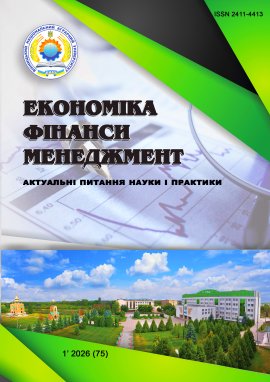
Issue №: 1 (75)
The journal deals with the issues of efficiency of functioning of the national economics and organizational forms of management of the national economy. Attention is paid to the problems of marketing, management and efficiency of production and economic activity of agrarian enterprises. The issues of public administration and administration, accounting and taxation, banking and insurance, forecasting and modeling of economic processes, foreign economic activity, commodity flows of economic entities and their infrastructure support.
FORMATION OF ENTERPRISE RESILIENCE IN THE CONTEXT OF USING ASSERTIVE EMPLOYEES UNDER GLOBALIZATION CONDITIONS
STRELBYTSKA Tetiana – Postgraduate Student of the Third Year of Study of the Department of Economics and Entrepreneurship, Vinnytsia National Agrarian University (21008, Vinnytsia, 3, Soniachna Str.,
e-mail: strelbytskatatiana@gmail.com, https://orcid.org/0009-0000-0477-3914).
The article explores the behavioral determinants of enterprise resilience in the context of globalization, focusing on assertiveness as a key factor in maintaining organizational stability. The study emphasizes that traditional economic mechanisms are no longer sufficient to ensure sustainable development under growing market turbulence and global interdependence. Assertiveness, understood as a mature behavioral competence that combines confidence, self-regulation, and respect for the others, is examined as a behavioral driver of organizational adaptability and economic security.
The empirical research involved a survey of 250 employees from twelve enterprises of various sectors, assessing the relationship between the share of assertive workers and indicators of enterprise resilience. The results revealed a strong positive correlation (r = 0.82, p < 0.01) between assertiveness and the integral resilience index. The enterprises with over 11% of assertive employees had demonstrated significantly higher adaptability to market fluctuations, lower staff turnover, and higher profitability.
The scientific novelty of the study lies in identifying assertiveness as an independent behavioral determinant of enterprise resilience, integrating psychological and economic dimensions into a unified analytical model. The practical value of the results is expressed in their applicability for developing HR policies and behavioral training programs aimed at enhancing adaptive potential and internal stability.
The findings confirm that assertiveness functions as a behavioral infrastructure of economic security, fostering trust, autonomy, and collective responsibility. The article also highlights the behavioral mechanisms through which assertive communication reduces managerial risks and transaction costs. Overall, the study substantiates the view that strengthening enterprise resilience in a globalized environment requires investment in behavioral capital – particularly in assertive communication and psychologically safe organizational cultures that enhance adaptability, innovation, and long-term sustainability.
1. Alberti, R., & Emmons, M. (2017). Your perfect right: Assertiveness and equality in your life and relationships (10th ed., pp. 20–80). Oakland: New Harbinger. Retrieved from: https://www.researchgate.net/publication/232496056_Your_Perfect_Right_A_Guide_to_Assertive_Behavior [in English].
2. Williamson, O.E. (2008). The economic institutions of capitalism. The political economy reader: Markets as institutions, 27, 15–24. Retrieved from: https://d1wqtxts1xzle7.cloudfront.net/6640260/williamson__1985___chapter_1-libre.pdf [in English].
3. OECD (2023). Resilience in global value chains: Behavioral dimensions of organizational adaptation. Paris: OECD Publishing. DOI: https://doi.org/10.1177/0008125621106663 [in English].
4. Wolpe, J. (1968). Psychotherapy by reciprocal inhibition. Conditional Reflex: A Pavlovian Journal of Research & Therapy, 3, 234–240 [in English].
5. Bandura, A. (1990). Perceived self-efficacy in the exercise of control over AIDS infection. Evaluation and Program Planning, 13 (1), 9–17. DOI: https://doi.org/10.1016/0149-7189(90)90004-G [in English].
6. Deloitte Development LLC. (2024). Global human capital trends: Empowered employees and organizational resilience. deloitte.com. Retrieved from https://www2.deloitte.com/global/en/pages/human-capital/articles/human-capital-trends.html [in English].
7. Goleman, D. (2013). Focus: The hidden driver of excellence. New York: HarperCollins [in English].
8. Kahneman, D., & Tversky, A. (2000). Choices, values, and frames. Cambridge: Cambridge University Press. DOI: https://doi.org/10.1017/CBO9780511803475 [in English].
9. Alam, M.P. (2025). Building resilient organizations: The behavioural foundations of strategic flexibility. BUP DEVTHON 5.0 International Interdisciplinary Conference (BDIIC-2024) (Dhaka, Bangladesh). Retrieved from: https://www.researchgate.net/publication/390551135 [in English].
10. Nahapiet, J., & Ghoshal, S. (1998). Social capital, intellectual capital, and the organizational advantage. Academy of Management Review, 23 (2), 242–266. DOI: https://doi.org/10.5465/amr.1998.533225 [in English].
11. Holling, C.S. (2001). Understanding the complexity of economic resilience systems. Ecosystems, 4 (5), 390–405. DOI: https://doi.org/10.1007/s10021-001-0101-5 [in English].
12. Rötheli, T. (2017). Superforecasting: The art and science of prediction. Foresight, 19 (2), 256–258. DOI: https://doi.org/10.1108/FS-12-2016-0061 [in English].
13. Mishchuk, H., Oliinyk, O., & Bilan, Y. (2024). Brain gain and country’s resilience: A dependency analysis exemplified by OECD countries. Equilibrium. Quarterly Journal of Economics and Economic Policy, 19 (2), 215–232. DOI: https://doi.org/10.24136/eq.2024.009 [in English].
14. Shulha, D.M. (2024). Psykholohichnyi analiz poniattia «asertyvnist» u pratsiakh vitchyznianykh ta zarubizhnykh naukovtsiv [Psychological analysis of the concept of assertiveness in domestic and foreign research]. Naukovyi visnyk Lvivskoho derzhavnoho universytetu vnutrishnikh sprav (seriia psykholohichna) – Scientific Bulletin of the Lviv State University of Internal Affairs (Psychological Series), 1, 90–96. DOI: https://doi.org/10.32782/2311-8458/2024-1-13 [in Ukrainian].
15. Sakhno, A.A., & Boltovska, L.L. (2023). Efektyvnist vykorystannia tekhnolohii u konteksti dotrymannia pokaznykiv ekonomichnoi bezpeky pidpryiemstv [Efficiency of technology use in the context of economic security indicators]. Ekonomika, finansy, menedzhment: aktualni pytannia nauky i praktyky – Economy, finances, management: topical issues of science and practical activity, 2 (64), 104–119. DOI: https://doi.org/10.37128/2411-4413-2023-2-7 [in Ukrainian].
16. Khaietska, O.P. (2024). Problemy ta perspektyvy hlobalizatsii, hlobalni problemy liudstva [Problems and prospects of globalization, global problems of humanity]. Ekonomichnyi prostir – Economic Space, 189, 316–322. DOI: https://doi.org/10.32782/2224-6282/189-55 [in Ukrainian].
17. Vinueza Morales, S.X., Castellanos-Herrera, S., & Ramón Poma, G.M. (2022). Comunicación asertiva y relaciones interpersonales en docentes universitarios de la carrera de medicina: Caso UCACUE. Green World Journal, 5 (3). DOI: https://doi.org/10.53313/gwj53030 Retrieved from: https://www.greenworldjournal.com/index.php/ambiental/en/article/view/255/236 [in Spanish].
18. Keates, C. (2022). Students’ experience of the challenges of using assertive communication. British Journal of Nursing, 31 (15), 790–798. DOI: https://doi.org/10.12968/bjon.2022.31.15.790 [in English].
About the journal
С1 Economics and International Economic Relations (by specialization)
D1 Accounting and Taxation
D2 Finance, Banking, Insurance and Stock Market
D3 Management
D4 Public Management and Administration
D5 Marketing
D7 Trade
J3 Tourism and Recreation
Founded in 1997 under the name ”Bulletin of Vinnytsia State Agricultural Institute”. In 2010-2014 it was published under the name “Collection of Scientific Papers of Vinnytsia National Agrarian University”. Since 2015 “Economics, finance, management: current issues of science and practical activity” (Certificate of State Registration of Mass Media No. 21154-10954 PR dated 12/31/2014).
