

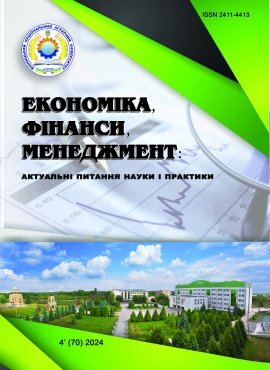
Issue №: 4 (70)
The journal deals with the issues of efficiency of functioning of the national economics and organizational forms of management of the national economy. Attention is paid to the problems of marketing, management and efficiency of production and economic activity of agrarian enterprises. The issues of public administration and administration, accounting and taxation, banking and insurance, forecasting and modeling of economic processes, foreign economic activity, commodity flows of economic entities and their infrastructure support.
ORGANIZATIONAL AND SPATIAL FEATURES OF INNOVATION MANAGEMENT IN SMART CITIES DEVELOPMENT
KRYSOVATYY Ihor – Candidate of Economic Sciences, Associate Professor of the Department of Entrepreneurship and Trade, West Ukrainian National University (46009, Ternopil, 11, Lvivska Str., e-mail: i.krysovatyy@wunu.edu.ua).
Organizational and spatial features of managing the innovative development of smart cities are a key aspect of their successful transformation. The article examines the organisational and spatial characteristics of innovation management in smart city development. It identifies the role of the cities as centres of innovative development that accumulate intellectual and financial resources, thus facilitating technological and social progress. The research emphasises the challenges of urbanisation that necessitate new development models integrating economic, social, and spatial aspects. The concept of a smart city is analysed as a contemporary approach to urban development management in the digital era. The evolution of this concept from its inception to the present day is examined in part, along with its role in enhancing the efficiency of urban systems and improving citizens’ quality of life. Particular emphasis is placed on key operational mechanisms of smart cities, including integration of ICT infrastructure, analytical processing of collected data, development of interactive citizen engagement, and ensuring sustainable development.
The research methodology is based on a systems approach, utilising methods of structural analysis, comparative analysis, and modelling of urban processes. Special attention is devoted to spatial and organisational aspects of fostering innovative development in smart cities under various operational conditions.
A significant component of the study is the comparative analysis of the models of spatial innovation development in urban studies. The research highlights the tendency towards combining elements from different models in urban development practice. The primary factors in forming innovative environments in cities are identified. The article examines the approaches to overcoming limitations of basic elements in digital city management through establishing appropriate innovation infrastructure within existing cities, around universities or research centres, or concurrent with the construction of new cities.
1. Bitiuk, I.M., & Paskal, L.V. (2024). Rehionalnyi menedzhment: Rozvytok rozumnykh mist Ukrainy [Regional management: Development of smart cities in Ukraine]. Ekonomika ta suspilstvo – Economy and society, 69, 778–789. DOI: https://doi.org/10.32782/2524-0072/2024-69-121 [in Ukrainian].
2. Budnikevych, I., Zablodska, I., & Bastrakov, D. (2023). Smart-kontseptsiia innovatsiinoho prostoroho rozvytku: Dosvid rozvynutykh krain [Smart concept of innovative spatial development: Experience of developed countries]. Modeling the Development of the Economic Systems, 4, 99–106. DOI: https://doi.org/10.31891/mdes/2023-10-13 [in Ukrainian].
3. Kizliar, O.O. (2022). Suchasni standarty vprovadzhennia kontseptsii «Smart City» [Modern standards of implementing the «Smart City» concept]. Stratehichni napriamy sotsialno-ekonomichnoho rozvytku derzhavy v umovakh hlobalizatsii: zbirnyk tez V Mizhnarodnoi naukovo-praktychnoi konferentsii – Strategic directions of socio-economic development of the state in the conditions of globalization: collection of abstracts of the V International Scientific and Practical Conference. (pp. 91–94). Khmelnytskyi: Leonid Yuzkov Khmelnytskyi University of Management and Law [in Ukrainian].
4. Kizliar, O. (2024). Tsyfrova transformatsiia rehioniv Ukrainy yak peredumova implementatsii kontseptsii rozumnoho mista [Digital transformation of Ukrainian regions as a prerequisite for the implementation of the smart city concept]. Visnyk Khmelnytskoho natsionalnoho universytetu. Seriia: Ekonomichni nauky – Bulletin of Khmelnytskyi National University. Series: Economic Sciences, 332 (4), 457–464. DOI: https://doi.org/10.31891/2307-5740-2024-332-69 [in Ukrainian].
5. Kovalenko, Yu.O., & Zubarev, S.V. (2022). Rozvytok kontseptsii «rozumnykh mist» v Ukraini: Problemy ta metody otsinky [Development of the «smart cities» concept in Ukraine: Problems and assessment methods]. Naukovi pratsi Donetskoho natsionalnoho tekhnichnoho universytetu. Seriia: «Ekonomichna» –Scientific works of Donetsk National Technical University. Series: «Economic», 2 (26), 71–79. DOI: https://doi.org/10.31474/1680-0044-2022-2(26)-71-79 [in Ukrainian].
6. Nemirovska, O.V. (2025). Upravlinskyi pidkhid do rozghliadu Smart City yak suspilnoho prostoru staloho rozvytku [Managerial approach to considering Smart City as a public space for sustainable development]. Transformatsiina ekonomika – Transformational Economics, 4 (09), 12–17. DOI:https://doi.org/10.32782/2786-8141/2024-9-2 [in Ukrainian].
7. United Nations. (2016). Nova prohrama rozvytku mist [New Urban Agenda]. Habitat III. habitat3.org. Retrieved from: https://habitat3.org/wp-content/uploads/NUA-Ukrainian.pdf [in Ukrainian].
8. Pandas, A.V. (2015). Metody analizu ta rehuliuvannia prostoroho rozvytku velykoho mista [Methods of analysis and regulation of the spatial development of a large city]. Naukovi ohliad – Scientific review, 7 (17). naukajournal.org. Retrieved from: https://naukajournal.org/index.php/naukajournal/article/view/536/708 [in Ukrainian].
9. Pin, A.M. (2018). Kontseptsiia rozumnoho mista v konteksti rozvytku innovatsiinoho upravlinnia [Smart city concept in the context of innovative management development]. Sotsialno-ekonomichni problemy suchasnoho periodu Ukrainy – Socio-economic problems of the modern period of Ukraine, 4 (132), 114–118 [in Ukrainian].
10. European Commission. Smart cities. commission.europa.eu. Retrieved from: https://commission.europa.eu/eu-regional-and-urban-development/topics/cities-and-urban-development/city-initiatives/smart-cities_en [in English].
11. Hollands, R.G. (2008). Will the real smart city please stand up? City, 12 (3), 303–320. DOI: https://doi.org/10.1080/13604810802479126 [in English].
12. Marvin, S., Luque-Ayala, A., & McFarlane, C. (Eds.). (2016). Smart urbanism: Utopian vision or false dawn? London: Routledge DOI: https://doi.org/10.4324/9781315730554 [in English].
13. Richter, Ch. (2016). Digital collaborations and entrepreneurship – The role of share economy and crowdsourcing in the era of smart city. Lappeenranta University of Technology. lutpub.lut.fi. Retrieved from: https://lutpub.lut.fi/bitstream/handle/10024/123706/Chris%20Richter%20A4.pdf?isAllowed=y&sequence=2 [in English].
About the journal
С1 Economics and International Economic Relations (by specialization)
D1 Accounting and Taxation
D2 Finance, Banking, Insurance and Stock Market
D3 Management
D4 Public Management and Administration
D5 Marketing
D7 Trade
J3 Tourism and Recreation
Founded in 1997 under the name ”Bulletin of Vinnytsia State Agricultural Institute”. In 2010-2014 it was published under the name “Collection of Scientific Papers of Vinnytsia National Agrarian University”. Since 2015 “Economics, finance, management: current issues of science and practical activity” (Certificate of State Registration of Mass Media No. 21154-10954 PR dated 12/31/2014).
