

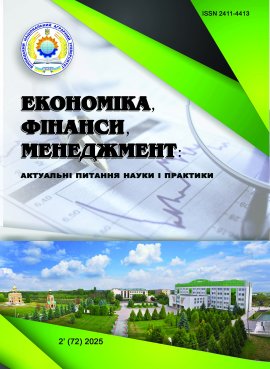
Issue №: 2 (72)
The journal deals with the issues of efficiency of functioning of the national economics and organizational forms of management of the national economy. Attention is paid to the problems of marketing, management and efficiency of production and economic activity of agrarian enterprises. The issues of public administration and administration, accounting and taxation, banking and insurance, forecasting and modeling of economic processes, foreign economic activity, commodity flows of economic entities and their infrastructure support.
SOCIAL RESPONSIBILITY OF HOSPITALITY ENTERPRISES AND IMPLEMENTATION OF ENVIRONMENTALLY FRIENDLY PRACTICES TO THEIR ACTIVITIES
STAVSKA Uliya – Candidate of Economical Science, Associate Professor, Head of the Department of Business and Service Areas, Vinnytsia National Agrarian University (21008, Vinnytsia, 3, Soniachna Str., e–mail: usv.urf@ukr.net).
ZAMRIY Victor – Assistant of the Department of Business and Service Areas, Vinnytsia National Agrarian University (21008, Vinnytsia, 3, Soniachna Str., e-mail: mzed2017@ukr.net).
The article examines key aspects of forming a socially responsible business model in the hospitality industry of Ukraine, in particular in wartime conditions, as well as practical approaches to implementing environmental initiatives that ensure sustainable development and a harmonious balance between economic efficiency and the social mission of business.
The study examines the current issues of implementing social responsibility and environmentally friendly practices to the activities of hospitality enterprises. The study focuses on real sustainable development practices that are currently used in the domestic hospitality sector, such as: energy–efficient technologies, reducing of the resource use, waste sorting, supporting of local suppliers, environmental certification and implementing of educational and awareness–raising campaigns.
It was found that the most common are energy-efficient measures (use of LED lighting, energy control systems), waste sorting, reduction of water consumption and partial use of bio-tableware. At the same time, the level of integration of strategic social responsibility of hospitality enterprises (CSR), such as cooperation with communities, certification according to international environmental standards (ISO 14001, Green Key), remains insufficient. It was found that the main barriers are high implementation costs, insufficient staff knowledge, weak infrastructure and lack of state incentives.
The article justifies the need for an integrated approach to the formation of a socially responsible business in the hospitality sector. Mechanisms are proposed to motivate enterprises to implement measures or practices aimed at greening, including: preferential taxation, public–private partnerships, training programs for employees, popularization of ecotourism and increasing environmental culture among consumers.
The results of the study can be used in the process of strategic planning, development of corporate responsibility policies, as well as in the development of national standards for sustainable development in the field of tourism and hospitality.
1. Tserklevych, V.S., & Stavska, Yu.V. (2024). Antykryzove upravlinnia hotelem v tylovomu rehioni: instrumenty menedzhmentu, postvoiennyi dosvid, turystychni mozhlyvosti [Anti-crisis hotel management in the rear region: management tools, post-war experience, tourism opportunities] Transformatsiina ekonomika – Transformational Economics, 3 (08), 56–64. DOI: 10.32782/2786-8141/2024-8-8 [in Ukrainian].
2. Chervanova, I.V. (2023). Sotsialna vidpovidalnist biznesu: kontseptualni pidkhody ta praktychni aspekty [Corporate Social Responsibility: Conceptual Approaches and Practical Aspects]. Ekonomika ta derzhava – Economy and State, 2, 55–60 [in Ukrainian].
3. Pohuda, N.V., & Kastorska, S.K. (2020). Korporatyvna sotsialna vidpovidalnist yak skladova stratehii rozvytku turystychnoho pidpryiemstva [Corporate social responsibility as a component of the development strategy of a tourism enterprise]. Efektyvna ekonomika – Effective economy, 1. DOI: 10.32702/2307-2105-2020.1.51 Retrieved from: http://www.economy. nayka.com.ua/pdf/1_2020/53.pdf [in Ukrainian].
4. Bocharova, N.A. (2020). Ekolohichnyi aspekt korporatyvnoi sotsialnoi vidpovidalnosti pidpryiemstv [Environmental aspect of corporate social responsibility of enterprises]. Ekonomika transportnoho kompleksu – Economics of the transport complex, 35, 32–47. DOI: 10.30977/EɌɄ.2225-2304.2020.35.0.32 [in Ukrainian].
5. Fedorenko, S.V., Vasylenko, A.O., & Palytsia, S.V. (2024). Ekolohichna modernizatsiia pidpryiemnytstva v umovakh pisliavoiennoi vidbudovy Ukrainy [Ecological modernization of entrepreneurship in the context of post-war reconstruction of Ukraine]. Ahrosvit – Agroworld, 8, 83–88. DOI: 10.32702/2306-6792.2024.8.83 [in Ukrainian].
6. Hlobalna initsiatyva zi zvitnosti GRI [Global Reporting Initiative GRI]. globalreporting.org. Retrieved from: https://www.globalreporting.org [in Ukrainian].
7. Pankiv, N., & Byk, V. (2023). Ekolohizatsiia hotelno-restorannoi sfery v konteksti staloho rozvytku turyzmu v Ukraini [Greening the hotel and restaurant sector in the context of sustainable tourism development in Ukraine]. Visnyk Khmelnytskoho natsionalnoho universytetu. Seriia: Ekonomichni nauky – Bulletin of the Khmelnytsky National University. Series: Economic Sciences, 2, 146–156. DOI: https://doi.org/10.31891/2307-5740-2023-316-2-23 [in Ukrainian].
8. Tretiak, D.S., Pakhota, N.V., & Kaminska, A.V. (2025). Motyvatsiia personalu pidpryiemstv v umovakh suchasnykh vyklykiv [Motivation of enterprise personnel in the face of modern challenges]. Aktualni problemy staloho rozvytku – Current problems of sustainable development, 2, 2, 69–75. DOI: 10.60022/2(2)-7S [in Ukrainian].
9. Bukreieva, D.S., & Denysenko, K.V. (2022). Sotsialna vidpovidalnist biznesu yak osnova zabezpechennia dilovoi aktyvnosti pidpryiemstv: yevrointehratsiinyi aspect [Social responsibility of business as a basis for ensuring business activity of enterprises: a European integration aspect]. Ekonomika ta suspilstvo – Economy and Society, 38. DOI: https://doi.org/10.32782/2524-0072/2022-38-52 Retrieved from: https://economyandsociety.in.ua/index.php/journal/article/view/1316 [in Ukrainian].
10. ISO 26000:2010 Guidance on social responsibility. Geneva: ISO, 2010 [in English].
11. Kravchuk, N.N., & Krasnoiartsev, V.O. Enerhozberihaiuchi tekhnolohii u hotelnomu hospodarstvi [Energy-saving technologies in the hotel industry]. dspace.nuft.edu.ua. Retrieved from: https://dspace.nuft.edu.ua/server/ api/core/bitstreams/b23fed8d-6a72-4520-a964-077334275129/content [in Ukrainian].
12. Mamontenko, N.S. (2025). Stalyi rozvytok hotelnoho biznesu v Ukraini:
stymuly, pereshkody i naikrashchi praktyky [Sustainable development of the hotel business in Ukraine: incentives, obstacles and best practices]. Stalyi rozvytok ekonomiky – Sustainable development of the economy, 3 (54), 308–313. DOI: https://doi.org/10.32782/2308-1988/2025-54-47 [in Ukrainian].
13. Cherevychna, N.I., Seredenko, V.V., & Srebniuk, K.S. (2025). Suchasni ekolohichni innovatsii ta yikh vplyv na efektyvnist roboty hotelnykh pidpryiemstv Ukrainy [Modern environmental innovations and their impact on the efficiency of hotel enterprises in Ukraine]. Tavriiskyi naukovyi visnyk. Seriia: Ekonomika – Tavria Scientific Bulletin. Series: Economics, 23, 259–265. DOI: https://doi.org/10.32782/2708-0366/2025.23.31 [in Ukrainian].
14. Kulyk, A.M., Bryndzia, Z.F., & Spiak, H.I. (2021). Rozvytok hotelno-restorannoho biznesu v konteksti optymizatsii lohistychnykh protsesiv [Development of the hotel and restaurant business in the context of optimizing logistics processes]. Mizhnarodnyi naukovyi zhurnal «Internauka». Seriia: «Ekonomichni nauky» – International scientific journal «Internauka». Series: Economic Sciences», 1 (45), 1, 14–28. DOI: 10.25313/2520-2294-2021-1-6867 [in Ukrainian].
15. International Tourism Association. Green Building Certification and Customer Preferences. Annual Report 2023. ita.org. Retrieved from: https://ita.org/reports/green-tourism-2023.pdf [in English].
16. Azizov, S.P., & Kozhan, N.V. (2018). Vykorystannia kontseptsii upravlinnia imidzhem pidpryiemstva u pidvyshchenni yoho konkurentospromozhnosti [Using the concept of enterprise image management to increase its competitiveness]. Problemy innovatsiino-investytsiinoho rozvytku – Problems of innovation and investment development, 15, 74–81 [in Ukrainian].
17. Brych, V.Ia., & Petrukha, N.M. (2025). Rol ekolohichnykh innovatsii u transformatsii turystychnykh pidpryiemstv [The role of environmental innovations in the transformation of tourism enterprises]. Innovatsiina ekonomika – Innovative economy, 1, 164–170. DOI: https://doi.org/10.37332/2309-1533.2025.1.19 [in Ukrainian].
18. Bohdanowicz, P. (2006). Environmental awareness and initiatives in the Swedish and Polish hotel industries – survey results. International Journal of Hospitality Management, 25, 4, 662–682 [in English].
19. Riepin, K. (2024). Ekolohichna polityka Ukrainy: imperatyvy, pryntsypy, kryterii [Environmental Policy of Ukraine: Imperatives, Principles, Criteria]. Development Service Industry Management – Development Service Industry Management, 1, 159–165. DOI: https://doi.org/10.31891/dsim-2024-5(23) [in Ukrainian].
20. Kamyshnykova, E.V. (2020). Kontseptsiia stratehichnoho upravlinnia korporatyvnoiu sotsialnoiu vidpovidalnistiu [Concept of Strategic Management of Corporate Social Responsibility]. Problemy systemnoho pidkhodu v ekonomitsi – Problems of a Systemic Approach in Economics, 1 (75), 113–120. DOI: https://doi.org/10.32782/2520-2200/2020-1-16 [in Ukrainian].
21. OECD. Green Investments and Agricultural Productivity. OECD-FAO Agricultural Outlook. 2023. oecd.org. Retrieved from: https://www.oecd.org/en/publications/oecd-faoagricultural-outlook-2023-2032_08801ab7-en.html [in English].
22. Tkachenko, V.V. (2025). Motyvatsiia personalu ta sotsialna vidpovidalnist biznesu v umovakh voiennoho stanu: vplyv na efektyvnist operatsiinoi diialnosti [Personnel motivation and business social responsibility in martial law: impact on operational efficiency]. Aktualni pytannia ekonomichnykh nauk – Current Issues in Economic Sciences, 10. DOI: https://doi.org/10.5281/zenodo.15336234 [in Ukrainian].
23. United Nations World Tourism Organization (2022). Guidelines for the Development of Sustainable Tourism. UNWTO. Madrid [in English].
24. Kotler, P., & Lee, N. (2020). Corporate social responsibility: doing the most good for your company and your cause. Hoboken : Wiley [in English].
25. Global Sustainable Tourism Council (2024). Sustainable Tourism Criteria. gstcouncil.org. Retrieved from: https://www.gstcouncil.org [in English].
26. Ekolohichna vidpovidalnist pidpryiemstva tse shliakh do staloho rozvytku [Environmental responsibility of the enterprise is the way to sustainable development]. ziko.com.ua. Retrieved from: https://ziko.com.ua/ekolohichna-vidpovidalnist-pidpryiemstva-tse-shliakh-do-staloho-rozvytku/?srsltid=AfmBOooa TWtDNeZclDVaYuQk-y-gVZrq9wHXf88rcgYx376e4kPtw1rW [in Ukrainian].
27. Pushkar, M.S., & Holinach, L.I. (2018). Sotsialna vidpovidalnist biznesu: teoriia i praktyka [Social responsibility of business: theory and practice]. Ternopil: Kart-blansh [in Ukrainian].
28. Font, X., & Figueras, M. (2017). Corporate social responsibility in the hospitality industry [Corporate social responsibility in the hospitality industry]. International Journal of Hospitality Management – International Journal of Hospitality Management, 61, 1–9 [in Ukrainian].
29 Henderson, J.C. (2007). Corporate social responsibility and tourism: Hotel companies in Phuket, Thailand, after the Indian Ocean tsunami [Corporate social responsibility and tourism: Hotel companies in Phuket, Thailand, after the Indian Ocean tsunami]. International Journal of Hospitality Management – International Journal of Hospitality Management, 26, 1, 228–239 [in English].
30. Green Key Global. International eco-label for tourism facilities. 2023. greenkey.global. Retrieved from: https://www.greenkey.global [in English].
About the journal
С1 Economics and International Economic Relations (by specialization)
D1 Accounting and Taxation
D2 Finance, Banking, Insurance and Stock Market
D3 Management
D4 Public Management and Administration
D5 Marketing
D7 Trade
J3 Tourism and Recreation
Founded in 1997 under the name ”Bulletin of Vinnytsia State Agricultural Institute”. In 2010-2014 it was published under the name “Collection of Scientific Papers of Vinnytsia National Agrarian University”. Since 2015 “Economics, finance, management: current issues of science and practical activity” (Certificate of State Registration of Mass Media No. 21154-10954 PR dated 12/31/2014).
