

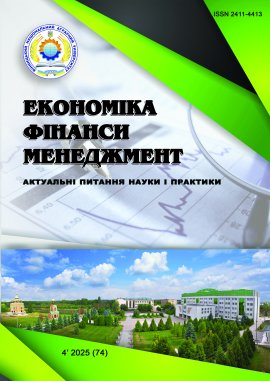
Issue №: 4 (74)
The journal deals with the issues of efficiency of functioning of the national economics and organizational forms of management of the national economy. Attention is paid to the problems of marketing, management and efficiency of production and economic activity of agrarian enterprises. The issues of public administration and administration, accounting and taxation, banking and insurance, forecasting and modeling of economic processes, foreign economic activity, commodity flows of economic entities and their infrastructure support.
STRATEGY FOR IMPLEMENTING THE METAUNIVERSE AS AN EFFECTIVE TOOL FOR THE DIGITAL TRANSFORMATION OF THE HOTEL AND RESTAURANT BUSINESS
ZAKHAROVA Tetiana – Assistant of the Department of Business and Service, Vinnytsia National Agrarian University (21008, Vinnytsia, 3 Soniachna St., e-mail: zakharovatet@ukr.net).
The article presents the results of the study on the application of metaverse technologies as a tool for digital transformation of the hotel and restaurant business. The combination of VR/AR solutions, three-dimensional virtual spaces, blockchain technologies and immersive platforms is presented, which ensures the formation of new formats of service, communication and monetization in the hospitality sector. Digital innovations open up opportunities for increasing the competitiveness of the enterprises and provide a new level of interaction with customers. Thanks to the integration of the metaverse, effective tools are created for adapting to the rapidly changing digital environment and developing business in the context of globalization.
The content of the concept of "metaverse" in the context of hotel and restaurant activities is revealed, its role in the digital ecosystem of the enterprise is determined, as well as the functions of creating added value for customers, optimizing internal processes and expanding sales channels.
Modern scientific approaches and practical cases of the application of the metaverse in the hospitality industry are identified, the main models of its use are systematized: virtual showrooms, immersive events, NFT loyalty programs, social metaspaces, VR staff training and digital twins of accommodation facilities.
The author's five-stage model MetaHospitality 5.0 is proposed, within which digital maturity diagnostics, metavision formation, VR/AR customer journey design, MVP solution testing and scaling with integration into operational activities are highlighted. For each stage, key tools, metrics and calculation indicators are identified that provide a quantitative assessment of the effectiveness of metaprojects.
The barriers to implementing the metaverse implementation strategy in the domestic hotel and restaurant business are analyzed, related to financial, personnel, regulatory and security restrictions. The need for a phased adaptive approach for the successful integration of the metaverse is stated and directions for the further research are identified, in particular, the development of the models for assessing the economic effectiveness of metatechnologies and adapting world experience to the conditions of the national market.
1. Buhalis, D., Lin, M.S., & Leung, D. (2023). Metaverse as a driver for customer experience and value co-creation: implications for hospitality and tourism management and marketing. International Journal of Contemporary Hospitality Management, 35 (2), 701–716. DOI: https://doi.org/10.1108/IJCHM-05-2022-0631 [in English].
2. Gursoy, D., Malodia, S., & Dhir, A. (2022). The metaverse in the hospitality and tourism industry: An overview of current trends and future research directions. Journal of Hospitality Marketing & Management, 31 (5), 527–534. DOI: https://doi.org/10.1080/19368623.2022.2072504 [in English].
3. Calisto, M.L., & Sarkar, S. (2023). A systematic review of virtual reality in tourism and hospitality: The known and paths to follow. International Journal of Hospitality Management, 116, 103623. DOI: https://doi.org/10.1016/j.ijhm.2023.103623 [in English].
4. Chen, S., Chan, I.C.C., Xu, S., Law, R., & Zhang, M. (2023). Metaverse in tourism: drivers and hindrances from stakeholders’ perspective. Journal of Travel & Tourism Marketing, 40 (2), 169–184. DOI: https://doi.org/10.1080/10548408.2023.2227872 [in English].
5. Chen, J., Wu, X., & Lai, I.K.W. (2023). A systematic literature review of virtual technology in hospitality and tourism. SAGE Open, 13 (3). DOI: https://doi.org/10.1177/21582440231193297 [in English].
6. Sánchez-Amboage, E., Crespo-Pereira, V., Membiela-Pollán, M., & Jesús Faustino, J.P. (2024). Tourism marketing in the metaverse: A systematic literature review, building blocks, and future research directions. PLOS ONE, 19 (5), e0300599. DOI: https://doi.org/10.1371/journal.pone.0300599 [in English].
7. Koo, C., Kwon, J., Chung, N., & Kim, J. (2022). Metaverse tourism: conceptual framework and research propositions. Current Issues in Tourism, 26 (20), 3268–3274. DOI: https://doi.org/10.1080/13683500.2022.2122781 [in English].
8. Monaco, S., & Sacchi, G. (2023). Travelling the metaverse: potential benefits and main challenges for tourism sectors and research applications. Sustainability, 15 (4), 3348. DOI: https://doi.org/10.3390/su15043348 [in English].
9. Zainal Abidin, N.H., Fauzi, M.A., Wider, W., Mat Daud, W.M.N.S., & Musa, R. (2025). Metaverse in tourism and hospitality industry: science mapping of the current and future trends. Journal of Tourism Futures, 11 (2), 171–186. DOI: https://doi.org/10.1108/JTF-05-2024-0089 [in English].
10. Dehtiar, N.A. (2024). Vykorystannia tekhnolohii metavsesvitu u protsesi tsyfrovizatsii turystychnoi diialnosti [The use of metaverse technologies in the process of digitalization of tourism activities]. Ekonomika ta suspilstvo – Economy and Society, 69. DOI: https://doi.org/10.32782/2524-0072/2024-69-76 Retrieved from: https://economyandsociety.in.ua/index.php/journal/article/view/5173/5117 [in Ukrainian].
11. Boiko, M.H., & Bondar, S.V. (2022). Tsyfrova transformatsiia yak imperatyv rozvytku hotelnoho biznesu [Digital transformation as an imperative for the development of the hotel business]. Investytsii: praktyka ta dosvid – Investments: practice and experience, 23, 32–38. DOI: https://doi.org/10.32702/2306-6814.2022.23.32 [in Ukrainian].
12. Pukach, Ya.O. (2024). Napriamky vprovadzhennia tsyfrovykh tekhnolohii u hotelnomu biznesi [Directions for the introduction of digital technologies in the hotel business]. Ekonomika ta suspilstvo – Economy and Society, 60. DOI: https://doi.org/10.32782/2524-0072/2024-60-68 Retrieved from: https://economyandsociety.in.ua/index.php/journal/article/view/3612/3543 [in Ukrainian].
13. Bondar, S.V. (2024). Formuvannia stratehii tsyfrovizatsii subiekta hotelnoho biznesu [Formation of a strategy for the digitalization of a hotel business entity]. Ekonomika ta suspilstvo – Economy and Society, 60. DOI: https://doi.org/10.32782/2524-0072/2024-60-40 Retrieved from: https://economyandsociety.in.ua/index.php/journal/article/view/3592/3523 [in Ukrainian].
14. Lysiuk, T.V., Tereshchuk, O.S., & Pasichnyk, M.P. (2022). Innovatsiini tekhnolohii u hotelno-restorannomu hospodarstvi [Innovative technologies in the hotel and restaurant industry]. Ekonomika ta suspilstvo – Economy and Society, 40. DOI: https://doi.org/10.32782/2524-0072/2022-40-11 Retrieved from: https://economyandsociety.in.ua/index.php/journal/article/view/1450/1395 [in Ukrainian].
15. Tyshchenko, S. (2021). Tsyfrovi tekhnolohii v industrii hostynnosti [Digital technologies in the hospitality industry]. Tavriiskyi naukovyi visnyk. Seriia: «Ekonomika» – Tavrian Scientific Bulletin. Series: «Economics», 7, 131–139. DOI: https://doi.org/10.32851/2708-0366.2021.7.16. [in Ukrainian].
16. Ianchuk, T.V. (2025). Metavsesvit i virtualna realnist yak novi instrumenty tsyfrovoho marketynhu [Metaverse and virtual reality as new tools of digital marketing]. Mizhnarodnyi naukovyi zhurnal «Internauka». Seriia: «Ekonomichni nauky» – International scientific journal «Internauka». Series: «Economic Sciences», 10 (102). DOI: https://doi.org/10.25313/2520-2294-2025-10-11494 Retrieved from: https://www.inter-nauka.com/uploads/public/17622591797011.pdf [in Ukrainian].
17. Holovnia, O.M. (2023). Zabezpechennia rozvytku staloho turyzmu v umovakh hlobalnykh ekolohichnykh vyklykiv [Ensuring the development of sustainable tourism under global environmental challenges]. Biznes Inform – Business Inform, 9, 152–161. DOI: https://doi.org/10.32983/2222-4459-2023-9-152-161 [in Ukrainian].
18. Stavska, Yu.V. (2025). Formuvannia stratehii rozvytku zakladiv industrii hostynnosti v umovakh hlobalizatsiinykh vyklykiv [Formation of development strategies for hospitality industry enterprises under globalization challenges]. Efektyvna ekonomika – Efficient Economy, 4. DOI: http://doi.org/10.32702/2307-2105.2025.4.70 Retrieved from: https://www.nayka.com.ua/index.php/ee/article/view/6268/6344 [in Ukrainian].
About the journal
С1 Economics and International Economic Relations (by specialization)
D1 Accounting and Taxation
D2 Finance, Banking, Insurance and Stock Market
D3 Management
D4 Public Management and Administration
D5 Marketing
D7 Trade
J3 Tourism and Recreation
Founded in 1997 under the name ”Bulletin of Vinnytsia State Agricultural Institute”. In 2010-2014 it was published under the name “Collection of Scientific Papers of Vinnytsia National Agrarian University”. Since 2015 “Economics, finance, management: current issues of science and practical activity” (Certificate of State Registration of Mass Media No. 21154-10954 PR dated 12/31/2014).
